Meta’s GEM, Part 2: Finding the Scaling Law

Last year, I first wrote about Meta’s Generative Ads Recommendation Model or GEM. Over the last couple of years, Meta published several blog posts covering different facets of their ad infrastructure in the age of AI. Meta also highlighted GEM, Andromeda, Adaptive Ranking Model, Lattice etc. in several quarterly earnings calls to explain how AI is transforming their ad infrastructure. Admittedly, how all these connect together can often be confusing. I expect Meta to highlight GEM’s more recent developments again in this week’s Q3 earnings call, so I wanted to explain the back end of Meta’s ad infra in more lucid language with an illustrative example.
Every time we open Instagram (IG), Meta runs an auction instantly that we don’t get to see. In less than a second, Meta’s systems sift through tens of millions of ads to decide which one deserves the next slot in our feed. Last week, Meta published a new engineering blog post on GEM, the model that increasingly sits at the heart of that decision, along with the research paper behind its new architecture, Kunlun. Since both are quite dense, let me walk you through what actually happens when someone scrolls IG, and where GEM fits in.
Imagine an IG user named Maya. Over the past few months, she has watched a lot of trail running Reels, liked a friend’s marathon photos, and saved a post on half-marathon training plans. Last week, she clicked on an ad for running shoes but didn’t buy them. On Sunday evening, she opens Instagram. What exactly happens then?
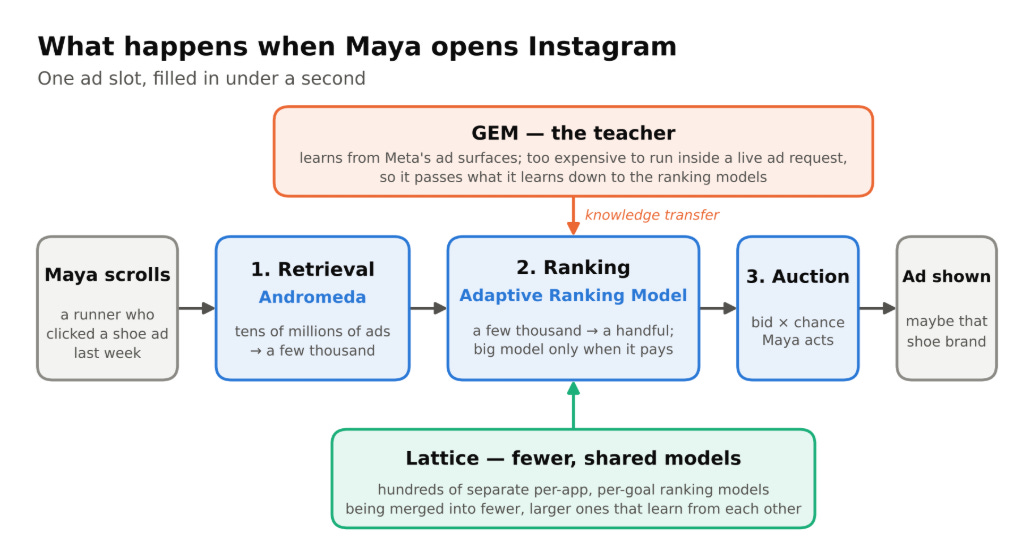
The first step is retrieval. No model can carefully evaluate tens of millions of ads for every person in real time, so a system called Andromeda acts like a bookstore clerk who knows Maya’s taste and quickly pulls a few thousand plausible picks off the shelves: running shoes, GPS watches, race registrations, and perhaps a few curveballs. It isn’t trying to pick the winner; all it’s doing is just making sure the winner is somewhere in the pile.
Next comes ranking, where increasingly powerful models whittle those few thousand candidates down to a handful. This is where the Adaptive Ranking Model comes in, and its key insight is that not every request deserves the same amount of brainpower. If Maya seems to be idly killing time, a standard model will do. But since she clicked on running shoes just last week, the system may decide her request is worth routing to a much larger, LLM-scale model that still responds in about 100 milliseconds. Since launching on Instagram in Q4 2025, Meta said this model has driven a 3% increase in conversions and a 5% increase in click-through rate for the users it targets. The survivors then enter the auction, where each advertiser’s bid is weighed against the odds that Maya will act on the ad, and the winner shows up in her feed before her thumb finishes the scroll.
Two more pieces sit behind the scenes. For years, Meta ran hundreds of separate ranking models, each tuned for a narrow job such as predicting clicks on Instagram Stories or purchases from Facebook Feed. Lattice merges them into fewer, larger models that share what they learn, so a pattern spotted on Reels can help predict behavior on Stories. Meta has kept consolidating since first describing Lattice in 2023; in Q4 2025, folding Facebook Stories and other surfaces into the main Facebook model, along with other back-end improvements, drove a 12% increase in ad quality.
The other piece is GEM, which never actually shows Maya an ad. It is too expensive to run inside a live ad request; Susan Li said on the 3Q’25 call that using it for inference would be “too cost prohibitive”. Instead, GEM is the teacher. It learns from behavior across all of Meta’s ad surfaces and passes that knowledge down to the smaller, faster models that do the live work. It’s a bit like a head chef who develops the recipes and trains the line cooks but rarely plates a dish. When GEM gets smarter, every model downstream of it gets smarter too.
I asked Claude to visually show the entire process which you can see below:
So how much smarter did it get? Here is the table Meta shared last week:
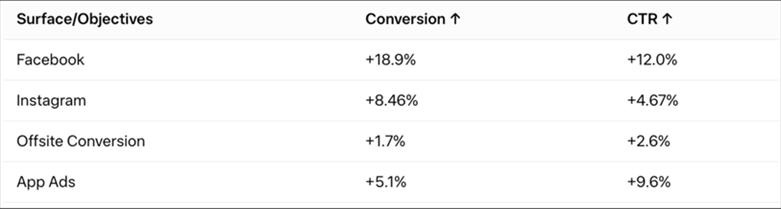
For context, when Meta quantified GEM’s impact in 2Q’25, it was a 5% lift in conversions on Instagram and 3% on Facebook Feed. Based on the data above, it doesn’t seem like Meta’s ad improvements are plateauing yet.
Of course, the question still remains whether Meta’s ad engine eventually hits a wall, beyond which pouring more compute into it stops paying off. The Kunlun paper gives us some clues as it mentioned that Meta’s ad models now improve in the same predictable way large language models do as you add compute. Behind the paywall, I will explain the ideas behind these gains, what this scaling law does and doesn’t tell us, and why I think Meta’s ad engine may remain the best primary home for its compute.
Subscribers get the daily journal and five+ years of Deep Dives, i.e. full-length analyses with financial models on 70+ companies. The daily is just how I think out loud between the Deep Dives!

 点赞
 收藏
 点踩
 分享