Mistral Large 4 is live in Otari

Mistral's largest model to date is available through Otari from day one, alongside the rest of the Mistral model family. If you already run traffic through Otari, it's one model string away, and it inherits the policies, traces and cost tracking you already have in place.
Mistral has released Mistral Large 4, which it's calling Le Chonk. It's a 1.05-trillion-parameter, natively multimodal Mixture of Experts model, and it's live in Otari, Mozilla AI's open-source gateway and policy layer, today.
That means you can put it on real workloads without new SDKs, new credentials or a new governance setup. The rest of this post covers what the model is, what changes when you add a model to a production stack, and how Otari handles it.
Meet Le Chonk
Mistral Large 4 activates 49B of its 1.05T parameters per token, so you get the capacity of a trillion-parameter model at roughly the inference cost of a mid-size dense one.
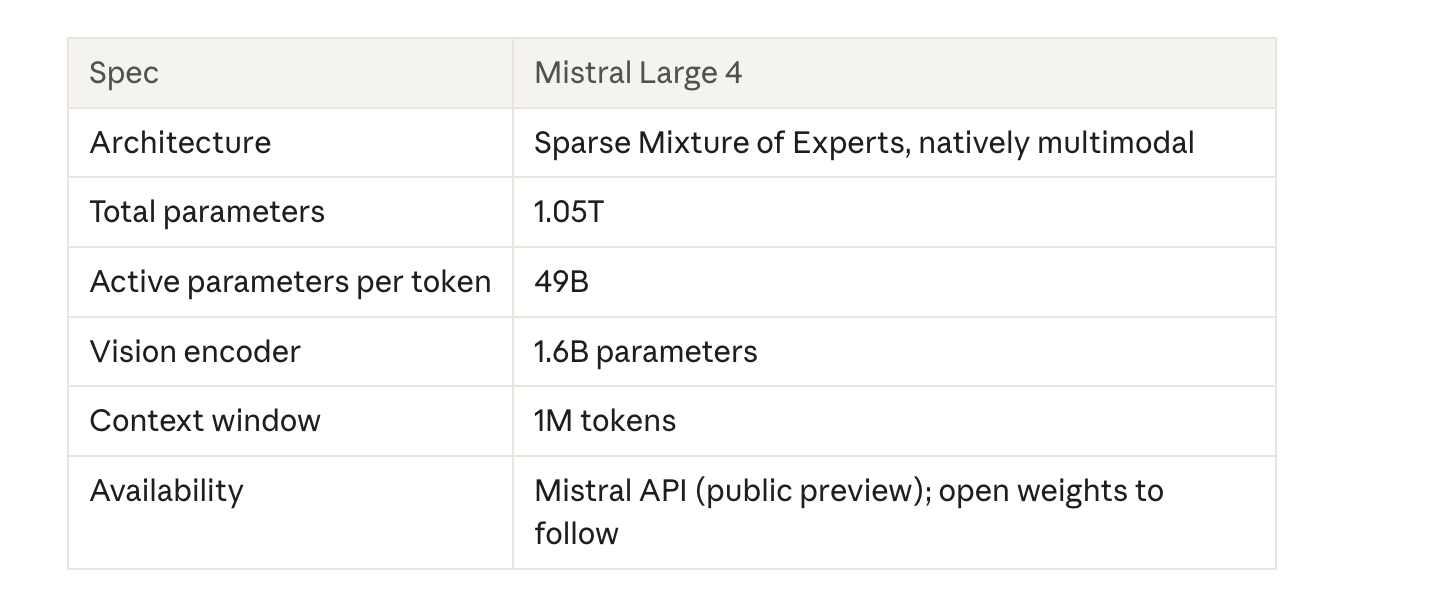
On Mistral's published evaluations, Large 4 leads other US and European open-weight models on aggregate benchmarks. Mistral also reports state-of-the-art results among open models on enterprise workloads in cybersecurity, finance and manufacturing, plus strong coding and agentic performance.
The multimodal story is the most interesting part. Mistral points to complex documents, engineering drawings and satellite imagery, with the model able to inspect what it sees, reason about it and act on it inside an agentic workflow.
It's also distinctly European. Mistral is building the model and the infrastructure behind it in Europe, as part of a wider push toward open, sovereign AI infrastructure.
Those are vendor benchmarks, so treat them as a starting point. The numbers that matter are the ones you measure on your own traffic, which is where Otari comes in.
A new model shouldn't mean a new stack
Every frontier release widens your options. In production, it also creates work. Adding a provider usually means another SDK, another set of API keys, different rate limits and response formats, and another invoice. For agents, the cost is higher: a model swap can change which tools an agent reaches for and how it behaves, and any guardrails tied to one provider's platform don't carry over to the next.
The model that best fits a workload today probably won't be the best fit in six months. Costs move, capabilities shift, and open-weight models keep closing the gap. Most teams don't have a model problem; they have an infrastructure problem.
How Otari handles it
Otari sits at the connection point between your applications and agents and the models and tools they call. Because routing, policy and observability live in that one layer, a new model plugs into everything you already run.
Connect
You can try Mistral Large 4 on otari.ai, the hosted Otari platform, in three steps:
- Sign in at otari.ai and create an API token.
- Install the Otari Python SDK: pip install otari
- Set your token as `OTARI_API_KEY` and call the model:
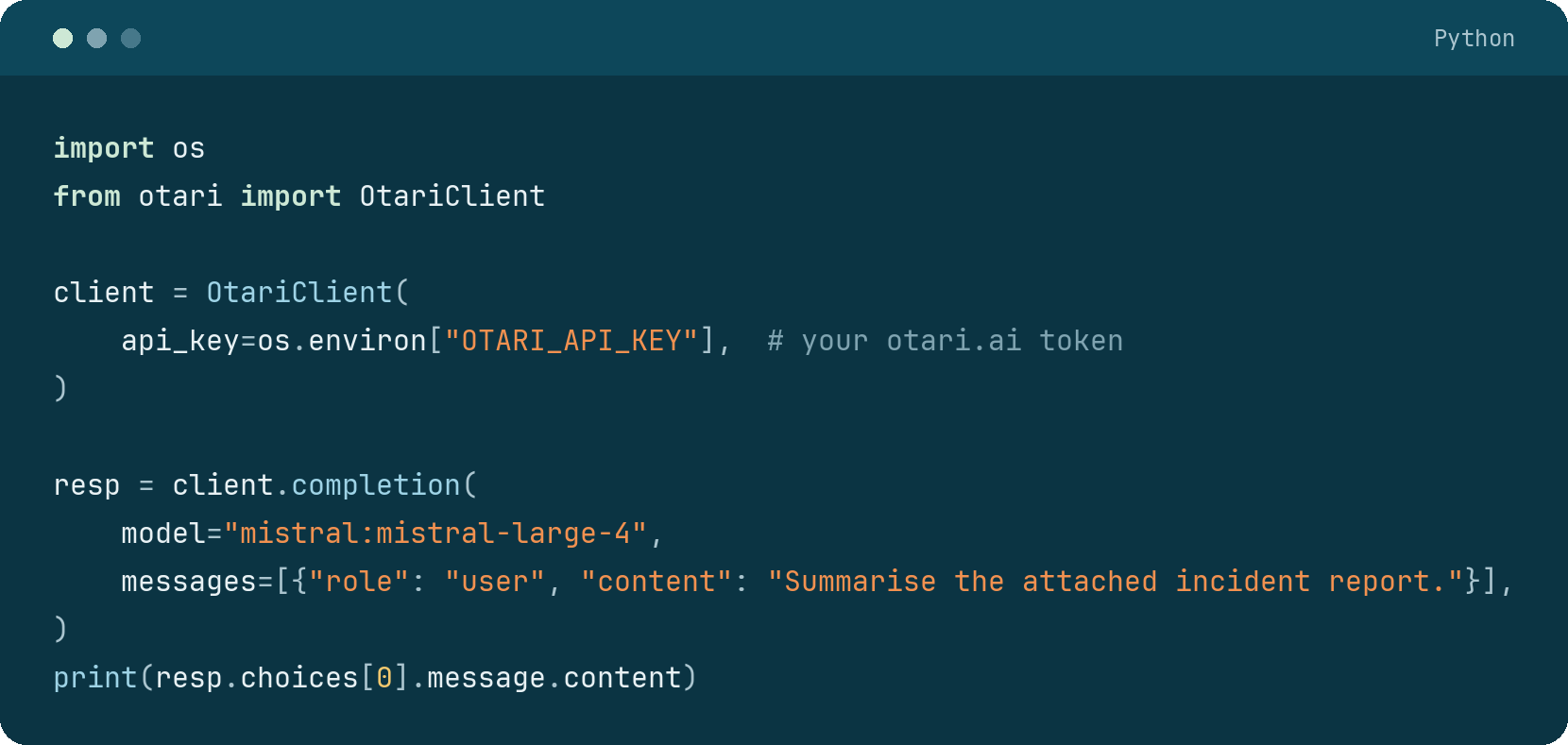
Models use a provider: model selector, so switching between Mistral Large 4 and any other model means changing one string. Already using the OpenAI SDK? Keep your code and set base_url="https://api.otari.ai/api/v1".
Provider keys are managed centrally in Otari, not scattered across services. Run Large 4 next to the other Mistral models and the rest of your providers, with intelligent routing and provider failover handled at the gateway.
Govern
Your policies live in Otari, not in a provider's console, so they apply to Large 4 the moment you route to it. Otari connects to agent hooks, the points where an agent is about to process a prompt or run a tool, and evaluates two kinds of checks:
- Deterministic checks verify explicit rules against recorded evidence. Was a protected file edited? Was a forbidden command attempted? Did the required tests pass after the latest change?
- LLM-as-a-judge checks assess work that needs judgment. Does the change follow your architecture? Does it meet the acceptance criteria?
Agents run autonomously inside the boundaries your team defines, without a human approving every step.
Understand
Model calls, agent actions and policy decisions land in one history, with traces, timestamps and cost per request. That's how you validate Mistral's claims on your own workload: compare Large 4 against your current model on latency, spend and policy outcomes, using the same data you already trust.
Otari is open source and provider-agnostic. Adopting a new model never commits your infrastructure to a single vendor.
Get started
Mistral Large 4 and the full Mistral model family are live in Otari now. Self-host Otari from the open-source repository or use the managed platform, then point your existing integration at the new model.
At Mozilla AI, we think AI should increase choice, not reduce it. We're not here to tell you which model to pick. We're building the infrastructure that lets you choose, change and govern models on your own terms.
Own your LLM infrastructure. Govern autonomous agents.
Meet Otari by Mozilla AI → otari.ai

 点赞
点赞 收藏
收藏 点踩
点踩 分享
分享