Social Security’s Role in the Federal Debt Explosion
Social Security is often discussed as a future solvency problem. The debate usually focuses on the year the trust fund will be depleted and on the benefit cuts that would follow under current law. But the paper under discussion argues that this framing misses an important point. Social Security is already affecting the federal budget. Since 2010, the program has run persistent cash-flow deficits, requiring the Treasury to borrow from the public to finance benefit payments.
Social Security’s Role in the Federal Debt Explosion: Past, Present, and the Reform Imperative
- Romina Boccia and Ivane Nachkebia
- Working Paper, 2026
- A version of this paper can be found here
- Want to read our summaries of academic finance papers? Check out our Academic Research Insight category
Key Academic Insights
Social Security is already contributing to federal debt
The paper argues that Social Security should be evaluated through its annual cash flows, not only through trust fund accounting. Since 2010, tax revenues have been insufficient to cover program expenditures. According to the authors’ calculations, after including the interest cost associated with those shortfalls, Social Security added more than $1.5 trillion to federal debt between 2010 and 2025 and is projected to add another $3.4 trillion through 2032.
The financing problem is not only demographic
Population aging is a major part of the problem, but the authors argue that benefit design has also contributed significantly. Earnings-related benefits, generous treatment of early cohorts, wage indexing, and inflation adjustments have all increased spending relative to dedicated revenues.
Trust fund solvency can obscure the current fiscal problem
Policy debates often focus on 2032, when the OASI trust fund is projected to be depleted. But the paper emphasizes that trust fund reserves are intragovernmental Treasury securities. When those securities are redeemed to cover cash-flow shortfalls, the Treasury must obtain the funds through taxes, spending reductions elsewhere, or additional borrowing from the public.
Economic growth alone cannot close the gap
Stronger wage growth improves Social Security’s finances, but it also raises future benefits because initial benefits are wage-indexed. In the authors’ model, even substantially higher real wage growth leaves the program in persistent cash-flow deficit. Real wages would need to grow by roughly 5% annually to achieve 75-year solvency through growth alone
Structural reform matters more than any single financing fix
The paper evaluates several reform paths, including flatter benefits, slower benefit growth, higher retirement ages, and higher payroll taxes. The central finding is that reforms addressing benefit growth and eligibility can materially improve long-term cash flows, while revenue increases alone tend to provide only temporary relief if underlying benefit growth remains unchanged.
Practical Applications for Investment Advisors
Treat Social Security as part of long-term fiscal risk
Social Security is not merely a retirement-planning issue. Its financing structure affects federal deficits, Treasury borrowing, interest costs, and potentially long-term economic growth. Advisors evaluating strategic asset allocation should therefore recognize entitlement spending as one component of the broader US fiscal outlook.
Do not treat scheduled benefits as risk-free planning assumptions
The paper highlights the difference between scheduled benefits and benefits payable under current financing arrangements. Investors approaching retirement should understand that projected benefits depend on future policy decisions involving taxes, benefit formulas, retirement ages, or borrowing.
Incorporate policy uncertainty into retirement planning
Younger clients face particularly long exposure to future reforms. Planning assumptions should therefore include sensitivity analysis around Social Security replacement rates, claiming ages, and payroll taxes rather than relying on a single benefit projection.
Separate demographic pressures from policy choices
An aging population is important, but it does not fully explain Social Security’s finances. Benefit indexation, eligibility rules, taxes, and political choices matter as well. Advisors should be cautious about narratives suggesting that stronger economic growth or demographic normalization alone will resolve the program’s funding gap.
How to Explain This to Clients
“Most people hear that Social Security has a problem in 2032, when its trust fund is expected to run out. But this paper argues that the fiscal problem is already happening. Social Security has been paying out more in benefits than it collects in dedicated taxes since 2010. The government has been financing the difference through additional borrowing. Demographics are part of the reason, but they are not the whole story. How benefits are calculated and increased over time also matters. That means some form of reform is likely to become increasingly important. For retirement planning, it makes sense to treat future Social Security benefits as an important source of income, but not as an assumption that should remain completely unchanged for decade..”
The Most Important Chart from the Paper
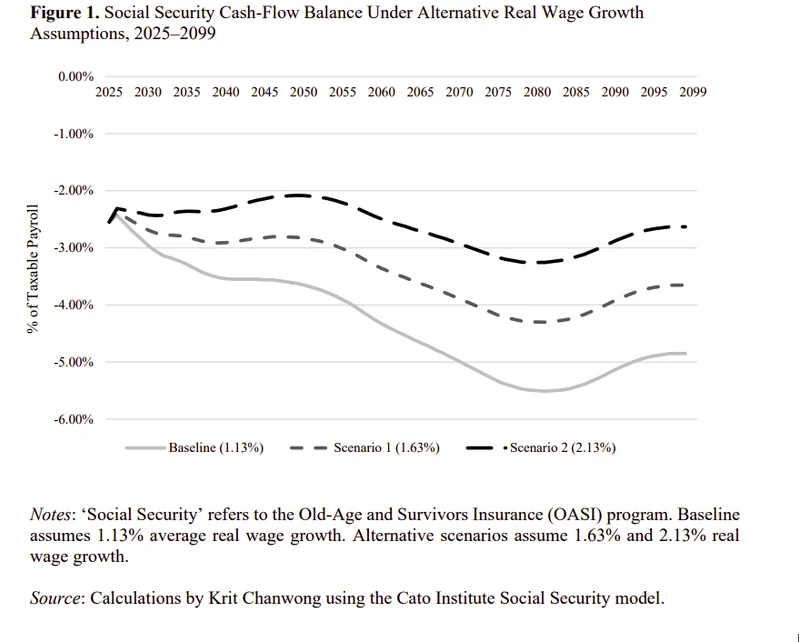
The results are hypothetical results and are NOT an indicator of future results and do NOT represent returns that any investor actually attained. Indexes are unmanaged and do not reflect management or trading fees, and one cannot invest directly in an index.
Abstract
Social Security is not just the largest federal program but also a key contributor to the United States’ fiscal imbalance. This chapter argues that the program’s financing challenge does not stem solely from demographic shifts but also from its earnings-related benefit design, real benefit growth over time, and political inertia that has delayed structural reform. Since 2010, Social Security has run continuous cash-flow deficits, adding more than $1.5 trillion to the national debt, with projections of $3.4 trillion more by 2032. From a unified budget perspective, the program’s 75-year unfunded obligation totals $32 trillion. Drawing on international experience, and the Cato Social Security model, this chapter evaluates policy options that could reduce the program’s contributions to structural US deficits and debt.
was originally published at Alpha Architect. Please read the Alpha Architect disclosures at your convenience.

 点赞
点赞 收藏
收藏 点踩
点踩 分享
分享