Firm-to-firm financial linkages and dollar risk transmission
'%20fill-opacity='.8'%20d='M3.256%203.913a3.083%203.083%200%200%200-.003%204.397L8%2012.998l4.743-4.684a3.085%203.085%200%200%200%20.001-4.4c-.6-.593-1.4-.914-2.233-.914a3.17%203.17%200%200%200-1.91.635L8%204.087l-.601-.452A3.17%203.17%200%200%200%205.489%203c-.834%200-1.634.321-2.233.913m10.19%205.111-4.748%204.69a.996.996%200%200%201-1.397%200L2.549%209.02a4.083%204.083%200%200%201%20.004-5.82A4.17%204.17%200%200%201%205.488%202c.907%200%201.787.29%202.512.835A4.17%204.17%200%200%201%2010.51%202c1.093%200%202.146.422%202.936%201.202a4.085%204.085%200%200%201%200%205.822'%20/%3e%3c/svg%3e)
'%20stroke-opacity='.75'%20stroke-width='1.5'%20stroke-linejoin='round'/%3e%3c/svg%3e)

The US dollar’s influence on emerging markets extends well beyond banks, bond markets, and international trade. It can also reach firms that neither borrow in dollars nor export, simply because they depend on suppliers that do. The mechanism is trade credit. Large firms often borrow cheaply in foreign currency and then finance domestic customers through accounts receivable. This effectively turns non-financial corporations into intermediaries between global dollar funding markets and local supply chains. The paper’s central insight is therefore not merely that dollar debt creates risk. It is that the allocation of that risk across firms depends on balance-sheet strength, contractual flexibility, and the structure of financial relationships inside the supply chain.
Firm-to-firm financial linkages and dollar risk transmission
- Hardie, Saffy and Simonovska
- Journal of Financial Economics, 2026
- A version of this paper can be found here
- Want to read our summaries of academic finance papers? Check out our Academic Research Insight category
Key Academic Insights
Dollar Risk Can Reach Firms Without Dollar Debt
The paper identifies a domestic transmission channel through which exchange-rate shocks affect firms that may have no direct foreign-currency liabilities. Large upstream firms borrow in dollars and extend trade credit to domestic buyers. As a result, downstream firms can become indirectly exposed to the dollar through their financing relationships with suppliers.
Trade Credit Is a Major Source of Corporate Finance
Trade credit is not a marginal balance-sheet item. In the authors’ sample, accounts payable represent about 22% of total liabilities and 32% of short-term liabilities, while accounts receivable account for approximately 17% of assets and 36% of short-term assets. The firms in the sample are also net providers of trade credit, with receivables exceeding payables by roughly 7% of assets
Large Firms Act as Financial Intermediaries
Larger firms enjoy better access to foreign-currency borrowing and use that funding to support working capital and customer financing. Average FX debt represents about 22% of total debt, but the share exceeds 88% for firms in the top decile of the distribution. These firms also borrow more cheaply in foreign currency than in local currency, supporting the idea that large corporations intermediate foreign funding to smaller domestic partners.
Dollar Borrowing Finances More Than Long-Term Investment
The accounting decomposition shows that for every dollar of additional FX debt, approximately 57 cents are allocated to short-term assets. Of that amount, around 13 cents support cash, 14 cents finance inventories, and 15 cents finance accounts receivable. Thus, roughly 26% of the FX borrowing directed toward short-term assets is associated with trade-credit provision.
Trade Credit Can Either Buffer or Amplify Shocks
The economic effect of trade credit depends on the financial condition of the supplier. A financially unconstrained supplier can keep repayment terms stable and absorb the exchange-rate loss through lower profits. A constrained supplier has less capacity to insure customers and may instead pass part of the shock downstream by changing repayment terms or reducing credit.
The Profit Shock Is Much Larger Than the Credit Adjustment
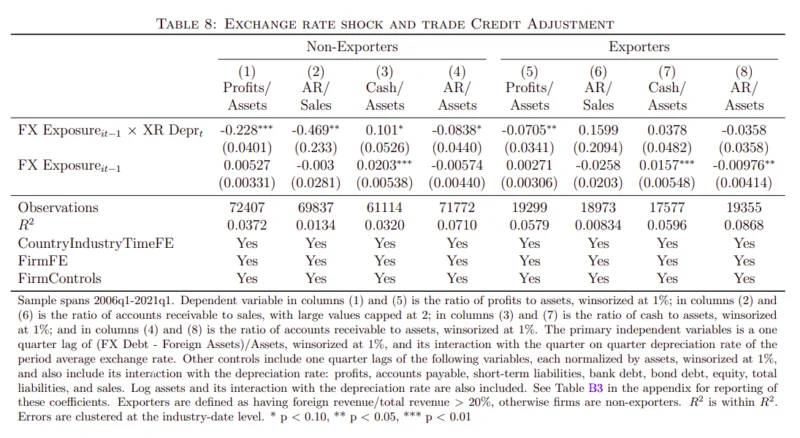
For a non-exporting firm with high FX exposure, the authors estimate that a 10% depreciation reduces quarterly profits by approximately 0.4 percentage points of assets. That amount is about twice the firm’s average quarterly profit margin. Yet accounts receivable decline by only around 0.14 percentage points of assets, implying that suppliers absorb most of the shock rather than fully passing it to buyers.
The Adjustment Is Asymmetric
The paper finds that both appreciations and depreciations affect profitability, but only depreciations lead exposed non-exporters to reduce trade credit and increase cash buffers. This asymmetry is important because it supports a financial-constraint explanation: firms alter customer financing when the depreciation pushes repayment constraints toward binding, not simply whenever exchange rates move.
Dollar Exposure Is a Network Risk, Not Just a Firm-Level Risk
The broader implication is that foreign-currency leverage cannot be evaluated only at the company level. A firm with no dollar debt may still be vulnerable because its supplier finances receivables with dollar borrowing. Conversely, a financially strong supplier may protect an entire customer network by absorbing shocks. Currency exposure is therefore embedded in relationships, not merely in individual balance sheets.
Practical Applications for Investment Advisors
Look Beyond Reported Foreign-Currency Debt
Traditional company analysis may classify firms without dollar liabilities as unexposed. This paper suggests that such a conclusion can be incomplete. Investors should examine whether firms depend on suppliers that borrow in foreign currency, whether customer financing is material, and whether payment terms could tighten during a depreciation.
Analyze Working Capital as a Transmission Channel
Accounts receivable, accounts payable, cash holdings, and short-term debt can provide useful signals about how firms transmit stress. A decline in receivables accompanied by rising cash may indicate that a supplier is reducing implicit financing and demanding payment sooner. That adjustment can affect customers before it appears in sales or default data.
Distinguish Exporters From Non-Exporters
The same amount of dollar debt can have very different consequences depending on the revenue structure. Exporters may possess a natural hedge through foreign-currency revenues, while domestically focused firms face a more pronounced mismatch. Currency analysis should therefore compare FX liabilities with both foreign assets and foreign revenues.
Incorporate Supply-Chain Finance Into Emerging-Market Risk Analysis
Country allocation and security selection in emerging markets should account for more than sovereign risk, exchange-rate volatility, and bank credit. Large non-financial corporations may be important providers of liquidity to smaller firms. Their ability to sustain trade credit can influence the resilience of sectors and local supply chains during periods of dollar strength.
How to Explain This to Clients
“A company does not need to borrow directly in dollars to be affected by a stronger dollar. It may depend on a supplier that uses dollar debt to finance customer payment terms. When the local currency weakens, a financially strong supplier may absorb the loss and continue offering credit. A weaker supplier may ask for faster payment or reduce credit, passing part of the shock to its customers. This means currency risk can travel through business relationships, not just through a company’s own debt.”
The Most Important Chart from the Paper
The table compares how exchange-rate depreciation affects exposed exporters and non-exporters. For non-exporters, greater FX exposure is associated with a statistically significant decline in profits, a reduction in trade-credit intensity, an increase in cash holdings, and a fall in accounts receivable. For exporters, the profit effect is much smaller, while the cash and trade-credit responses are not statistically significant.
The results are hypothetical results and are NOT an indicator of future results and do NOT represent returns that any investor actually attained. Indexes are unmanaged and do not reflect management or trading fees, and one cannot invest directly in an index.
Abstract
We study how U.S. dollar fluctuations transmit through domestic supply chains in emerging markets. Large firms borrow in foreign currency and extend trade credit to domestic partners, exposing the supply chain to exchange rate risk. We develop a model where financially constrained suppliers pass through shocks to buyers, while unconstrained firms absorb them. Using quarterly firm-level data from 19 emerging markets, we provide empirical evidence consistent with the model’s predictions. We find that even highly exposed firms reduce trade credit only modestly following a depreciation, while accepting large profit losses, suggesting that firm-to-firm credit relationships partially shield downstream firms from financial shocks.
was originally published at Alpha Architect. Please read the Alpha Architect disclosures at your convenience.