Scientists Trace How Cancer Passed Between Twins Before Birth

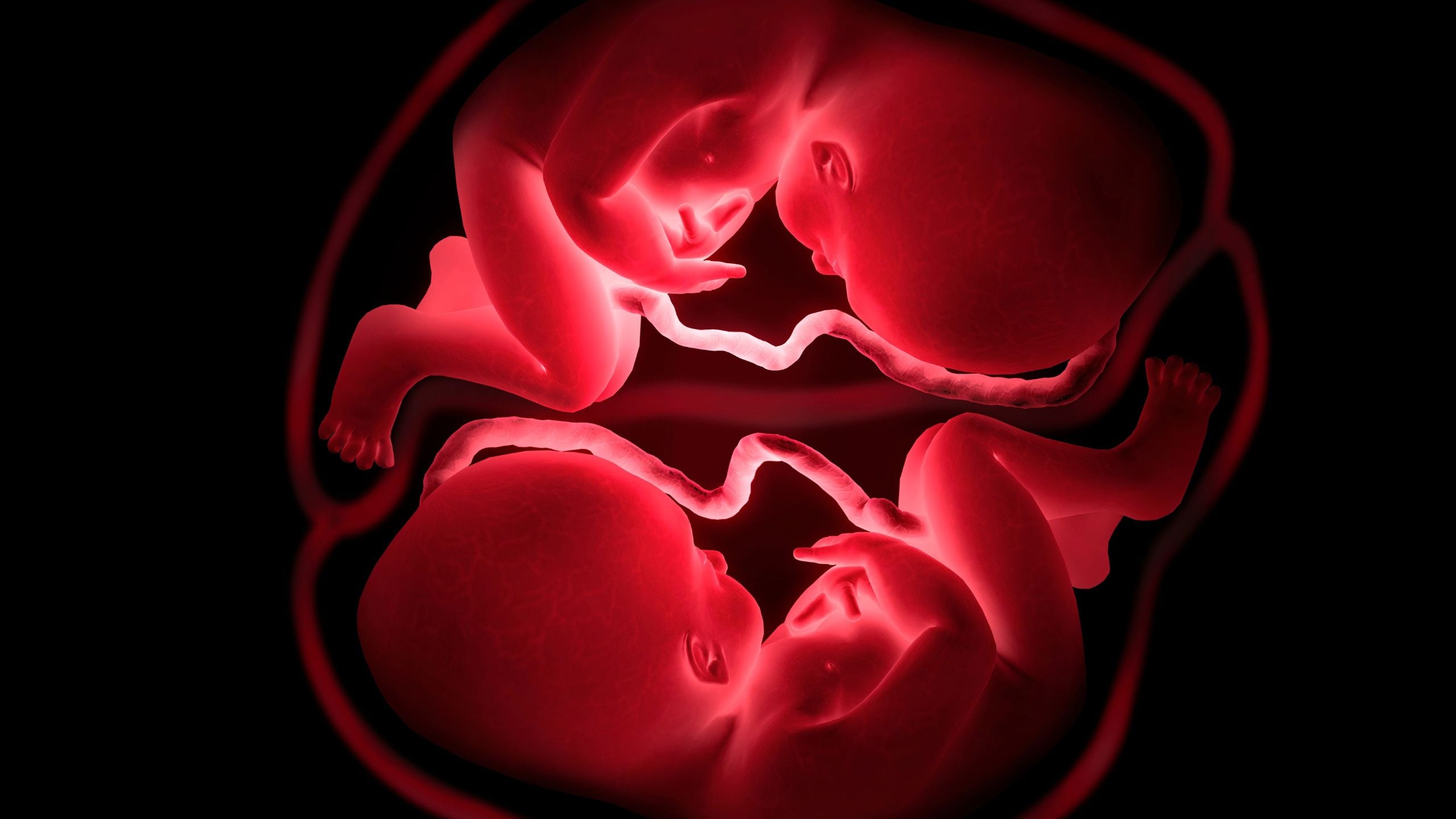
A facial mass detected before birth prompted the early delivery of identical twin sisters. A fetal MRI at 33 weeks showed the mass on one baby's face. When the sisters were born a week later, tumors were found in both.
Two children had the same cancer, raising a question that their shared beginnings alone could not answer.
Had the disease started separately in each sister, or had cancer cells crossed from one to the other before birth?
Researchers turned to a record hidden within their cells. DNA changes, accumulated as their bodies developed, allowed the team to reconstruct events that had happened months before anyone saw a tumor.
The study in Nature Communications shows that the cancer began in one sister and passed to the other in the womb, most likely through a single transfer late in the second trimester. The same investigation uncovered clues to how the sisters themselves had formed.
The two girls, Amelia and Amaya, died soon after birth. Their family consented to post-mortem examinations for research. The authors dedicate the study to the sisters, whose mother wanted them acknowledged by name.
The team included researchers from the Wellcome Sanger Institute, Great Ormond Street Hospital and the University of Cambridge.
The baby with the facial mass is called twin A in the paper. At birth, she had tumor deposits in several organs. Her sister, twin B, initially had lesions in her skin; disease involving the membranes around the brain and spinal cord was detected later.
The tumors were reported as undifferentiated sarcomas. Soft tissue sarcomas arise in tissues such as muscle, fat and the body's supporting structures. All the twins' tumor samples carried the same fusion of two genes, MN1 and ZNF341.
Matching tumors were only the beginning: the team needed to identify whose cells had started the cancer.
Here, an apparent contradiction proved useful: identical twins are not necessarily genetically identical.
They begin with the same fertilized egg, but DNA changes can arise as their cells multiply. A change acquired by one cell can pass to its descendants, marking a particular branch of the developing body's cellular family tree.
Comparing those marks across tissues reveals shared ancestors and distinguishes one twin's cells from her sister's.
The team sequenced 10 tumor samples, 12 normal tissue samples from the twins and 11 placental samples. They also examined 12 placental samples enriched for cells involved in forming the placenta.
The researchers found that cancer began in twin A, then cancer cells passed to twin B before birth and formed tumors there too. The evidence was in the second baby's tumors: their cells carried genetic markers belonging to her sister.
The study points to spread across the placenta they shared. The genetic analysis establishes which sister the cancer came from, but does not directly show the cells crossing or the route they took.
The most likely starting site was twin A's facial mass. The cancer diversified into different cell populations and spread within her body before reaching her sister. The pattern in twin B supported a relatively late, single transfer.
The researchers then used accumulated mutations to estimate when this happened. Assuming mutations built up at a constant rate, they placed the tumor's origin near the end of the first trimester and its transfer late in the second trimester.
Those dates are estimates that depend on the assumed mutation rate, rather than direct observations.
There was another surprise: normal cells had moved in the opposite direction. Genetic markers in a spleen sample from twin A suggested around 75 percent of the sampled cells originated in twin B, consistent with blood-cell mixing between the sisters.
The twins' earliest cell lineages also contributed unevenly to their bodies and placenta. One branch contributed almost exclusively to twin A, another to both sisters and the placenta, and a third to twin B and the placenta. The pattern favored an earlier embryonic split than the classical model for this type of identical twinning predicts.
However, this was one pair of twins, and the analysis could recover only lineages that survived in the tissues sampled.
Earlier research on twins with leukemia has also explored cancer's beginnings before birth. This case adds a detailed reconstruction of a soft tissue tumor's journey, without establishing how often such transfers occur.
Nor does the study show that a cancer in one twin must reach the other. The researchers interpret the transfer as a rare event, rather than an unavoidable consequence of the sisters sharing their prenatal environment.
The approach offers a way to investigate the developmental origins of childhood tumors alongside normal growth.
The research has been published in Nature Communications.

 点赞
点赞 收藏
收藏 点踩
点踩 分享
分享