Link Building & Outreach for AI Search

Large language models are expensive to train.
A typical commercial model is already months out of date on its very release date and the knowledge it comes with is fuzzy at best. Retrieval remains the dynamic memory layer of all AI assistants and the most significant type is grounding with organic search. This means that have a very strong link. Strong links. Nice. Let's talk about that now.
SEOs and link builders strategize and debate various angles and nuances of outreach methods, build outreach databases and systems, they look at metrics (DAPA DRAPA...) good links are being refused because they don't meet a number made up by a SaaS company that has nothing to do with Google's link authority and approximates it at best. Hell, we've got one too!
So all this work and thinking goes into it and then we ruin it at the end with one simple thing that happens almost every single time.

Incongruence.
Show me any of your outreach based links, articles, posts and such and I will be able to tell you who wanted the link on that page.
- I will be able to tell
- Any experienced SEO or link builder will be able to tell
- Google's web spam team will be able to tell
- Google's models and algorithms will be able to tell
This problem of poor link integration has plagued the industry for two decades now and the same is happening with inorganic mentions in the age of AI search. So much time, energy and money going to waste.
Have a quick play with the following data visualisation to lock in on one important context. As people read a piece of content, they'll feel varying degrees of desire for a link:
[link-desire]
Knowing where to place links is a skill that refines with time and most senior journalists and bloggers don't even think about it. What do you call that?
Intuition.
All experienced web authors link out to other pages in almost identical ways. It's as if there's an optimal way that links should be and millions of experienced web authors do it in the same or very similar way. Linking habits as a stable and predictable element of human behaviour.
I've collected gigabytes of data and billions of tokens worth of link patterns in both organic and inorganic link patterns. I've then trained a deep learning model on these user behaviour signals and now have a model that can predict user behaviour. When I show it plain text, it simply knows where the human will place the links on it. It's a model with human-level intuition for natural link integration.
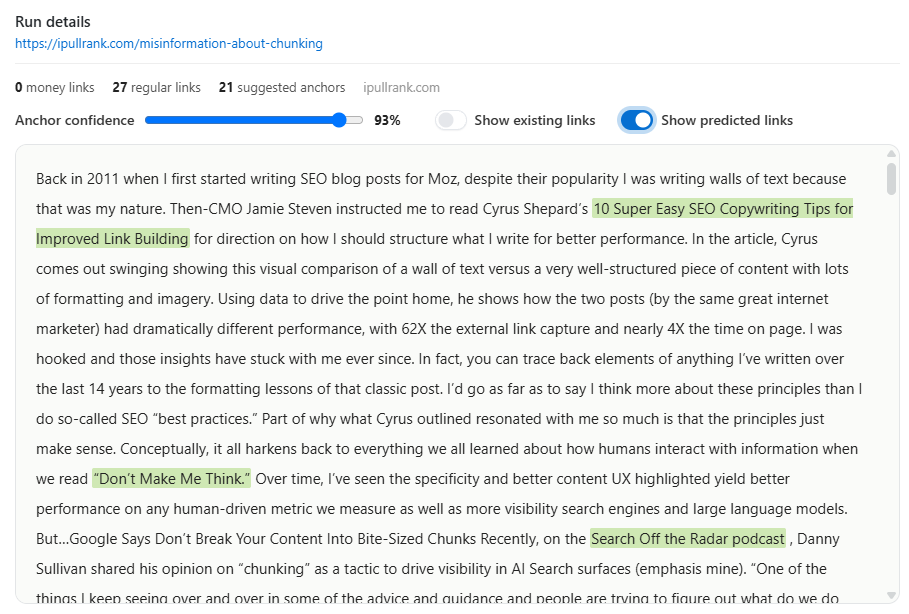
Let's zoom in from abstract to precise now. Here's our link analysis of Mike's chunking article. Mike is a domain expert with many years of blogging experience. Can you guess which spans of text are his links?
Back in 2011 when I first started writing SEO blog posts for Moz, despite their popularity I was writing walls of text because that was my nature. Then-CMO Jamie Steven instructed me to read Cyrus Shepard’s 10 Super Easy SEO Copywriting Tips for Improved Link Building for direction on how I should structure what I write for better performance. In the article, Cyrus comes out swinging showing this visual comparison of a wall of text versus a very well-structured piece of content with lots of formatting and imagery. Using data to drive the point home, he shows how the two posts (by the same great internet marketer) had dramatically different performance, with 62X the external link capture and nearly 4X the time on page. I was hooked and those insights have stuck with me ever since. In fact, you can trace back elements of anything I’ve written over the last 14 years to the formatting lessons of that classic post. I’d go as far as to say I think more about these principles than I do so-called SEO “best practices.” Part of why what Cyrus outlined resonated with me so much is that the principles just make sense. Conceptually, it all harkens back to everything we all learned about how humans interact with information when we read “Don’t Make Me Think.” Over time, I’ve seen the specificity and better content UX highlighted yield better performance on any human-driven metric we measure as well as more visibility search engines and large language models. But…Google Says Don’t Break Your Content Into Bite-Sized Chunks Recently, on the Search Off the Radar podcast , Danny Sullivan shared his opinion on “chunking” as a tactic to drive visibility in AI Search surfaces (emphasis mine).
Here's our model's predictions at 93% confidence threshold:
And here are Mike's actual links:
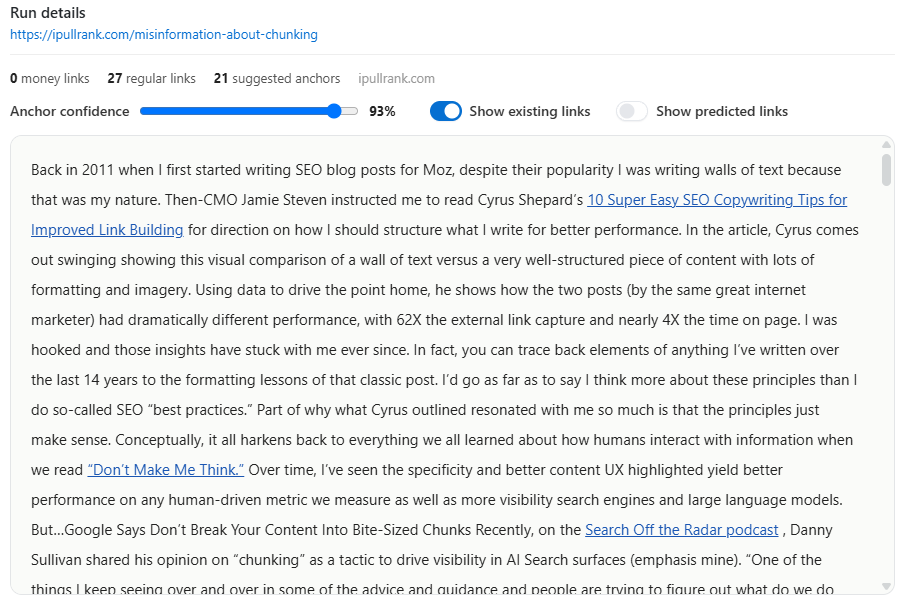
Oh, I'm getting goosebumps. It's as if it read Mike's mind!
Our deep learning model can tell organic and inorganic links apart and so can Google's. Forget about DAs and PAs. Poor link integration is what kills all value of your outreach efforts.
Sure. It's not always perfect. Sometimes the model will miss a link prediction (e.g. there is a pairwise determination) and sometimes it will flag something that should be a link, but isn't (e.g. BubbaChunk), see below.
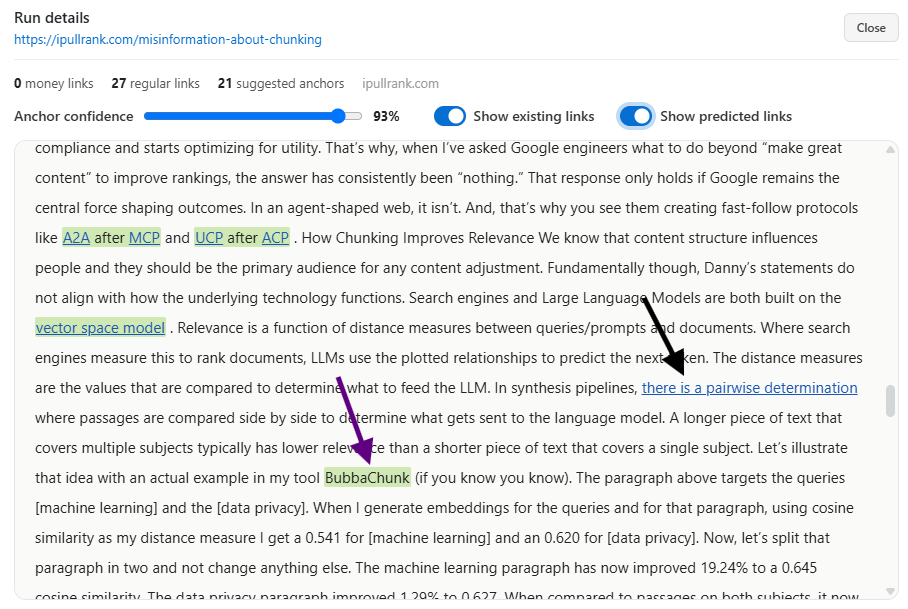
Why am I showing you all this? I'm reinforcing a notion that there's a natural order of things on the web and everything falls into a pattern. Links included. Google's web spam and search quality algorithms and language models are literally designed for pattern matching.
Inorganic links and mentions get caught when they sit where no reader wanted or expected them. Experienced writers place links by instinct, in patterns stable enough for a model to predict, and links and mentions that break those patterns stand out to both algorithms and human reviewers.
Now here's a real curveball.
Let's pick someone with two decades of blogging experience and thousands of blog posts, someone whose links are completely natural and effortless, a second nature. Seth Godin. Pay him $10,000 and ask to write a piece with a link to your page. I almost guarantee you he would fail at his usual natural link integration and so would most of you who are reading this. Why?
Because as soon as your link becomes the primary goal, the content becomes secondary. Links should be there in support of content, not the other way around.
So you're reading this and thinking, I can do better, I can be clever about this. I can integrate my links so they fit the content perfectly. But see, the SEO industry has already poisoned the web content community with the 1 + 2 rule. One money link plus a couple of authority links to 'make it look natural'. Here's my experience with a brainwashed publisher. These guys charge a $150 editorial fee, with the following requirements:
Only one commercial link is allowed. It should look natural and not spammy. No adult and gambling sites! Include 1-3 Authority links to well-ranked news, government or similar sites.
Ironically the 1 + 2, works against the very thing it asks for. It:
- Makes the post look less natural.
- Aids algorithmic detection.
- Provides a pattern for manual actions.
- Creates a negative user experience.
- Encourages poor link integration.
Fun Fact: Organic content often contains 10-20 links on a page, while classic blog networks tend to be quite stingy with 2-3 links per post.
Four rules for links that read as editorial
Liberal linking
Link to every page that helps the reader, on every relevant domain, including domains you have no stake in. This is the habit the 1 + 2 formula breaks.
Signal | Question to ask |
|---|---|
Coverage | Does the page link to the sources, terms and entities a reader may want to follow? |
Openness | Does it link to other domains as readily as to its own? |
Consistency | Does its link density match the host site's editorial posts? |
Independence | Would the links still be there if no link had been paid for? |
Blend | Does any single link stand out from the rest? |
Purpose
Every link must have a strong purpose. There are ten: attribution, reference, definition, expansion, identification, example, action, relationship, proof and promotion. Yes, promotion is on the list. A commercial link is fine when it passes the same test as every other link on the page.
Purpose | What the link does for the reader |
|---|---|
Attribution | Credits the person or outlet behind a quote, image or idea |
Reference | Points to the source of a fact or figure |
Definition | Explains a term the reader may not know |
Expansion | Gives more depth on a point the text only touches |
Identification | Shows exactly which person, company, product or place is meant |
Example | Shows an instance of what the text describes |
Action | Lets the reader do something, such as buy, sign up or download |
Relationship | Connects the subject to a related person, organisation or story |
Proof | Backs a claim with evidence |
Promotion | Points to something the publisher or a partner wants to promote |
Primacy
A link must lead to the strongest possible page for that spot, judged by logic, situation, narrative, utility and relevance. If a better page exists for the anchor, the link is in the wrong place.
Test | Question to ask |
|---|---|
Logic | Is this the page the anchor text promises? |
Situation | Does it suit what the reader needs at this point? |
Narrative | Does it continue the story the article tells? |
Utility | Is it the most useful page on the subject? |
Relevance | Does it match the sentence the link sits in? |
Natural anchor text
If your anchor text fits the natural pattern of existing anchor text on that site, your link will be near impossible to devalue or penalise.
Signal | Question to ask |
|---|---|
Pattern fit | Does the anchor match how the host site phrases its own links? |
Plain wording | Does it describe the source or the action, with no target keyword? |
Grammar | Does it read as a natural part of the sentence? |
Rarity | Is the exact phrase uncommon, like most anchors in the long tail? |
Click point | Does it sit on the words a reader would expect to click? |
Content first, links second
The better the content, the less link-building effort it needs. Step zero is to create value: if there's nothing worth linking to, no linking technique will fix that. Then:
- As a starting point, focus on content.
- Consider all that is of value and where it lives.
- Write and link out generously to the best pages, on all relevant domains and in tune with your readers' expectations.
Placement
The principles above still fail when one line in the text exists only to carry a link. That single line in the wrong place is enough to expose the link.
As a reader moves through a text, their desire for a link rises and falls. It peaks where the text names a source, makes a claim or mentions something the reader may want to look up. A natural link sits at one of those peaks.
How many peaks get a link depends on the threshold. Linking only the absolute essentials gives the fewest links, a conservative threshold gives more, and a liberal threshold gives the most.
Take a client link placed in a story that gives the reader no reason to want it. Even if the story did call for a link at that point, the client's page would not be the strongest target. This is the links-as-an-afterthought pattern, where content is written to carry a link.
WARNING: The above is much easier said than done, and you only realise that once you sit down and try to do it yourself. There's this psychological phenomenon that drives people to claim that their link integration is "good enough" because they just put work into it and don't feel like doing more of it. The only way to fix this is to ask another SEO the following:
Who wanted the link/mention on this page?
If they can guess your link correctly, then it's not good enough.
Inorganic Link Detection
Some websites (you know ) make it trivially easy to detect inorganic placements with severe topical incongruence and obvious link integration. But there are many sophisticated methods which are easy to miss by a human but a perfect job for a machine. Here's my paid link detection algorithm in action:
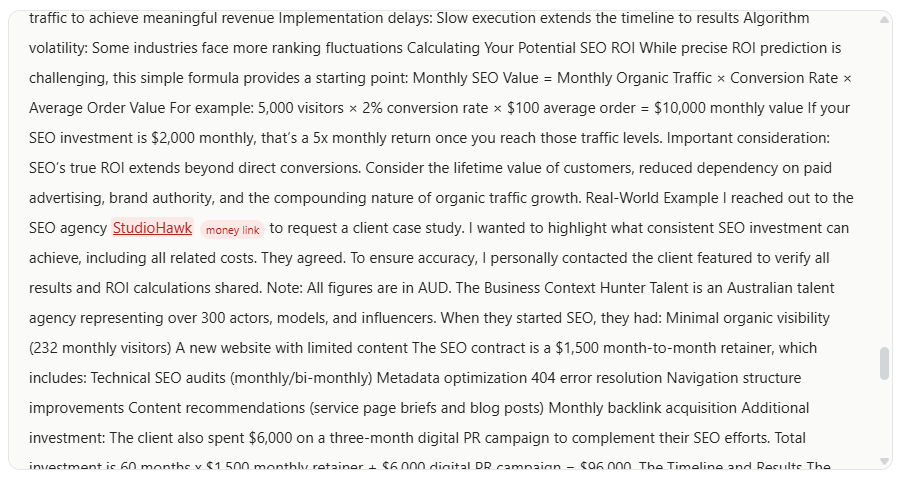
Now, algorithms get things wrong all the time so I shall pass no judgement here and leave the final verdict to you, the reader. But the point I'm making is that if our algorithm can detect this type of thing, then so can Google's, and for this reason most outreach-based links are ignored, or treated as a small negative signal.
Lazy, uninspired links ruin what could be truly great links.
But this is a hard thing to do. Like, really really hard. Even seasoned link builders struggle to make things fit. We're just not subject matter experts at every single thing and a lot of outreach content that gets pumped out is, how should I put it.... uninspired.
So, how do I solve this?
Adversarial Link Integration
We use an outreach workflow in app.dejan.ai that simultaneously battles our two algorithms. It puts two AI teams up against each other. The red team researches the topic, writes the article and places your link. The blue team is our paid link detector, and its only job is to find the link someone paid for. If it finds it, the article is discarded.
[adversarial-flow]
Only articles the detector can't crack make it to our outreach content library.
.
To be continued...

 点赞
点赞 收藏
收藏 点踩
点踩 分享
分享