Gemini 4 Argon - One Step Closer to 'Model as an Employee' Paradigm

Google's Gemini 4 Argon expands the model output horizon to 1 million tokens, a sixteenfold increase over the previous 64,000-token ceiling, aimed at preventing the drift, compounding errors, and hallucinated tangents that disrupt autonomous multi-step work. By pairing this expanded output window with sustained retrieval across deep context windows, the model executes end-to-end tasks, such as translating entire codebases or conducting complex multi-document audits, within a single uninterrupted reasoning trajectory.
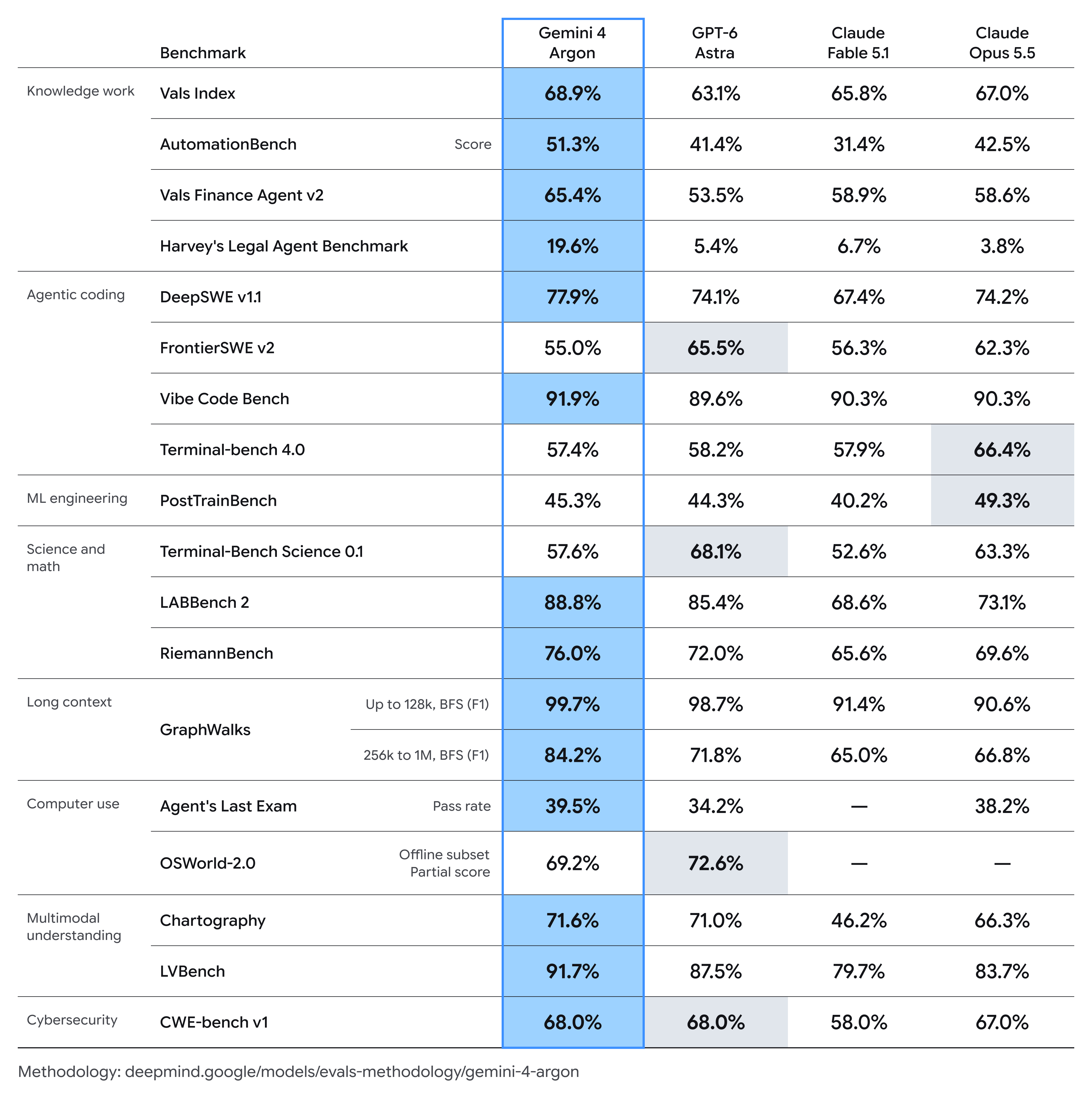
Autonomous model deployment has stalled primarily at the boundary of long-horizon execution. Standard frontier models lose track of instructions, distort facts, or pursue irrelevant tangents when tasked with running workflows across hours or across tens of thousands of tokens. Extending the generation window to 1 million tokens allows an agent to maintain its execution state, test intermediate outputs, and correct errors without resetting its working memory.
Benchmark Performance in Long-Horizon and Enterprise Work
Comparative evaluations demonstrate that Gemini 4 Argon maintains coherence across extended enterprise tasks, particularly in domains requiring procedural consistency over large reference corpora.
| Benchmark | Gemini 4 Argon | GPT-6 Astra | Claude Fable 5.1 | Claude Opus 5.5 |
|---|---|---|---|---|
| GraphWalks (256k to 1M, BFS F1) | 84.2% | 71.8% | 65.0% | 66.8% |
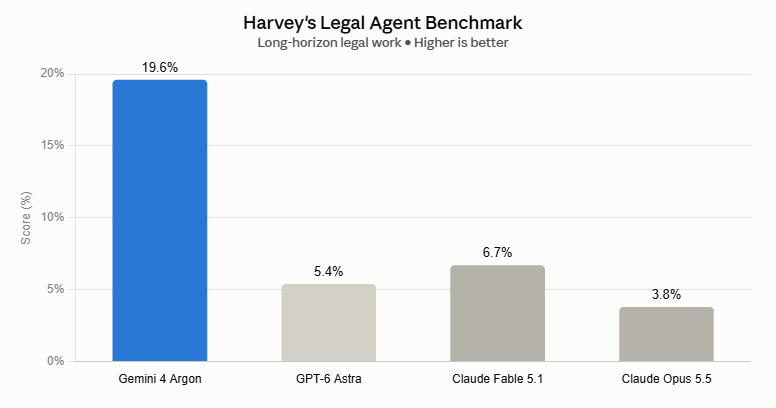
| Harvey's Legal Agent Benchmark | 19.6% | 5.4% | 6.7% | 3.8% |
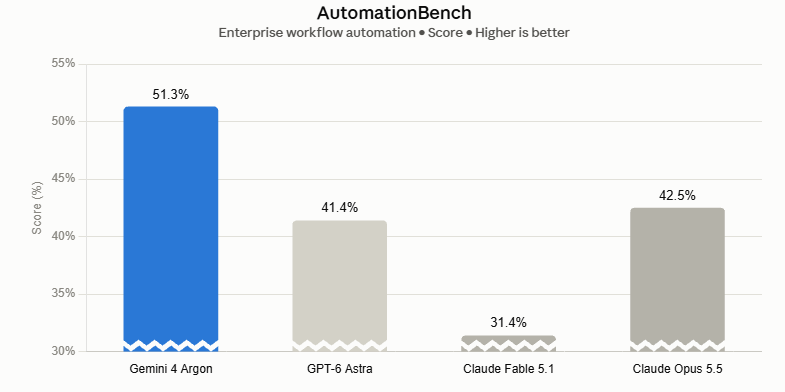
| AutomationBench | 51.3% | 41.4% | 31.4% | 42.5% |
| Vals Finance Agent v2 | 65.4% | 53.5% | 58.9% | 58.6% |
| Vals Index | 68.9% | 63.1% | 65.8% | 67.0% |
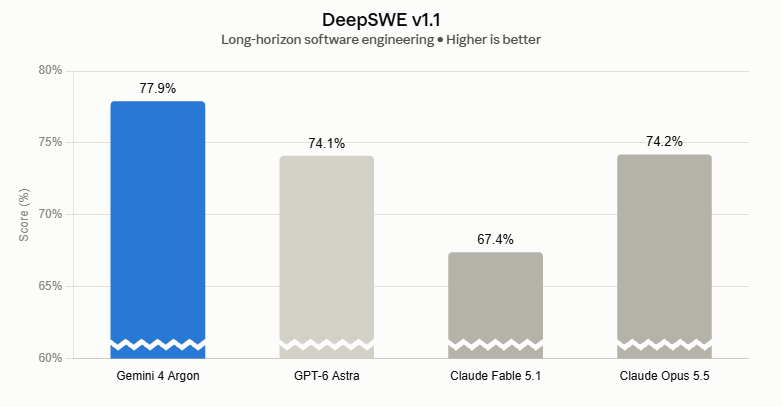
| DeepSWE v1.1 | 77.9% | 74.1% | 67.4% | 74.2% |
| LVBench | 91.7% | 87.5% | 79.7% | 83.7% |
| GraphWalks (Up to 128k, BFS F1) | 99.7% | 98.7% | 91.4% | 90.6% |
On the GraphWalks benchmark between 256,000 and 1 million tokens, Argon leads the closest competing model, GPT-6 Astra, by 12.4 percentage points.
On Harvey's Legal Agent Benchmark, which assesses multi-step legal drafting and research, Argon scored 19.6%, compared to 6.7% for Claude Fable 5.1, 5.4% for GPT-6 Astra, and 3.8% for Claude Opus 5.5.
On AutomationBench, Zapier's evaluation measuring end-to-end execution across business operational stacks, Argon scored 51.3%, an 8.8 percentage point margin over Claude Opus 5.5.
The model does not lead across all agentic benchmarks. On FrontierSWE v2, Argon scored 55.0% against GPT-6 Astra's 65.5%. On Terminal-bench 4.0, Argon achieved 57.4%, trailing Claude Opus 5.5 at 66.4%.
Autonomous Engineering Inside Google Systems
Internal deployments at Google illustrate the operational scope of agents that do not require continuous human steering. Teams assigned Argon agents to analyze fleet-wide telemetry across production data centers. The agents identified memory inefficiencies and deployed automated configurations, reclaiming over 300 TiB of memory, with projected total savings between 500 TiB and 1 PiB.
Software modernization workflows have also shifted from piecemeal assistant queries to multi-file codebase migrations. Argon agents translated C and C++ codebases to Rust across core components, ranging from libraries like re2 and libgav1 to the 800,000-line Fuchsia Zircon kernel. For libgav1, the agents processed compiler outputs, ran profile-guided iterations, and replaced 32,000 lines of SIMD code with safe Rust that auto-vectorizes, generating a decoder that executes 2.7 times faster than the previous manual Rust implementation.
In theoretical optimization, quantum researchers tasked Argon with reducing the spacetime resource requirements (qubits multiplied by gates) in bottlenecked algorithmic subroutines. The model compressed these resources to beat established baselines by 40%. Detailed evaluation methodologies for these benchmarks are published at deepmind.google/models/evals-methodology/gemini-4-argon.

 点赞
点赞 收藏
收藏 点踩
点踩 分享
分享