Snap Wants to be a State Actor??–Kansas v. Snap

For decades, private Internet services have uniformly tried to avoid being legally characterized as government actors. If they become state actors, they must comply with Constitutional restrictions–meaning the Constitutionally required freedoms of speech and press would extend to their user-authors and overlay the services’ content moderation decision. That would turn every content moderation decision into litigation-bait, and few if any Internet services could handle the litigation onslaught that would follow. Thus, there has been a long-standing understanding among private Internet services: it is existentially important that they don’t do anything that would convert them into a state actor.
* * *
[Note: as discussed below, I previously missed a Florida case previews the developments in this post. It’s still worth talking now because Snap’s choices are wild.]
Kansas state AG Kobach sued Snap for “deceptive and unconscionable practices” in Kansas state court. Like many other plaintiffs, Kobach argues that: Snap publicly lies to avoid getting slapped with mature ratings in app stores, and Snap designed itself to be addictive. Snap removed the Kansas case from state court to federal court, but Kobach sought to remand the case back to state court. This ruling grants Kobach’s remand request.
A case can remain in federal court if it involves “any person acting under an officer of the United States for or relating to any act under color of such office.” The litigant must show “(1) they acted under the direction of a federal officer, (2) the claim has a connection or association with government-directed conduct, and (3) they have a colorable federal defense to the claim or claims.”
To keep the case in federal court, Snap claims that it acted under the direction of a federal officer based on its work for DHS and FDA. For example, “Snap argues that it was helping DHS and the FDA discharge statutorily mandated missions.” Say what now?
First, Snap might not want to be highlighting its work for DHS or the FDA during the Trump era. I imagine many Snap users would not appreciate Snap taking money to become a propaganda proxy for the Trump administration.
Second, and more importantly, Snap has provided fodder to future plaintiffs who want to argue that Snap has become a state actor when it makes content moderation decisions. (There are a variety of ways plaintiffs can state those claims, typically under the umbrella of jawboning). I cannot see any scenario where Snap can financially or logistically handle the legal status of being a state actor. And it’s exposing itself to this potentially existential risk for…the benefit of remanding cases from state to federal court?
Snap could try to mitigate these harms in two ways. First, it can argue that any direction it took from the government was limited to specified topics and doesn’t implicate its broader content moderation function. Second, it could try to distinguish between being a jawboned entity for Constitutional purposes and the specific statutory elements of the removal statute, an argument strengthened by the fact that Snap’s request failed here (but see the Florida counterpart).
Despite that, Snap has provided plaintiffs with easy cut-and-paste material to support those plaintiffs’ claims that Snap “censored” them on behalf of the US government. Perhaps those claims will survive to summary judgment or even a trial where they might have failed on a motion to dismiss. Thus, as the cost of trying to obtain a smallish procedural win (i.e., to reposition what courts hears the cases), Snap has planted the seeds for long-term, expensive, and high-risk legal entanglements.
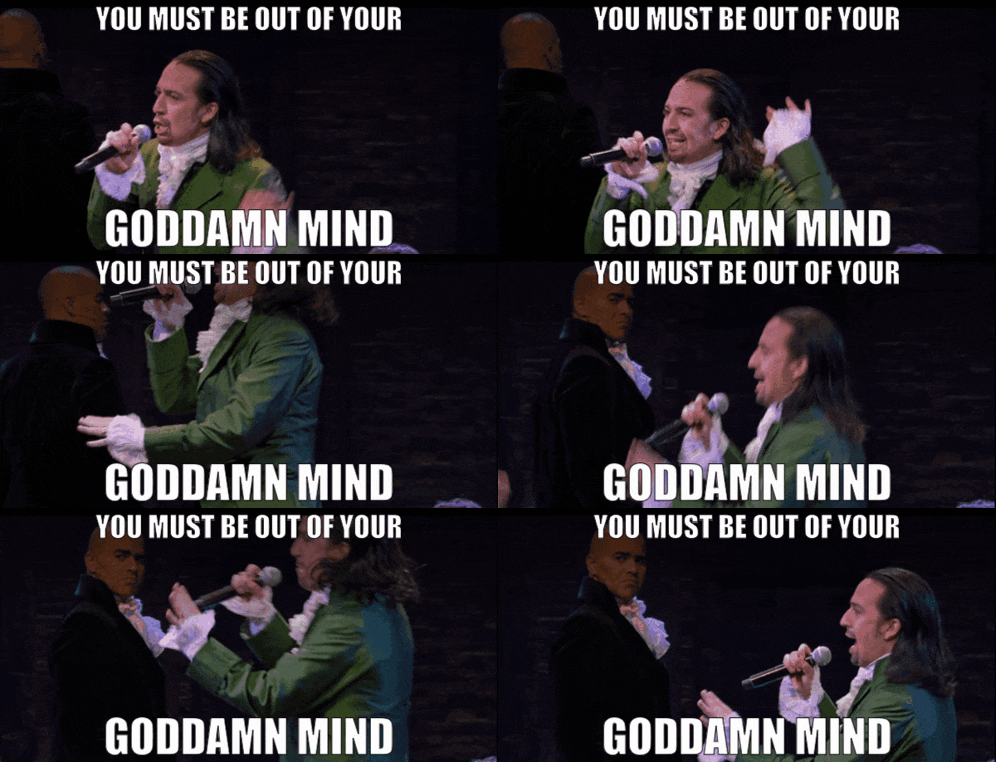
For that reason, as I read this case, my brain kept thinking of this clip:
* * *
If you want details about Snap’s work for DHS, Snap worked on the following projects:
- “Know2Protect, an educational campaign aiming to prevent “online sexual exploitation and abuse” and promote online safety”
- “Pledge2Protect, a campaign encouraging people “to take action and educate themselves concerning online child exploitation and preventative measures.””
- “Snap has helped DHS build “custom ‘lenses’”—a Snapchat feature that “allow[s] users to add interactive animations to photos and videos”—for its two campaigns”
- “DHS controls “where and how” its advertisements appear in Snapchat. And Snap obeys DHS’s request by targeting its campaigns to teenage users.”
- “Blue Campaign [] aims to prevent human trafficking and educate the public about human trafficking. DHS advertised Blue Campaign in Snapchat and dictated the placement of the ads.”
Some details about Snap’s work for FDA:
“The Real Cost” and “Next Legends” [] try to educate teenagers about the risks of nicotine and tobacco use. Snap helped the FDA build custom lenses featuring interactive animations that give facts about cigarette and vape usage….the FDA advertises in Snapchat to promote its campaigns. It “dictates” “where and how the advertisements” appear in Snapchat. Snap, per the FDA’s request, targets these advertisements to teenage users.
Much of this sounds like standard publisher-advertiser ad targeting interactions, i.e., the advertiser-customer directs the publisher-vendor to get the best ROI from the ads; with the tiny twist that this advertiser is the federal government. However, I couldn’t tell from this discussion how deeply Snap’s DHS and FDA work might have reached into Snap’s general content moderation activities.
The court says none of Snap’s evidence satisfies the statutory standards for being directed by a federal officer. The court summarizes:
No doubt, Snap performed some services for federal officers. Some of those services—like advertising on Snapchat—reflect no more than a standard arms-length commercial transaction. Other services, like lens production and custom research, didn’t involve a federal officer’s “strict guidance or control” over Snap. Snap thus has failed to identify any conduct that qualifies it as acting under a federal officer.
That conclusion ought to save Snap from the risks it has created for itself. However, Snap has successfully advanced this federal officer direction remand/removal argument at least once before in a case I previously missed. Off. of Att’y Gen. v. Snap Inc., 2025 WL 4035005 (N.D. Fla. Aug. 13, 2025), appeal docketed, No. 25-12814 (11th Cir. Aug. 18, 2025).
The Kansas court acknowledges the Florida lower court opinion:
The court respectfully disagrees with that case’s analysis, which suggests that Snap needn’t show a close or extensive relationship with the federal government to satisfy the acting-under prong. That conclusion isn’t tenable under Tenth Circuit law, which requires “strict guidance or control” and “close supervision of the private entity by the government[.]”
The fact that the Florida case is headed to the 11th Circuit makes that a potentially risky case for Snap and the industry generally. Imprecise words or broad statements from the appellate court could really put Snap (and others) into a much deeper legal hole. There’s also the chance Snap will appeal the Kansas ruling, giving a different appellate court the chance to do something wacky and problematic.
Case Citation: State v. Snap, Inc., 2026 WL 2525593 (D. Kansas Aug. 27, 2026)
Selected Posts About State Action Claims
- Meta Defeats Two More Account Termination/Content Removal Lawsuits
- Google Search Isn’t a Common Carrier–Richards v. Google
- TikTok Isn’t a U.S. State Actor (So Far)–Brooks v. TikTok
- Terminated User Loses Lawsuit Against Facebook–Hunt v. Meta
- Section 230 (Still) Applies to Contract Breach Claim–NJCCC v. McAleer
- More Account Termination Cases Fail in Court
- WeChat Defeats Account Termination Lawsuit–Sun v. WeChat
- Robert F. Kennedy Jr. Is Breaking Internet Law Faster Than I Can Blog It
- A Peek Into the Long Tail of Facebook’s Litigation Docket
- Jawboning Defendants Are 6-for-6 in the Ninth Circuit–Hart v. Facebook
- YouTube Still Isn’t a State Actor–Albertson v. Google
- Twitter Account Suspension Lawsuits Keep Failing–Hall v. Twitter
- Twitter Defeats Account Suspension Case–Craft v. Musk
- Government Submissions to a Trusted Flagger Program Aren’t Unconstitutional Jawboning–O’Handley v. Weber
- Facebook Defeats Lawsuit Over Account Suspension for a Voting Misinformation “Joke”–Hall v. Meta
- Prager’s Lawsuit Over Biased Content Moderation Decisively Fails Again (This Time, in State Court)–Prager v. YouTube
- The 5th Circuit Puts the 1st Amendment in a Blender & Whips Up a Terrible #MAGA Kool-Aid–NetChoice v. Paxton
- Facebook Defeats Jawboning Lawsuit Over COVID Misinformation Removal–Rogalinski v. Meta
- Another Account Suspension Case Yeeted–Rangel v. Dorsey
- Another Failed Lawsuit Over Trump’s Deplatforming–Rutenberg v. Twitter
- COVID Skeptic Loses Lawsuit Over Account Terminations–Hart v. Facebook
- Twitter Defeats Trump’s Deplatforming Lawsuit–Trump v. Twitter
- Account Suspension Lawsuit Against Twitter Survives Motion to Dismiss–Berenson v. Twitter
- Another Failed Lawsuit Over Facebook’s Content Removals–Brock v. Zuckerberg
- Section 230 Survives Yet Another Constitutional Challenge–Huber v. Biden
- Another Court Says Facebook Isn’t a State Actor–McWaters v. Houston
- Another Anti-Vaxxer Jawboning Lawsuit Fails–ICAN v. YouTube
- The First Amendment Protects Twitter’s Fact-Checking and Account Suspension Decisions–O’Handley v. Padilla
- One More Time: Facebook Isn’t a State Actor–Atkinson v. Facebook
- Two More Courts Tell Litigants That Social Media Services Aren’t State Actors
- Government Jawboning Doesn’t Turn Internet Services into State Actors–Doe v. Google
- Anti-Zionist Loses Lawsuit Over Social Media Account Suspensions–Martillo v. Facebook
- Court Nopes Another Lawsuit Over Facebook Suspensions–Orders v. Facebook
- Facebook Defeats Lawsuit By Publishers of Vaccine (Mis?)information–Children’s Health Defense v. Facebook
- Court Rejects Lawsuit Alleging YouTube Engaged in Racially Biased Content Moderation–Newman v. Google
- Yet Another Court Says Facebook Isn’t a State Actor–Brock v. Zuckerberg
- YouTube (Again) Defeats Lawsuit Over Content Removal–Lewis v. Google
- When It Came to @RealDonaldTrump, Twitter Couldn’t Please Everyone–Rutenberg v. Twitter
- Another Must-Carry Lawsuit Against YouTube Fails–Daniels v Alphabet
- Newspaper Isn’t State Actor–Plotkin v. Astorian
- An Account Suspension Case Fails Again–Perez v. LinkedIn
- Are Social Media Services “State Actors” or “Common Carriers”?
- Google and Twitter Defeat Lawsuit Over Account Suspensions/Terminations–DeLima v. Google
- More Plaintiffs (and Lawyers) Need To Be Reminded That YouTube Isn’t a State Actor–Divino v. Google
- Facebook Isn’t a Constructive Public Trust–Cameron Atkinson v. Facebook
- Google and YouTube Aren’t “Censoring” Breitbart Comments–Belknap v. Alphabet
- LinkedIn Isn’t a State Actor–Perez v. LinkedIn
- Section 230 Preempts Another Facebook Account Termination Case–Zimmerman v. Facebook
- Section 230 Ends Demonetized YouTuber’s Lawsuit–Lewis v. Google
- Court Rejects Another Lawsuit Alleging that Internet Companies Suppress Conservative Views–Freedom Watch v. Google
- Another Suspended Twitter User Loses in Court–Wilson v. Twitter
- First Voters Reject Tulsi Gabbard, Then a Judge Does–Gabbard v. Google
- YouTube Isn’t a State Actor (DUH)–PragerU v. Google
- Facebook Still Isn’t Obligated to Publish Russian Troll Content–FAN v. Facebook
- Vimeo Defeats Lawsuit for Terminating Account That Posted Conversion Therapy Videos–Domen v. Vimeo
- Russia Fucked With American Democracy, But It Can’t Fuck With Section 230–Federal Agency of News v. Facebook
- Private Publishers Aren’t State Actors–Manhattan Community Access v. Halleck
- Your Periodic Reminder That Facebook Isn’t a State Actor–Williby v. Zuckerberg
- Section 230 Protects Facebook’s Account and Content Restriction Decisions–Ebeid v. Facebook
- Court Tosses Antitrust Claims That Internet Giants Are Biased Against Conservatives–Freedom Watch v. Google
- Twitter Isn’t a Shopping Mall for First Amendment Purposes (Duh)–Johnson v. Twitter
- YouTube Isn’t a Company Town (Duh)–Prager University v. Google
- Facebook Defeats Lawsuit By User Suspended Over ‘Bowling Green Massacre’–Shulman v. Facebook
- Yelp, Twitter and Facebook Aren’t State Actors–Quigley v. Yelp
- Facebook Not Liable for Account Termination–Young v. Facebook
- Online Game Network Isn’t Company Town–Estavillo v. Sony
- Third Circuit Says Google Isn’t State Actor–Jayne v. Google Founders
- Ask.com Not Liable for Search Results or Indexing Decisions–Murawski v. Pataki
- Search Engines Defeat “Must-Carry” Lawsuit–Langdon v. Google
- KinderStart Lawsuit Dismissed (With Leave to Amend)
- ICANN Not a State Actor
The post appeared first on Technology & Marketing Law Blog.

 点赞
点赞 收藏
收藏 点踩
点踩 分享
分享