Sedlik v. Von Drachenberg: All About That Intrinsic Test? (Guest Blog Post)

by guest bloggers Bruce Boyden (Marquette Law) & Zahr Said (Santa Clara Law)
On June 9, the Ninth Circuit granted rehearing en banc in Sedlik v. Von Drachenberg, agreeing to reconsider the test for infringement first adopted in Sid & Marty Krofft v. McDonald’s back in 1977. At the time, we had just begun work on a joint project looking at copyright infringement doctrine generally, but we immediately pivoted to writing an amicus brief. Why ruin three perfectly good summer weeks in this way? This is the best opportunity the Ninth Circuit has had in decades to not only abandon its idiosyncratic approach to substantial similarity, but to take the lead by adapting copyright infringement doctrine for the age we are in now, when infringement cases often go to a jury. It could be a long time before another chance presents itself.
We’ll get to our specific proposal in a future post, but in this post we want to focus on how to frame the issue coming up before the full(ish) court, which will hear oral argument in this appeal on Tuesday, September 29. What does the Sedlik trial say or, even more importantly, not say about the shortcomings of the Ninth Circuit’s infringement test? One common reaction to the verdict below, including from the three-judge panel, was that the only reason the jury found in favor of the defendant is that its attention was “divert[ed]” from “objectively substantial copying of protected expression” by the vague language in the Ninth Circuit’s “intrinsic” test for substantial similarity. But we have our doubts that that is correct as a factual matter, and the danger is that mistaken perceptions about how the infringement inquiry is currently operating could lead the Ninth Circuit astray once more.
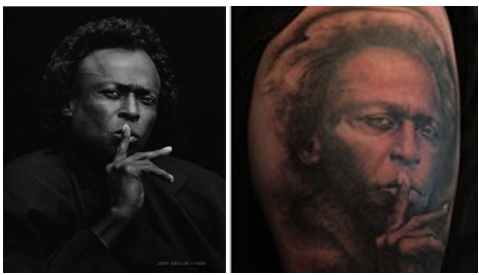
Before we get there, some brief background. Sedlik involves a copyright infringement claim by Jeffrey Sedlik, who took the well-known photo of Miles Davis on the left, against Katherine von Drachenberg, a/k/a “Kat von D,” who created a tattoo based on the photograph (at right). After a four-day trial, the jury rendered a verdict of non-infringement as to the tattoo and various social media posts, checking off a box that read “Not Substantially Similar” for each of six works at issue. The district court judge then denied Sedlik’s Rule 50(b) motion, and the Ninth Circuit affirmed. (The affirmance has now been vacated pending en banc review.)
Two judges on the panel, Judges Wardlaw and Johnstone, wrote lengthy concurrences expressing frustration that their hands were tied by the court’s “intrinsic test,” which “considers the perspective of the ‘lay observer’” and asks the jury to perform “a holistic comparison that focuses on whether the works are substantially similar in the total concept and feel of the works.” The panel believed that reversing a jury verdict on the intrinsic test “would be tantamount to ‘supplanting the jury’s subjective interpretation with [our] own,’” Sedlik panel op. at 15, making it “all but unreviewable” (Johnstone, J., concurring). As a fix, Judge Wardlaw proposed “dispensing with [the intrinsic test] altogether,” noting “the dispositive role the intrinsic test played here.”
We have a question about the right way to interpret this chain of events, but first we need to more fully explain the Ninth Circuit’s terminology and where it came from. (Copyright mavens can skip the next two paragraphs.) The golden era of test-making in copyright law dates from around the middle of the twentieth century. The Second Circuit was the first out of the gate with a multi-stage infringement inquiry in 1946’s Arnstein v. Porter. Under the original Arnstein framework, after establishing ownership of a valid copyright, the plaintiff had to make a two-part showing of infringement: that the defendant actually copied material from the plaintiff’s work, and that the copying took enough of “what is pleasing to lay listeners” to constitute wrongful appropriation. In later cases, the wrongful appropriation step was designated with a different term, “substantial similarity.”
The Ninth Circuit began developing its own version of the Arnstein inquiry in 1977’s Sid & Marty Krofft v. McDonald’s Corp. The key insight that prompted the new test was that nowhere in the Arnstein inquiry was the court formally required to evaluate how much of the allegedly copied material was protected expression. Copying of unprotected material, no matter how extensive, is insufficient to make a defendant liable for infringement. The Krofft panel’s solution, however, was to recombine pieces of Arnstein into a framework that, after establishing ownership of a valid copyright, required a plaintiff to show three things: access to the plaintiff’s work (which was part of Arnstein’s actual copying stage), followed by two forms of substantial similarity. First, there is the so-called extrinsic test, which as presently defined identifies and compares “the protectable elements of the plaintiff’s expression” in order to “assess similarities in the objective details of the works. The second form of substantial similarity is the intrinsic test, which “considers the perspective of the ‘lay observer’” and asks the jury to perform “a holistic comparison that focuses on whether the works are substantially similar in … total concept and feel.”
It’s the intrinsic test that was the focus of attention in the panel decisions: the per curiam opinion concluded that “the district court did not err in denying Sedlik’s Rule 50(b) motion because the jury’s verdict was based on an application of the intrinsic test,” and in turn “[b]ecause the jury’s verdict was based on an application of the intrinsic test, we will not second-guess it.” The concurring opinions likewise lamented that the result “came down to the ‘intrinsic’ test,” producing an “inscrutable no-infringement verdict.”
That leads to our question: Why is everyone so certain that the jury decided this case based on the intrinsic test? It’s not just the panel judges; most commentators have made the same assumption. (One of us (Said) has a forthcoming essay, Reading the Jury’s Mind, that dives into further detail on this question.) The assumption is not only unwarranted, it’s misleading; it suggests that the way to fix the Ninth Circuit framework is to eliminate the intrinsic test. While we agree the intrinsic test should go, the right way to do that is by rethinking the whole infringement determination, not by targeting only one subpart.
It could turn out that the well-known problems with the intrinsic test are a red herring in this case. Here’s the issue: under the Ninth Circuit framework, the plaintiff must demonstrate both forms of substantial similarity to prevail at trial, the extrinsic test and the intrinsic test. The jury was clearly informed, in its instructions and at trial, that it needed to consider both tests. As a result, the jury could have found for the defendant on the basis of the extrinsic test, the intrinsic test, or both. Indeed, the substantial similarity instructions required the jury to consider the extrinsic test as their “first step,” and if they failed for the plaintiff there, the inquiry was over. See Jury Instr. 20. That means that the jury may never even have reached the intrinsic test.
What makes a verdict based on the extrinsic test a plausible scenario is that the jury heard a considerable amount of argument and evidence at trial that the elements copied by the defendant were not copyrightable, which for all we know could have been the basis of its verdict. The verdict form sheds no light on this; none of the six questions on substantially similarity broke the question down by test. (As a side note, it is possible to include doctrinal nuance for the jury to decide, as we saw with Griffin v. Sheeran’s detailed verdict form, which allowed the jury to make clear that it was finding for Sheeran on the basis of independent creation.) In her post-trial decision, Judge Dale Fischer seemed to agree: “The Court must draw the reasonable inference that the jury found that it was the unprotected elements of the Portrait that were copied.” Both parties then briefed the Ninth Circuit panel on both the intrinsic and the extrinsic tests on appeal, which suggests that they considered the issue a live one at that point. In fact, one of Sedlik’s main arguments—at summary judgment, and again on appeal—was that the extrinsic test ought to dispose of the case as a matter of law, in his favor. It’s therefore puzzling, given its role in the litigation up until that point, that the extrinsic test has pretty much disappeared from view.
So why has everybody been assuming that the jury verdict was based only on the intrinsic test? It makes sense that the panel would base its decision on the intrinsic test; an appellate court can affirm on any basis present in the record, and since according to Ninth Circuit case law, the intrinsic test is now characterized as unreviewable, that provides a quick resolution to the appeal. But that’s a different question from what the jury in fact decided, and much of the commentary seems to be making an unsupported assumption that the jury was on track to find for the plaintiff until it was derailed by the intrinsic test. We think instead that, on a review of the record, the proper outcome of the infringement inquiry is not obvious in this case (in fact we disagree), but we agree that the en banc rehearing presents an opportunity for the Ninth Circuit to fix the sequencing and elements of the decision-making process in infringement cases, which has been a problem ever since Sid & Marty Krofft was decided.
One possible explanation for why the panel focused on the intrinsic test may have had to do with how the infringement inquiry is usually litigated in the Ninth Circuit. As we’ll explain later, the infringement inquiry is a mixture of factual and legal questions that are difficult to split apart but are problematic to consider together. The Ninth Circuit framework addresses this problem by allowing judicial review of the extrinsic test, but only the extrinsic test, on a motion for summary judgment. In some ways this makes sense, because the question of what in the plaintiff’s work constitutes protectable expression is one of the more legal tasks in the infringement inquiry. There thus may be some temptation to think of the extrinsic test as an issue for the judge, leaving only the intrinsic test as an issue for the jury. But that’s not what happens. The parties may not even move for summary judgment on the extrinsic test. Even if there is such a motion and it is denied, the jury will then consider both tests, not just the intrinsic test. If anything, the jury is likely to focus even more attention on the extrinsic test, which it is typically instructed to consider first. Whatever happens beforehand, once the case gets to trial, the jury is then asked to do much of the work of filtering unprotected material from the plaintiff’s claims.
In a subsequent post, we’ll address another issue that particularly concerned the Sedlik panel judges, the apparent “asymmetry” in granting summary judgment for defendants if the extrinsic test fails, but denying summary judgment to plaintiffs if they succeed on the extrinsic test. And we’ll describe and expand upon the solution proposed in our amicus brief, namely, that wrongful appropriation be reformulated to include a clear test for protected expression followed by an assessment of the appropriation considered from the perspective of the ordinary observer, also known as the audience test. Stay tuned!
Prior Tattoo Copyright Blog Posts
- Tattoo Artist Wins Copyright Claim, But Gets Zero Damages–Alexander v. Take Two
- Videogame Maker Has Implied License to Depict Copyrighted Tattoos–Hayden v. 2K
- This Blog Has Jumped the Shark: I’m Covering a Copyright Opinion About a Tattoo of Tiger King’s Joe Exotic–Cramer v. Netflix
- Jury Awards Damages to Tattoo Artist for Video-Game Depiction–Alexander v. WWE 2K
- Can Tattoos Infringe Copyrights, and If So, What Happens Then?–Sedlik v. Kat Von D
- Depicting Randy Orton’s Tattoos in a Video Game Could Be Copyright Infringement–Alexander v. WWE 2K
- Videogame Doesn’t Infringe Tattoo Copyright By Depicting Basketball Players–Solid Oak Sketches v. 2K Games
- Copyright and Tattoos: Hangover II Injunction Denied, But the Copyright Owner Got Some Good News Too–Whitmill v. Warner Bros.
- Tattoo Advertising/Human Billboards
- Copyright in Tattoos
- Also, see Q2 of my 2005 contracts law exam and the sample answer.
The post appeared first on Technology & Marketing Law Blog.

 点赞
点赞 收藏
收藏 点踩
点踩 分享
分享