Premium: The Hater's Guide To AI Debt (Part 1)

The year is 2026, and you are a hyperscaler CEO. You zip up your Patagonia vest, type UPDATE ME ON CALENDOR TOODAY into ChatGPT, and see that you have a meeting with your CFO. They tell you that while they love all those GPUs you’re buying for those data centers that will absolutely get built and totally agree that you should buy more, your company cannot actually afford to buy them at the current pace.
“But we’re one of the single-largest cash-generating companies in the world!” you scream so hard that your horribly-trained Shiba Inu starts chewing on the side of your Aeron chair. “We’ve been doing AI for years! Where is the money?”
The CFO furrows their brow. “Well, that’s the thing. We’re not actually generating that much cash from it, and actually appear to be losing money. Why do we want to buy more GPUs? We still haven’t installed most of the ones we bought-”
You begin to shake uncontrollably. “To. Do. Artificial. Intelligence. What. Is. It. You. Don’t. Understand. Why. More. GPUs. Now.” The Shiba Inu is now tearing into your Eames chair, but you’re too angry to notice.
Your CFO, thankful that there’s a Microsoft Teams window between the two of you, seeks to calm you down, and asks ChatGPT to give them a script to calm you down. “I understand that you didn’t like what I said — and that’s on me. I have a really great solution for you that I think will solve the problem — we’ve got great credit, and we’d be able to raise in all sorts of ways. It’s not just a solution — it’s a strategy.”
You stop shaking. Your idiot Chief Financial Officer had a great idea. You ask ChatGPT to vibe code a dashboard of potential options and it crashes your Chrome browser. “I just ran the numbers. You’re right.” Your CFO smiles as they see your Shiba Inu empty its bladder in the background.
While I’m editorializing a little, this is the current state of the largest tech companies in the world, with Oracle, Google and Amazon going cashflow negative (with Meta not far behind) in pursuit of an indeterminately-large opportunity to sell AI software or rent AI chips (bought from either NVIDIA or Broadcom, see my hater’s guides for more) to either Anthropic and OpenAI or, in Google’s case, Meta.
To reiterate what I’ve been saying for a while, big tech has a few issues with the AI buildout:
- AI chips are extremely expensive.
- AI data centers take a great deal of time to build and energize.
- AI services are expensive to run.
- AI services do not appear to generate much revenue.
Hyperscalers have traditionally run relatively-lean operations with operating expenses that didn't necessarily scale with revenues, along with low capital expenditures (IE: long term investments in the business) that meant that even Oracle’s effectively-flat revenues didn’t stop it from printing cash every quarter.
All of that changed thanks to the incredible cost of AI data centers.
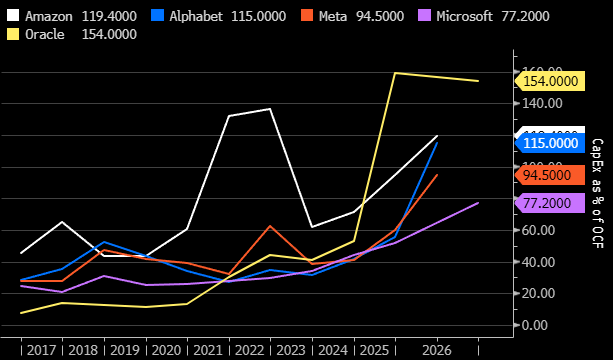
Capital expenditures are becoming a dramatic share of operating cashflow — as in the total money the company brings in and spend on a quarterly basis — with chart looking relatively-sleepy outside of Amazon’s massive expansion of its logistics network in 2021 and 2022 and Meta’s abominable investments in the Metaverse until the AI bubble began to eat away at every available dollar of cashflow.
Their argument would be that they’re “building the infrastructure of the future,” but that doesn’t appear to have A) shown up in revenues or B) eased up the strain on cashflow. While Google, Oracle, Microsoft, and Amazon have added over a trillion dollars to their revenue backlogs from Anthropic and OpenAI alone, the money they’re adding doesn’t seem to be helping with the burn.
Here’s a chart to illustrate the point. An easy way to view the calculation is that this is a percentage of the incoming dollars to the company being eaten up by capital expenditures — and as you can see, that equates to almost every dollar that big tech is making.
Meanwhile, as the AI bubble inflated, a new breed of company emerged — the “neocloud,” a company that raises money to buy AI chips and build data centers. These companies are usually either a brand new entity conjured up through the dark magic of Jensen Huang or cryptocurrency miners (who already have access to power, though often not enough) converting their Bitcoin/Ethereum operations into AI data centers.
In some cases, the neoclouds rent capacity from colocation firms like Core Scientific and Applied Digital who, in turn, raise debt to build the data centers and secure the power, leaving the neoclouds to buy all of the IT gear to go inside.
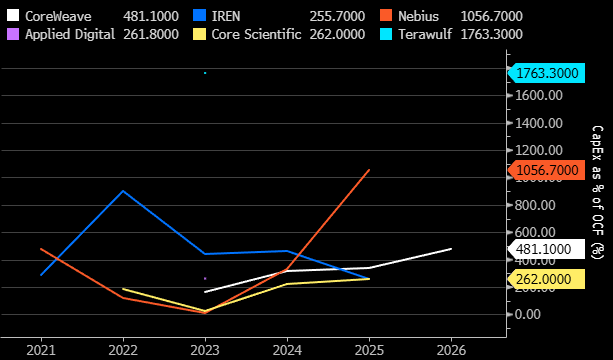
Much like the hyperscalers, neoclouds have committed to build gigawatts of data center capacity, which means they’ve had to raise massive amounts of debt. And while their capital expenditures rival the biggest companies in the world, their revenues are a footnote to the amount of cash going out the door, and it’s only getting worse every quarter:
As I’ve said before, while everybody wants to make the AI bubble really complex, it’s actually super simple: hundreds of billions of dollars are being invested to make single-digit billions of dollars maybe, some day, if AI data centers actually get built at scale and OpenAI and Anthropic can afford to pay for their compute.
The unbelievable cost of building AI data centers is such that everyone that does so only appears to lose money, to the point that the richest companies in the world are running a deficit, and the AI compute specialists are hemorrhaging billions of dollars a quarter on the off chance that they might make it back by the year 2030.
Not to worry, though. The combined might of private credit, investment banks and global bond markets have funded over $500 billion in AI-related debt issuance in 2026 alone, across a combination of regular bonds, convoluted special purpose vehicles, convertible notes (IE: loans that convert into stock), delayed-drawn term loans, and direct lending, with a worrying amount of the same names — such as asset managers like Blackrock and Blackstone and Japanese banks MUFJ and SMBC — popping up across a vast majority of the deals.
Yet the problem isn’t just that it’s very expensive, but that everyone I’ve mentioned has made it clear they’re going to need more and more money. Goldman Sachs estimates that hyperscalers will raise $400 billion in bonds alone in 2027, and consensus analyst estimates have CoreWeave, Nebius, and IREN spending an aggregate $97 billion, which will be funded almost entirely through debt.
Well, okay, there’re way more problems than that.
Every hyperscaler, data center SPV, and neocloud will need to raise money during an era of abject chaos and ever-climbing prices: interest rates are spiking for literally everybody, and NVIDIA just raised its prices by 15% as a result of DRAM costs skyrocketing, which has increased the cost of GPUs and basically every other imaginable thing that goes in a data center.
Today’s newsletter is the first part in a comprehensive and gruesome exploration of the world of debt propping up the AI bubble, breaking down how the debt works, how it’s raised, who’s funding it, and why the increasing cost of everything threatens to make the AI buildout untenable. I’ve got the charts, numbers and explanations you need to understand how strange and expensive things are about to get.
This is the Hater’s Guide To AI Debt, or The KobayAIshi Maru.

 点赞
点赞 收藏
收藏 点踩
点踩 分享
分享