The Problem of Distracted Driving — A PM Case Study

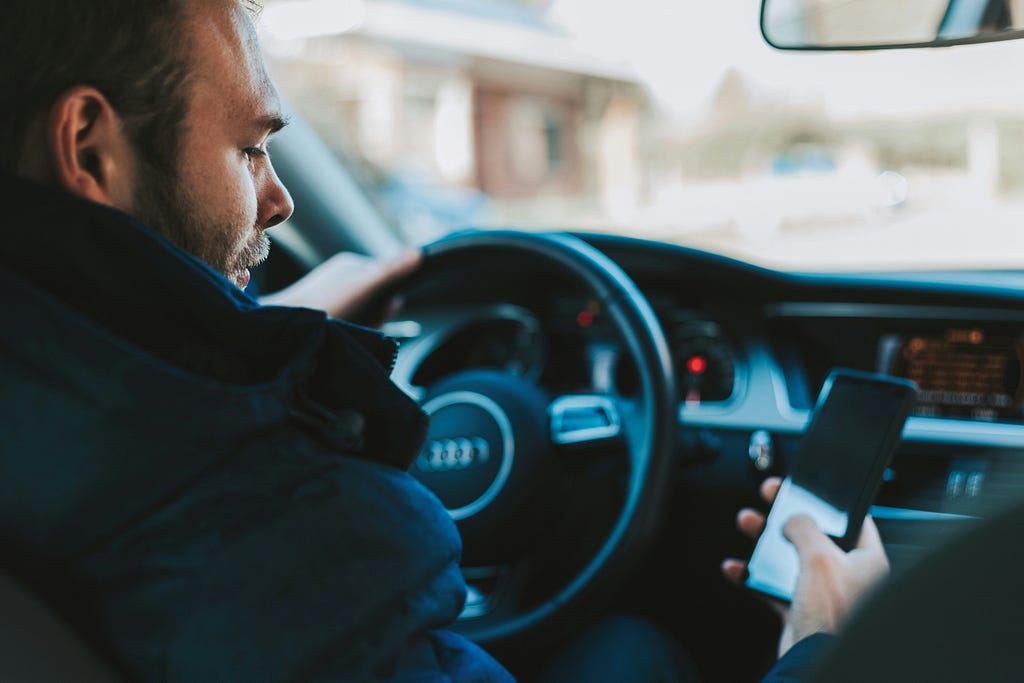
I am sure I am not the only one who has seen those videos while doomscrolling where people are driving and simultaneously using their phones. They are not just peeking at an important notification for less than a second, but fully having conversations on social platforms or even watching IG reels! In fact, this is not something I have seen only on social media, but out in the real world, too. People are using their phones while driving 4-wheelers and even 2-wheelers.
It is no hidden truth that people are addicted to these platforms. Countless studies have established this. Moments like these tingle my PM senses (I know, I recently went out to watch Spider-Man, so I could not help myself!). I started researching. The first thing I did was lay out a plan before digging into anything.
The Plan
- Identify the real problem: Often as PMs, we feel trapped by the idea that what we think is a problem is essentially nothing but our own bias. To avoid this, it is important to find real data to prove its authenticity.
- What is the scale? You must have heard this before: not all problems are worth solving. A human life is precious and immeasurable, but proactively creating a solution requires a problem that is either measurable in monetary terms or severe enough that it demands solving at any cost.
- Find available solutions: Perhaps a solution already exists. We can evaluate their pros and cons and see if there is any room for improvement.
- Devise our own solution: You do not just solve problems immediately! There are various steps to take before jumping into a solution:
- Persona identification
- Solution ideation
- Evaluation of each option
- Finding the best-fitting solution
So, let’s get to it!
Problem Identification and Scale
Finding the data was really not that difficult. I went around using various AI tools to enable my research and evaluated the backing sources. While there is no definitive global data available to support the research on accidents caused by smartphone distractions, bodies like the National Safety Council (NSC) in the US report an estimated 1.6 million crashes occurring annually due to phone usage. A journal article published in Oxford Academic suggested that drivers using their phones (handheld or hands-free) are roughly four times as likely to be involved in a crash.
There is even a scientifically backed distraction metric showing that reading or sending a text takes a driver’s eyes off the road for an average of 5 seconds. For anyone driving at 90 km/h, this means covering 120 meters without paying attention to the road!
There could be more data here, but for the interest of this article, I find this information sufficient to establish my problem statement:
“Drivers get distracted by their phones while driving. This poses a huge risk of a potential accident on the road as they lose awareness due to the phone’s distractions.”
Target Persona
Before diving into new solutions, we need to ideate our target persona:
- Name: Rohan
- Age: 35
- Goal: To avoid distractions created by his smartphone while driving.
- Frustration: Rohan gets immediately distracted the moment he hears his phone or sees a notification and tries to respond. Moreover, Rohan is addicted to watching IG reels and cannot stop himself from scrolling while stuck in traffic.
Evaluating existing solutions
Are there any solutions out there? In short, yes! There are various solutions that exist at both the device and vehicle levels. I evaluated these options, keeping in mind that a significant chunk of people ride 2-wheelers as well.
- Apple CarPlay / Android Auto — If you have a car that supports either of these, you must have seen the driving mode option on your device and your car’s smart screen. It is an optional capability that relies on the driver’s choice. If enabled, it automatically turns on the moment your phone connects to your car and stops you from using your phone thereafter. Now, it sounds like a potentially good feature, but there are some cons. To begin with, it is optional and not mandatory, which makes it totally dependent on the driver’s sensibility (and if people were sensible, they wouldn’t be using their phones in the first place!). Also, it has an easy way out: you just need to confirm a pop-up request on your phone to bypass the restriction.
- Driver Detection — Modern smartphones are really smart! They have technology that can measure a user’s position with over 94% accuracy by analyzing the car’s interior geometry using the device’s camera. Other methods, like tracking user micro-movements and turning angles when entering the vehicle, also exist. The prime example of such technology in use is Apple’s crash detection. If a severe crash happens, the iPhone’s built-in motion sensors and microphones detect it. If the user remains unresponsive, it sounds an alarm and automatically calls emergency services to the user’s coordinates after 20–30 seconds. While this is a post-incident solution rather than a proactive one, knowing the technology exists means it can be tweaked.
- DND — The old-school Do Not Disturb. Just turn on DND mode, and no notifications or calls will disturb you while driving. The con, again, is that it is totally driver-dependent.
These existing solutions have flaws, such as not being automatically enabled or being post-incident in nature.
Finding new solutions
Forced restriction on device usage while driving
The driver’s device can be restricted from usage while driving. This is more like an enhancement over the existing smartphone driving mode, making it mandatory and irreversible while the driver is operating the car. The question here is: how do we determine who is the driver and who is the passenger? This can be drawn based on the assumption that the device connected to the car is the driver’s, placing the restriction there. However, it clearly has potential loopholes and risks:
- What if the device is not connected to the car?
- What if the car does not have connected device capabilities in the first place?
- What if the phone connected to the car does not belong to the driver?
- What about a 2-wheeler rider?
Questions like these definitely put this solution under intense scrutiny.
Automatic emergency braking and driver monitoring
This one does not rely on the user, but the car itself. Modern cars come with various safety features like traction control, ABS, electronic stability control (ESC), autonomous emergency braking (AEB), and ADAS. One such feature I observed in the Chinese car manufacturer BYD is an advanced AI-based driving and sensor system that tracks the driver’s eye movement, head position, and alertness. Such capabilities can be introduced in mass-market cars to fire alarms and provide semi-assistance. Again, there are clear cons:
- Expensive tech: Such tech is possible but expensive to roll out in mass-market cars.
- Difficult to retrofit: It can be a new feature in upcoming cars but cannot be retrofitted to existing vehicles on the road.
Smart cameras on the streets/roads
For years, streets and highways across the world have used high-speed, advanced monitoring cameras operated by local police to track drivers and vehicles using AI and ML. This technology can be improved to track users on smartphones. It is not difficult to train such systems on data of drivers using phones while driving. It is also agnostic; all vehicles, including 2-wheelers, fall under this supervision. If a person is found using their phone, local police departments can issue fines. Probable and obvious cons include:
- Dependence on local laws: If a country does not have laws punishing this behavior, the solution goes straight to the trash.
- Bordering on privacy intrusion: There is common noise around the world regarding government surveillance. Tracking people could be seen as a breach of personal privacy, as it permits governments to increase surveillance in the name of protection.
Alerting authorities while driving
Smartphones can track user motion to identify if the user is potentially driving. If identified as a driver and found using the phone for a prolonged period, alerts can be sent to authorities, incurring fines. This solution is highly punitive. Cons include:
- Negative flagging: Devices are susceptible to on-device failures. Software or hardware glitches can lead to negative flagging, unnecessarily causing trouble for the user.
- Privacy intrusion: This is definitely a potential intrusion into personal privacy.
Automated alert silencing and app blocking
Using device capabilities, automated DNDs can be triggered. This silences all notifications and calls, with fail-safes for emergencies. A step further would be blocking non-essential apps, meaning everything except calling and map services. Users would not be able to open distracting apps while driving. Clear cons include:
- Incorrect imposition: Similar to the previous solution, this relies heavily on the device and can incorrectly impose restrictions, making the user’s life difficult.
- Difficulty in drawing the line: Finding the logic to determine which apps should be blocked and which should not is impeccably hard.
The Proposed Path Forward
Based on the above options, the best approach I see holds potential is a hybrid one. Modern vehicle technology that tracks driver attention can proactively warn users and take semi-control during critical lapses, preventing fatal crashes. Needless to say, this technology needs improvement and optimization to cut costs and become mass-market friendly.
Simultaneously, having a systemic check on drivers using smart infrastructure (AI cameras) acts as a strong deterrent. People will be much more mindful if they know using a phone while driving could result in a heavy fine. Plus, since the AI camera solution does not require retrofitting, it helps solve the problem for vehicles already on the road!
I am sure there are even better solutions out there or currently in development while I am writing this piece. I will be delighted to know your thoughts on it, information on the existing tech that I didn’t cover here.
The Problem of Distracted Driving — A PM Case Study was originally published in Bootcamp on Medium, where people are continuing the conversation by highlighting and responding to this story.

 点赞
点赞 收藏
收藏 点踩
点踩 分享
分享