Premium: The Hater's Guide To Circular Financing (Part One)
[NVIDIA Company Meeting, the present day, YMCA playing]
JENSEN HUANG: We love NVIDIA, don’t we folks? We’re the biggest, most-beautiful semiconductor company, we make the biggest, hottest GPUs for Clammy Sammyand Wario Amodei’s huge, beautiful AI labs, but they can’t afford them because they’re losing so much money! [crowd booing]
It’s okay! It’s okay! Big strong men, the biggest muscles, big, beautiful, strong men like Satya Nadella are calling me, begging — they’re begging, can you believe it? — they’re begging me, “Sir, Sir, please ship me Vera Rubin sir! I can’t get enough!” [crowd braying] they can’t get enough of Vera Rubin! They’re begging me to get Vera over there! Vera! Where’s Vera! [scanning crowd] get her up here! No, no, don’t do it, she’s too shy!
We love Grace too, [voice turning gravely] Grace Blackwell, what a gal! I told them all we’re going to ship a trillion dollars of Grace Blackwell and Vera Rubin by the end of 2027, our beautiful girls Grace and Vera, they’re our biggest and most-expensive girls yet, our Gee-Pee-Yous, the media says “we don’t believe you sir!” but I’m gonna make everyone buy ‘em, hell I’m gonna give ‘em the money to do it like I did with CoreWeave and then I’m gonna tell Clammy Sammy and say “Samuel, give ‘em a few billion like you gave to Michael Intrator,” and he’ll say “yes sir!”
Now, people are saying to me — “Sir! Sir! Your customers can’t afford your semiconductors! Sir, they’re too expensive!” and I say they’re not expensive enough! We’re gonna charge ‘em 17% more! [crowd braying] Should we up the price? Should we do it? We’re gonna do it!
In my mind, this is how Jensen Huang speaks to his workers, more than 70% of whom are millionaires as a result of NVIDIA’s remarkable stock growth, and from what I’m told by insiders, there’s a near-manic attention paid to stock movements as a result. I imagine working there must feel a little insane.
Assuming you arrived before the stock went parabolic in 2024, you’ve seen your RSUs explode 10x in the space of a few years, all based on the back of everybody talking about how big and huge AI is…
…all as it becomes blatantly obvious that NVIDIA’s biggest customers are, for the most part, funded by NVIDIA.
While NVIDIA still ostensibly sells things other than AI GPUs (like autonomous cars, laptop graphics cards, and simulation technology for robotics), more than 90% of its revenue comes from data center hardware. As a result, the company has become almost-entirely valued on whether or not it can continually come up with rationalizations for its largest customers to spunk tens of billions of dollars a quarter.
Why else would NVIDIA invest even an iota of effort into making an NVIDIA-branded Openclaw or build a platform for LLMs to do “agentic” things, or give $6 billion to Poolside (while investing another $1 billion) and hire away most of its staff? Why else would it plan to invest billions of dollars in Perplexity at a $30 billion valuation that lands somewhere between “fucking stupid” and “laughable”?
Sorry, I’m being a little vague. Everything NVIDIA has done for the last three years has existed to do two things:
- Create sales for its AI GPUs and associated hardware.
- Create demand for AI compute for its customers.
NVIDIA has succeeded in doing the first primarily by selling these GPUs to hyperscalers like Amazon, Google, Microsoft, Oracle, and Meta, who make up somewhere between 50% and 60% of its GPU sales depending on which analyst you ask.
The rest comes from a mixture of unnamed “sovereign AI customers” and “neoclouds” — companies that exist to raise debt, buy NVIDIA GPUs, and put them in data centers to rent to theoretical AI customers. Per Vivek Arya of Bank of America (at the BoFA Global Technology Conference in June), sales to “neocloud/sovereign/on-premise” were about the same as those to hyperscalers, and while it’s tempting to dither here and say “there could be large sovereign buildouts!” I can’t find compelling evidence that these actually exist outside of a theoretical 75 billion Euro investment in AI infrastructure in France by SoftBank, which doesn’t have that much money to spend.
In any case, NVIDIA’s entire strategy has become a case of either convincing the largest companies in the world to give Jensen Huang $100 billion a year or artificially inflating its revenues through circular financing, which is obviously what I’m talking about today.
This is the first part of my Hater’s Guide To Circular Financing, a comprehensive analysis of the current state of NVIDIA’s massive circular financing operation, why it has yet to break, its limitations, and the material concerns that were raised in its latest quarterly earnings.
The second part, coming next week, will cover the history of circular financing, where we’ve seen it before, and what we can learn from its horrible past.
What Is Circular Financing?
It’s pretty simple: circular financing is the process of a company investing in another company with the explicit understanding that some (or all) of that money will be spent with the company investing it.
What differentiates it from vendor financing is that it isn’t actually offering up its balance sheet or offering any credit. Instead, NVIDIA invests capital directly and becomes a paying customer, which in turn allows its investment to turn to a bank and say “hey, I’ve got a customer, lend me money based on its existence!”
The bank in question says “wow, looks like you have money coming in, and it’s from a company with high-grade, investment-quality credit! It doesn’t matter that the company in question is literally also a supplier and investor, because banks are stupid, the money is technically real, and we don’t have financial regulations.
The OG-Circular Financing company is CoreWeave, a former Bitcoin miner that was able to convert its crypto-mining business into an AI GPU rental business, with NVIDIA both investing and signing a $1.3 billion, four-year-long contract to rent back its own GPUs, which in turn allowed it to raise $2.3 billion in debt from Magnetar and Blackstone, both of whom had also invested, in a way that is absolutely legal somehow.
When CoreWeave prepared to go public, , with CEO Michael Intrator adding that said IPO “wouldn’t have closed” without its support. When CoreWeave struggled to sign a lease, NVIDIA agreed to backstop it. When CoreWeave faced financial trouble, NVIDIA invested another $2 billion. NVIDIA has invested in both Anthropic and OpenAI, both of whom are set to spend billions of dollars renting NVIDIA GPUs from CoreWeave. And when things got really tough, NVIDIA expanded its deal to rent back its own chips to over $6 billion.
NVIDIA has done the same for multiple other neoclouds, both investing in and signing a $1.5 billion contract to rent back its GPUs from Lambda, $2 billion in Nebius, $2.1 billion in IREN, an unknown sum in Nscale, and agreeing to spend $4.9 billion to rent GPUs from Sharon AI, an Australian data center company with a whopping $1.9 million in quarterly revenue.
Now, you’ve maybe heard that NVIDIA is one of the single-most profitable companies in the world — the largest on the US stock market, in fact — and may have some confusion about why it’s having to dabble in such blatant circular financing shenanigans.
It’s actually pretty simple: NVIDIA’s GPUs (and the data center infrastructure around them) are now so expensive that any customer that wants to buy them has to have billions of dollars, which in turn means said customer needs to be able to raise billions of dollars of debt. While A100 GPUs cost $10,000 and H100s around $35,000 a GPU at launch, B200s started at around $64,000 a piece, with a GB200 rack (36 CPUs and 72 GPUs) coming in at around $3.5 million, and because AI is so big and so huge, you need to buy thousands of them for a gigawatt data center.
Initially, this wasn’t too bad, because hyperscalers have (at least before the AI bubble) been cash-rich, asset light businesses with the best credit in the world, allowing them to sink free cash flow (and over $244 billion in debt so far in 2026) into capex.
This profligate spending, combined with NVIDIA’s powerful circular financing rituals, have been working like a charm to keep revenues exploding. It handily beat-and-raised every single quarter as hyperscalers were rewarded with bumps in their stock prices every time they promised to give Jensen Huang money.
The problem is that NVIDIA has to keep beating and raising, every single quarter, even though it just made over $96 billion in Q2 FY2027, growing 106% year-over-year, which I must be clear is absolutely bonkers and near-entirely dependent on hyperscalers and neoclouds still being able to afford its stuff.
Put another way, NVIDIA isn’t really “selling stuff to the market” so much as it’s “selling stuff to the few companies that can actually afford to buy its stuff.”
And this is about to become even more difficult thanks to a combination of sheer greed and the exploding cost of memory, with analysts expecting Vera Rubin racks to go for over $7.8 million a piece, and said estimates were before NVIDIA’s 17% price increase for both Blackwell and Vera Rubin, with all of this happening as the price of data center debt increases even for well-funded asset managers like Blackstone.
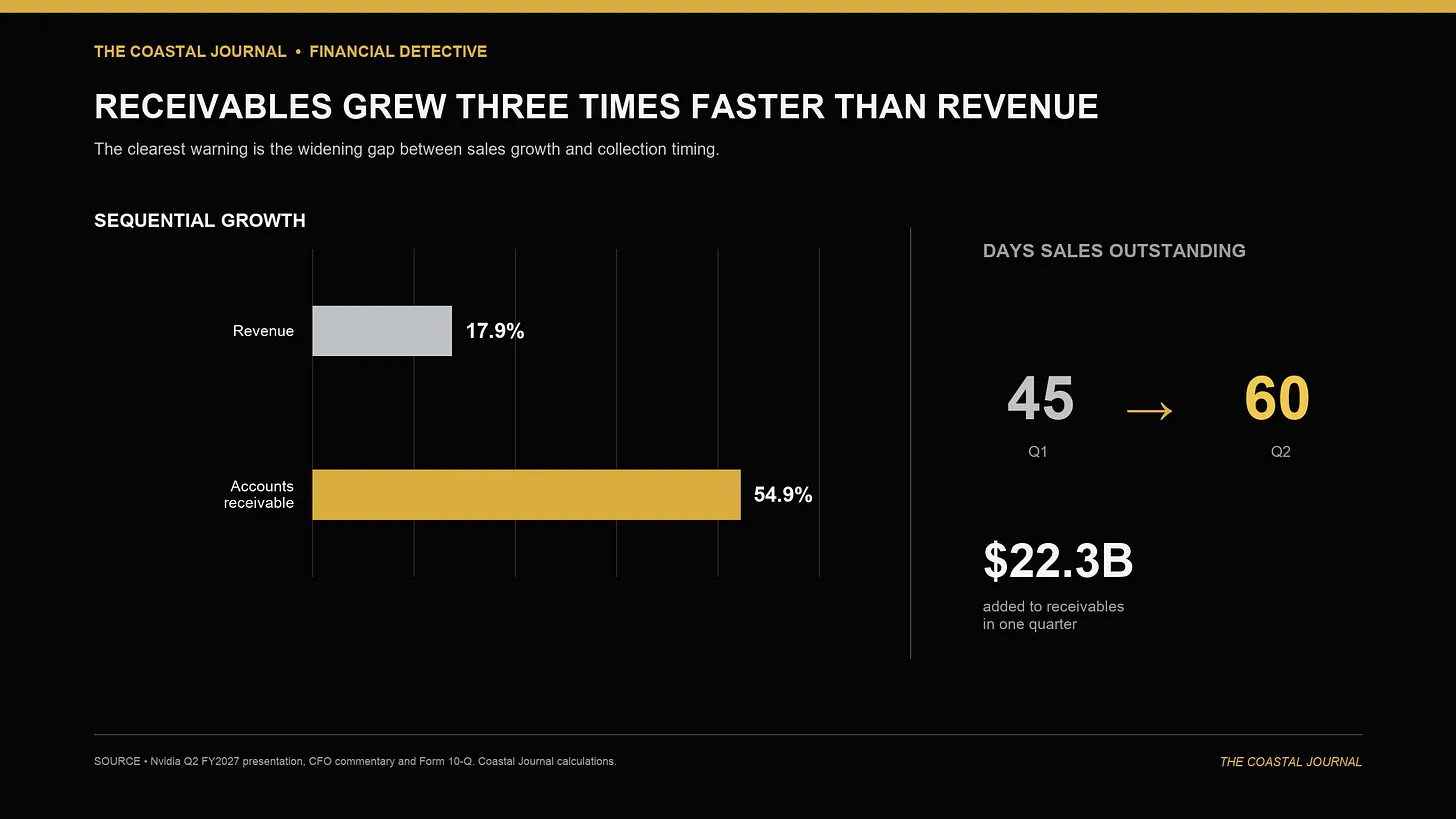
As a result, NVIDIA’s actual customer base — despite its astounding revenues — is contracting. Per NVIDIA’s Q2 FY2027 earnings, 70% of its accounts receivables came from five companies, and 44% came from three companies, up from (in the case of receivables) 64% attributable to three customers and 56% attributable to three customers in the two preceding quarters. Its days sales outstanding — a measurement of how many days it’s taking for customers to pay it — blew up from 45.4 days in Q1 FY27 to 59.6 days in Q2 FY27.
Why? Well…
That’s right, NVIDIA is now allowing some customers to pay either three months or an entire year after receiving equipment, allowing NVIDIA to book the sale, ship the chips and boost its revenue months before receiving any money.
You’re probably reading that and saying “well, Ed, don’t be unreasonable, it said investment-grade customer purchases,” and I really want to be clear that “investment-grade” includes both CoreWeave’s $8.5 billion GPU-backed loan and IREN’s $3.65 billion GPU financing from earlier in the year, despite both of these companies running at a massive loss and requiring NVIDIA to ply them with debt.
In other words, NVIDIA could easily be extending these ridiculous terms to the companies most-likely to skip out on their debts.
Why Isn’t The Market Scared Of Circular Financing? (And Why NVIDIA Has A Giant Mountain To Climb)
Simple! Through the cold, calculating lens of an investor, NVIDIA is yet to actually face any trouble.
While all of this feels very greasy and unstable, it’s yet to actually collapse. As I’ll get into later, there’s nothing illegal about circular financing, nor is there anything illegal about investing in your clients with the explicit understanding they’ll buy your stuff, as long as there’s no literal contingency that they’ll do so.
NVIDIA is also helped out by two distinct parts of its customer concentration:
- Its largest customers include Meta, Amazon, Google, and Microsoft, none of whom are going bankrupt as a result of the AI bubble bursting.
- It never actually names in its filings who its customers are, which means that any booster needing to defend its circular financing can just say “it’s probably one of the big ones who will be totally fine at the end of this!”
In other words, as long as the good times roll, everybody’s happy. The world of finance is incapable of thinking further than two quarters into the future. While it may say “2028,” everything about 2028 is framed in the terms of what’s either just happened or is about to happen. While CoreWeave might be horrendously unprofitable, bleeding cash and constantly raising billions of dollars at ever-increasing rates, it is yet to show signs of insolvency.
Sure, its customers are either Microsoft (for OpenAI), Google (for OpenAI), OpenAI (for OpenAI), Anthropic and Meta, but these companies are yet to stop paying it, so there’s no need for any concern, as nothing bad has actually happened. CoreWeave is yet to miss a payment, so as far as most analysts and journalists are concerned, quite literally nothing is wrong with CoreWeave in any way, shape or form.
You may think this is actively irresponsible, and you’re completely correct!
But remember that journalists and financial analysts are also hocking their words to people thinking about the world from the same two-quarters-ahead perspective, which means anyone who shorted CoreWeave at IPO likely lost their shirt if they assumed it would immediately die.
Basically, modern journalism and financial analysis is entirely dictated by the reality of the stock market. A company is “doing well” if its revenue continues to grow (even if it’s losing money!) and its stock price is going up. A company is “doing poorly” if it’s profitable but it isn’t growing as fast or its stock has gone down.
It’s a childlike way of viewing the world that mostly comes from a place of cowardice. If you base everything based on whether one or two numbers go up or down, you don’t really ever have to come to an opinion so much as following the consensus. You don’t need to say CoreWeave is good or bad or actually learn very much about it, you just have to say “well everybody’s worried” or “everybody’s excited” in whatever tone suits your audience.
Similarly, if you’re bullish, basically any number can look good. Revenue bad but stock up? The market loves this stock because of [white noise]. Revenue good but stock bad? The market is missing the opportunity of a lifetime. You don’t really ever have to have any independent thoughts if you’re trying to be positive or pro-industry, and with the right combination of numbers, you barely have to think at all.
This, of course, puts investors at a deep disadvantage, unable to prepare themselves for actual harmful events. When the news is framed entirely based on whether different numbers have gone up and whether a CEO or CFO has said something that moves another number, you don’t really investigate what’s happening so much as you interpret easily-manipulated numbers in a way that usually benefits the person manipulating them.
NVIDIA is a great example. On its Q2 FY27 earnings call, CFO Colette Kress said that NVIDIA would increase revenues by 70% in FY28, which works out to around (based on analyst consensus for FY27 of $396.5 billion) $674 billion in annual revenue.
Now, 2,400 words into this piece, you’re probably seeing the problem: NVIDIA has to increase revenues by 70% that are already mostly-dependent on a small group of big ticket customers spending tens of billions of dollars, at a time when debt is becoming either or both harder and more-expensive to raise, all as data center construction drags on as communities and states turn against those building them.
But because NVIDIA’s revenue is continuing to grow and guidance along with it, everything is fine, and if you went on Twitter just after NVIDIA’s earnings call, you’ll notice how quickly sentiment shifted from “worried” to “confident” based entirely on the after-hours sell-off from initial results and the stock ripping after Kress’ comments.
The truth is, NVIDIA can coast by as long as these very large customers continue to feed it money, which in some cases involves NVIDIA helping find the money to feed itself. For example, it invested $2 billion in a data center SPV for a SpaceX data center (along with $5.5 billion in other equity investments), which allowed the SPV to raise another $12.5 billion in debt because, much like its “they’ve got a contract!” deal with CoreWeave, the money is real, so the deal clears.
From the dullard/thought-hater’s perspective, everything looks fine, because all the money is real.
The problem is that NVIDIA has had to dip so deeply into the art of circular financing to get this year’s revenue done, and will have to do all this and more next year.
NVIDIA Is Inventing New Kinds Of Circular Financing Every Single Day
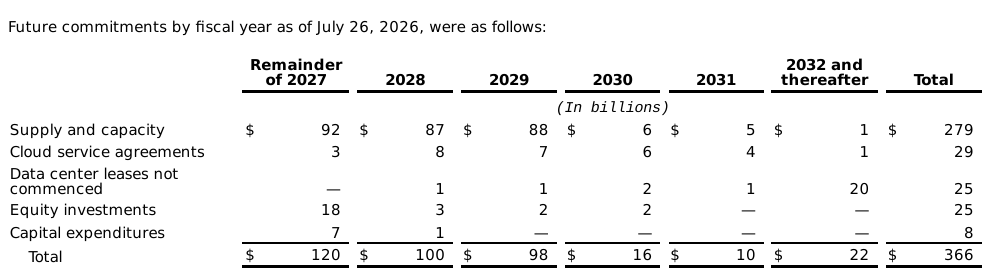
Buried in NVIDIA’s latest 10-Q is an interesting new table:

Sure, sure, $366 billion in commitments is bad, really bad actually, but what really interests me are those $25 billion worth of data center leases that have not yet commenced.
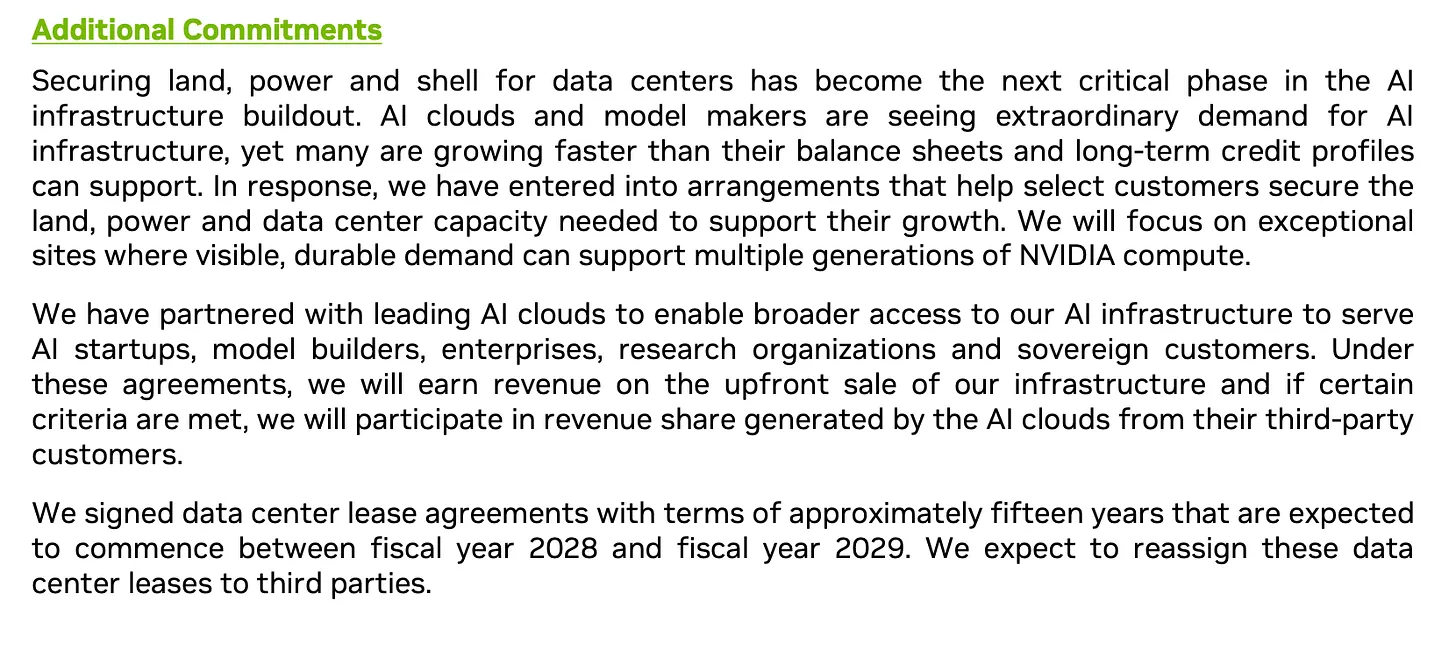
Jensen, NVIDIA sells the GPUs, why is NVIDIA leasing data centers?
So, no big deal, but in five year’s time NVIDIA has $20 billion of data center leases starting. No, really, no big deal folks! It’s fine! NVIDIA prints money…
…today. By 2032, the AI bubble will have burst, and NVIDIA will have much less revenue. But because it’s the year 2027, and nobody can think too far into the future unless it’s to say “number so big,” that’s where we are.
Anyway, that’s not even the weirdest part, as NVIDIA has, per CFO Colette Kress in its latest earnings call, creating a brand new vendor financing arrangement that really should worry people:
NeoClouds are seeing strong demand pipelines for many diverse offtakers. Rather than allocating their entire capacity to a single long-term offtake guarantee that lenders typically require to finance a data center independently, we have introduced a revenue-sharing structure. NVIDIA provides a take or pay commitment on a portion of the facility’s capacity, a minimum revenue guarantee that gives lenders the confidence to underwrite the project, and in exchange, we share in a portion of the Neocloud’s revenue earned above that floor. Independent capital still underwrites every deal on its own merits. We’re not making loans.
This is a lot of financial gobbledygook that mostly translates to “NVIDIA agrees to be a customer of a data center for a certain amount of capacity, and if the neocloud makes more than that deal, NVIDIA gets paid extra.” The reason Kress is saying “we’re not making loans” is because people are fucking stupid and are only scared of vendor financing — when a vendor lends money to someone to buy their stuff, which is different to when NVIDIA agrees to pay to rent back its stuff, which is not a loan but an agreement to give somebody money for a service, which is materially different for accounting purposes.
Anyway, Kress also added one other weird comment:
In this model, we get paid twice, once on the hardware sale and again through the share of rental revenue, a highly reoccurring stream layered on top of a one-time equipment purchase.
You mean it’s like the money moves in some sort of shape, Colette? A circle perhaps?
This, again, does not worry anyone, even though it’s the most blatantly circular scheme yet — NVIDIA agrees to rent back its chips, which helps somebody raise money to buy its chips, then that company pays a revenue share from renting those chips back to NVIDIA, and this relationship is also used to justify buying more chips.
Great! I sure hope this can last forever.
NVIDIA’s Ambitions Are Greater Than The Money That’s Actually Available, And The End of Its Revenue Share Deals Is A Warning Sign
So, NVIDIA’s latest bullshit came in the form of the announcement of its “$500 billion AI infrastructure fund,” which many journalists I refuse to link to immediately spent hours trying to rationalize and explain “how it might work,” when the answer was sitting in front of them: it doesn’t fucking exist!
Goldman Sachs Group Inc., Blackstone Inc. and Apollo Global Management Inc. had been working tirelessly for months to draw up debt deals that would help developers of artificial intelligence systems pay for chips from Nvidia Corp.
With slow progress on the complex deals, Nvidia’s chief executive officer, Jensen Huang, decided to change tack: He went public this week with the effort, saying the group is aiming to collectively finance AI computing deals totaling $500 billion — a round figure with no obvious provenance.
I’m honestly not sure how this isn’t some sort of securities fraud. NVIDIA doesn’t have a “fund” of any kind. It doesn’t exist. There is no fund. Yes, yes, I know there’s tons of articles talking about how NVIDIA might “backstop up to 25% of projects,” but there is no fund, and thus NVIDIA isn’t backstopping anything.
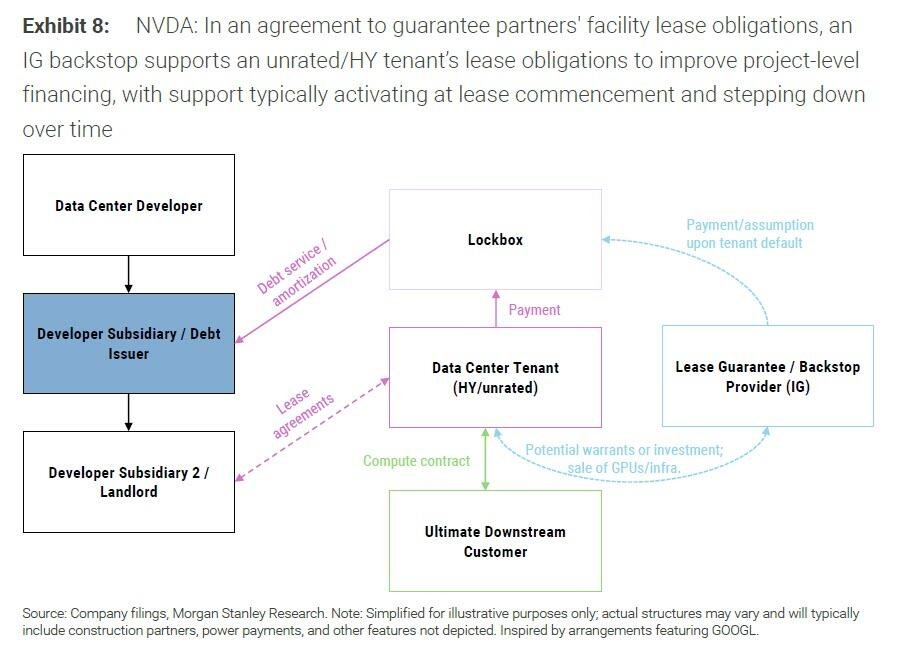
Any and all deals related to this “fund” will be the standard data center financing deals that have been happening again and again — and while I don’t love linking to Zerohedge, the account actually found a pretty good diagram of how one of the backstopped deal looks:

I’m gonna be honest, I finished that sentence, walked out the door, and came back to find this article from the Wall Street Journal to find that NVIDIA was now walking back these “get paid twice” deals:
Nvidia paused some deals in a new financing initiative that offered credit support to artificial-intelligence cloud providers in exchange for a share of revenue, according to people familiar with the matter.
Some Nvidia employees expressed concern to current and potential customers that the program could draw antitrust scrutiny, and said there are sensitivities around the extent to which the chip giant can dictate how their customers do business, the people said.
That’s weird. How would NVIDIA “dictate how its customers did business,” exactly?
In the first few weeks of the program, Nvidia rankled some of its potential partners with the extent of control it sought, some of the people familiar with the matter said.
Nvidia told some providers that they could rent the chips only to approved customers. Nvidia also indicated that it preferred the capacity to be distributed among several smaller AI companies rather than leased to a single large customer, the people said. Some cloud providers resisted, arguing that they should be free to select their own customers.
Yeah, I mean, they absolutely should, but why was Mr. Huang demanding exclusivity?
Nvidia disclosed the scale of the program for the first time in its quarterly filing this week. The company said it had made $36 billion of commitments under agreements that typically lasted six years, but noted that as cloud providers sold capacity to other customers, that commitment would decrease.
Under the proposed deals, Nvidia and each cloud provider would establish a base hourly rate for the GPUs intended to cover the provider’s costs, including the depreciation of the Nvidia chips, data-center expenses, and staffing, according to people familiar with the deals. Nvidia would receive 50% of any revenue cloud providers earned above that threshold on the GPUs, those people said.
So, this is me guessing here, but I think that NVIDIA was attempting to do an outright roundtripping scenario, in which it would say “yeah, I’m going to handle the financing of your data center, I’m going to use the debt raised for it to buy my GPUs, and then you’re going to have to rent them at an inflated price that gives NVIDIA a little extra cut to one of its portfolio companies it’s promised compute, such as when NVIDIA invested in Safe Superintelligence promising it “access to the next-generation, best-in-class NVIDIA Vera Rubin platform.”
This is all guesswork, of course, but the fact that NVIDIA has had to pull back on this deal (albeit while lying through its teeth about its continued existence) is a sign that it’s aware that there’s a lot more scrutiny of how it makes money than it anticipated.
It also means that there’re limits to its circular financing operations, even if those limits come from a fear of government reprisal rather than any kind of moral or ethical qualms.
And, to be clear, NVIDIA needs so many more of them to get things done. It needs so much money.
God damn does NVIDIA need so much money!
What Other Circular Financing Options Does NVIDIA Have Left?
So, while NVIDIA basically prints cash, it’s been machine-gunning it into various investments quarter-over-quarter, with $65.99 billion sunk into investing activities in the last nine months, and that’s before the money it’s putting into Poolside, the acquisition of Huggingface or its theoretical investment in Perplexity, which (assuming it puts $2 billion into Perplexity) works out to another $22 billion.
Another problem is NVIDIA’s cash and near-cash balance, which sat at $22.4 billion for the quarter, except that was boosted by its $25 billion bond sale, which isn’t to say that NVIDIA is in the poor house (its cash and marketable securities balance sat at $99.4 billion), but that its actual available liquidity is now materially challenged by its investments to the point it needed to raise debt.
All of this is to say that NVIDIA can afford more circular financing, its current pace is not one it can hold indefinitely, both because of the financials and the (now-present) specter of antitrust, which makes it much harder for it to do things like outright acquire a failing AI lab (see: SSI, Thinking Machines) or AI startup (like Perplexity).
The other problem is that NVIDIA absolutely loves signing circular deals but has never actually had to pay for one. While it technically has a $6.3 billion deal to buy back any unused compute from CoreWeave, said deal hasn’t kicked in yet because, well, the compute is mostly being used by OpenAI. Its $4.9 billion deal with Sharon AI, revenue share deal with Firmus, and deal to rent compute from Lambda are all for capacity that has yet to be completed, which means that NVIDIA is deep in the reaping stage with sowing dependent on the years-long process of data center construction that has yet to begin actually finishing…and I’d bet money that the transaction to buy the GPUs has already happened.
While NVIDIA can (in theory) afford to pay for this capacity, one has to wonder what happens if it’s never actually built. Neither Firmus nor Sharon have ever built a data center (Sharon leases three facilities in Australia, all operated by third-parties like Equinix and NEXTDC, whereas Firmus has one facility under construction with a further two planned), and any delays or issues with raising funding would cause further problems.
Sidenote: I’ve heard rumours that NVIDIA’s investment in Firmus was bordering on a bailout, with the company facing the potential of insolvency without the incoming funds, much like how Poolside failed to raise a $2 billion round before NVIDIA’s deal.
It should be a real material concern to NVIDIA investors that its capital keeps being invested in companies that are seemingly unattractive to other lenders or investors.
The other problem NVIDIA has is that it can’t really be the lender of last resort for compute, as doing so will trigger even the most torpor’d boosters’ spidey-sense.
As a result, it’s heavily-dependent on both Anthropic and OpenAI to keep buying compute from its various neoclouds. For example, IREN just signed a “multi-year AI cloud contract with a leading frontier AI lab,” which allowed it to raise $2.8 billion in GPU financing from private credit funds Blue Owl and Pacific Investment using the client prepayment as collateral.
This makes me believe that NVIDIA is reaching the end of its circular financing runway, at least through these “give money to every neocloud” deals, which leaves it with very few direct ways to feed money to itself.
If I had to guess, this will mean that NVIDIA moves into more third-party circular financing — feeding money to the customers of its customers so that its customers keep buying GPUs.
Here’re some ways it could do so:
- If OpenAI can’t make it to a public offering (despite whatever NVIDIA has said about that), NVIDIA is an obvious choice to feed it at least another $10 billion.
- Its investments in Safe Superintelligence and Thinking Machines are likely an attempt to create new customers for hyperscalers or its various neocloud counterparties, which means that it’s likely that they’ll receive further capital, if only to spend it at very specific places for very specific reasons.
- NVIDIA holds a $21 billion stake in SpaceX, and while its supposed plans to build 10GW of capacity seem a little fucking stupid, it’s likely that NVIDIA could do at least one more version of its Valor Equity Partners deal that was used to fund Colossus 2.
- The limitations here are based on whether private credit is able to help NVIDIA raise that money. That’s an open question.
- I’m not ruling out the possibility that Anthropic and NVIDIA do a similar deal to build out capacity in the future.
- Neocloud Lambda is eyeing a $3 billion round before a potential IPO. In the event that it actually goes public, NVIDIA is likely to repeat the same formula as CoreWeave, anchoring the IPO, raising the ceiling on its backstop deal, and making sure that it keeps buying AI servers from Super Micro.
- While the $500 billion deal is bullshit, I wouldn’t be surprised if NVIDIA was able to convince the various asset management firms to do a smaller version that existed as a kind of “pool” of AI compute that its investments like SSI (or even OpenAI) could use, but this again would require it to actually build the data centers.
Ultimately, the problem NVIDIA has is that there’re only so many neoclouds one can invest in, and there’re only so many plots of land in which you can put data centers. At the beginning of the operation, this all kind of rules, because NVIDIA can sell (or pre-sell) billions in GPUs without anyone ever building anything.
Much like the rest of the AI bubble, NVIDIA just needs to show some vacuous level of promise rather than ever actually build anything, as long as the GPUs can be ordered, and the checks actually clear.
That last part is where I think we’ll see the first problems.
Where The Cracks Form In Circular Financing
:
In a consumer transaction, payment and delivery usually happen together. Corporate suppliers commonly deliver equipment on credit and collect later. Under accrual accounting, Nvidia recognizes product revenue when control transfers and it expects to collect the consideration—not when the cash arrives.
That is standard accounting. Nvidia’s revenue-recognition policy says product sales are recorded upon transfer of control, while payment under normal terms is generally due shortly after delivery. Once those requirements are satisfied, Nvidia cannot simply postpone recognition to another quarter.

This is the accounts receivable problem I brought up earlier, but TCJ brings up another fascinating point — that CFO Colette Kress admitted that the time between shipping stuff and receiving payment was widening because its customers couldn’t afford to buy it:
Nvidia nevertheless acknowledges the ecosystem’s financial pressure. Its CFO commentary says many AI clouds and model makers are growing faster than their balance sheets and long-term credit profiles can support. Nvidia is therefore helping selected customers obtain land, power, financing, and Data Center capacity

To quote TCJ again, emphases theirs:
That gets us to the real issue. Before delivering GPUs, Nvidia could require faster payment, demand more cash upfront, reduce the order, or allow the transaction to occur later. Instead, it used its balance sheet to help customers take delivery now and pay later.
Delivery can create revenue today even when the cash will not arrive for months or if ever. Under stricter terms, some customers might still buy the same GPUs, but deployment and revenue could move into later quarters.
This creates a legitimate earnings-quality question:
> How much current growth depends on customers receiving more time, outside financing, supplier support, or guarantees to complete purchases they could not fund under ordinary terms today?
The disclosures show that Nvidia chose to extend more credit, allowing reported revenue to advance faster than cash collection.
As mentioned earlier, “investment-grade” could mean everyone from Microsoft to CoreWeave to SpaceX, and based on the extended payment terms, I’m gonna guess it’s one the ones with the shittier credit. The fact that NVIDIA’s continued revenue growth appears predicated on its ability to extend payment terms, and it’s very likely that those were extended toward a debt-dependent entity like CoreWeave or SpaceX.
To be clear, these statements about longer payment terms likely don’t refer to the current period, but are a warning for the future. If NVIDIA feels the need to extend year-long terms, this likely means that it expects one of the above companies to have to receive GPUs (or, at least, order them) without the commensurate debt actually arriving.
Don’t get me wrong, I think there’s plenty of money around to do more deals at the current scale, but to hit that ridiculous $674 billion annual revenue target, NVIDIA is going to need even bigger deals than that.
If I had to guess, SpaceX is going to announce some sort of $20 billion data center project sometime soon, along with some sort of CoreWeave (or other neocloud) deal that involves it building gigawatts (plural) of capacity with a “hyperscale” or “leading AI lab” that ends up either being for SpaceX or an AI lab like OpenAI, Anthropic, SSI or Thinking Machines.
“Leading” is entirely in the eye of the beholder. Or NVIDIA. You choose which.
The point I’m making is that there’s an eventual ceiling on the vendor financing train, and we’re likely about to hit it. While hyperscalers can afford, to some extent, to spend tens of billions of dollars every single quarter on NVIDIA’s GPUs, basically everybody else is dependent on private credit or the lowest tiers of the bond markets to go any further, and any deals above, say, $2.8 billion require a counterparty contract, like when CoreWeave raised $8.5 billion backed by its $21 billion contract from Meta.
Those deals are likely to become harder to secure thanks to the increasing scrutiny around the more than $3 trillion of off-balance sheet hyperscale compute contracts for data centers yet to enter service. While Microsoft, Google, Amazon and Meta definitely want to buy more GPUs, there comes a point at which we all have to recognize that CoreWeave et. al are yet to actually fucking build the capacity, which makes it a lot less necessary for hyperscalers to keep slinging them cash.
While the various AI labs could still sign theoretical contracts with whatever neoclouds NVIDIA is currently keeping alive, even they have limits of available cash and, of course, limited counterparty value because they’re so deeply unprofitable.
I think we’re at or about to hit the limits of these neocloud-hyperscaler deals, and that it’ll be difficult to raise enough money through them to do significant amounts of revenue for NVIDIA, or at least significant-enough to move the needle toward that 70% year-over-year bump.
If you see SpaceX sign a deal with any of NVIDIA’s chosen neoclouds, assume it’ll A) be huge and B) be an act of sheer desperation.
Circular Financing Only Makes Sense If You Ignore Your Gut
So, I want to be clear that despite all the greasiness, all of this money is currently real and legal, and that isn’t the problem.
The problem is that NVIDIA has only been able to grow this big by delving into the darkest arts of financial engineering, moving around cash and strong-arming counterparties into signing deals with each other in a way that you only do if you’re aware that there’s no natural way to keep up.
And that’s before it’s really had to perform! While it made $215.9 billion in revenue in Fiscal Year 2026 and $177.84 billion so far in Fiscal Year 2027, it has to make another $200 billion or more in the next six months, then another $674 billion in the four quarters that follow.
Even if hyperscalers double their spend — which will also require Oracle raising more debt at a time when both the funds and the hardware are becoming more expensive — the current scale of circular financing is insufficient to get the job done. NVIDIA will have to find multiple other companies to co-opt (or create) to buy tens of billions of dollars a year in GPUs, without fail, to make those numbers happen, on top of SpaceX having to find tens of billions of dollars, along with SB Energy, and along with the private credit funds cobbling together whatever miserable deals they can…at a much larger scale than today, where they’re already making (to quote Bloomberg) “slow progress.”
To put it more colloquially, a company with real demand, real customers, a stable customer base to grow from and real growth potential wouldn’t have to constantly engage in extremely weird shit all the time. It really is that simple. Journalists and analysts will try to convince you that you should actually think this is all perfectly normal because the money is real, but it’s actually all really weird and a sign that something bad is happening.
The longer it goes on, the worse the outcome will be, the more private credit (and by extension insurance and pension) money that will be at stake, and the more gullible retail investors will be left holding the bag at the end.
Thank You For Reading — and What To Expect In Part 2
This piece was originally meant to be focused on the history of circular financing, but the slew of NVIDIA news combined with its earnings made it important to focus exclusively on entering The Jensenverse.
Next week, I’m going to dig a little into the history of circular financing, along with the only other companies daring enough to rival NVIDIA — Broadcom and Google.
Thank you so much for subscribing to the premium newsletter. It’s my main source of income now, and if you ever wanna chat, email me at ez@betteroffline.com, signal me at ezitron.76, or hit me up on IB on the Terminal.