The Hidden Cost of AI Agent Sprawl: How Organizational Silos Are Draining Enterprise AI Budgets

Artificial intelligence is receiving unprecedented investment across the enterprise. Large organizations are assembling AI teams, hiring developers, partnering with consulting firms, purchasing platforms, experimenting with large language models, and developing AI agents designed to automate increasingly complex areas of work.
Yet having the budget to build AI does not necessarily mean an organization is building AI efficiently. In fact, one of the largest sources of AI waste may have very little to do with the technology itself. It may simply be that departments are not talking to one another.
The Same Company. The Same Problem. Multiple AI Agents.
Consider a large enterprise with thousands of employees and dozens of departments. Customer service identifies an opportunity and begins developing an AI agent that retrieves information, summarizes records, and recommends next steps. Somewhere else in the organization, operations begins developing an agent with remarkably similar capabilities. Human resources creates an internal knowledge agent. Finance develops an agent that retrieves documents, analyzes information, and generates reports. Sales commissions another agent capable of summarizing customer information and generating recommendations.
Each initiative may have a legitimate business case. Each may have its own budget, product owner, development team, vendor, roadmap, and executive sponsor. From inside each department, these investments make perfect sense. From an enterprise perspective, however, something very different may be happening.
The company could be paying multiple teams to solve variations of the same problem.
This is becoming a legitimate enterprise concern. McKinsey has cautioned that when GenAI development becomes disconnected from the broader organization, companies risk duplicating efforts and building disconnected components. Its guidance specifically recommends clearly defined capability maps, shared ownership, reusable components, and enterprise visibility so that teams do not unknowingly develop similar GenAI tools.
That is where AI innovation can quietly become AI inefficiency.
Big Budgets Can Hide Organizational Problems
Organizations with large technology budgets have obvious advantages in AI. They can hire more engineers. They can purchase sophisticated platforms. They can engage consulting partners. They can experiment quickly and fund multiple initiatives simultaneously. But money does not automatically create coordination. In fact, large departmental budgets can make duplication easier.
When individual business units have enough resources to independently solve their own problems, the immediate response can become:
“Let’s build it.”
The question that may not get asked is:
“Has someone else in the company already built this?”
That is a surprisingly expensive question to forget.
When two departments independently build similar capabilities, the company does not simply pay twice for development. It may duplicate product management, UX research and design, engineering, cloud infrastructure, model and API usage, data integrations, security reviews, accessibility testing, licensing, compliance, governance, and implementation. Then the agents enter production.
Now the company may also be paying twice for monitoring, maintenance, enhancements, support, security, model changes, and lifecycle management. The organization inherits the duplication.
Welcome to AI Agent Sprawl. Enterprise technology has experienced this pattern before.
· Application sprawl.
· SaaS sprawl.
· Cloud sprawl.
AI is now creating another version: Agent Sprawl.
This is no longer theoretical. Gartner predicts that by 2028, the average global Fortune 500 enterprise will have more than 150,000 AI agents in use, compared with fewer than 15 in 2025. Gartner warns that this explosion could create significant agent sprawl, IT complexity, and management challenges.
Perhaps even more revealing, Gartner reported that only 13% of organizations believe they have the right AI-agent governance in place. The danger is not simply having too many agents.
A global enterprise may legitimately need hundreds or eventually thousands of specialized agents. The problem begins when the organization cannot clearly see what those agents do.
· One department calls its solution a Knowledge Assistant.
· Another has an Employee Copilot.
· Another develops a Research Agent.
· Another launches an Intelligent Search Assistant.
· Different names.
· Different budgets.
· Different teams.
· Different interfaces.
Yet underneath those experiences, several agents may be retrieving information from similar systems, summarizing similar documents, using similar models, or performing overlapping workflows. That is a communication problem with an AI price tag.
The Visibility Problem
IBM reported in 2026 that only 18% of enterprises maintain a complete AI inventory. That statistic should concern more than cybersecurity and compliance teams. It should concern CFOs, CIOs, CTOs, product executives, enterprise architects, and anyone responsible for AI investment.
Because if an organization cannot confidently answer what AI capabilities it already owns, how can it confidently determine what it should fund next? And this is where individual project success can become misleading. A team can deliver on time. The technology can work. The agent can achieve its intended objective. The business unit can call the project successful.
But if another department has already developed 70% of the same underlying capabilities, the enterprise may still have made an inefficient investment. Local success does not automatically equal enterprise success.
The Cost Goes Beyond Technology
Duplicated development is only part of the problem. Agent sprawl can also fragment the user experience. Imagine an employee who needs one AI assistant for HR information, another for corporate policies, another for project documentation, another for analytics, and another for operational support. From the organization’s perspective, these may represent five successful AI initiatives.
From the employee’s perspective, the question becomes:
“Which agent am I supposed to use?”
Organizations can invest heavily in AI to reduce friction while inadvertently creating another layer of cognitive friction for the people expected to use it. The same fragmentation can occur underneath the experience.
Multiple agents may independently connect to the same enterprise systems. Multiple teams may create retrieval pipelines against similar knowledge bases. Different development groups may independently solve authentication, permissions, auditing, security, and governance.
The organization is no longer maintaining several interfaces. It may be maintaining several versions of the infrastructure behind them. That is where the budget impact compounds.
The Answer Is Not One Giant AI Agent
Solving agent sprawl does not mean eliminating specialized agents or forcing every department onto one enormous enterprise AI system. Different functions have different users, workflows, terminology, permissions, regulations, risks, and objectives.
A finance agent should understand finance. An HR agent requires different permissions than a customer-facing service agent. A healthcare agent may require specialized safeguards that a marketing agent does not.
Specialization is valuable. Unnecessary duplication is not.
The better approach is to determine which capabilities truly need to remain specialized and which can become reusable enterprise services.
· Identity and access management.
· Enterprise search.
· Knowledge retrieval.
· Document understanding.
· Analytics.
· Workflow orchestration.
· Security and compliance.
These are examples of capabilities that multiple specialized agents may potentially consume rather than every department rebuilding them independently. McKinsey has advocated this type of component-based approach to GenAI, where organizations identify reusable components and provide common infrastructure while allowing domain teams to develop solutions around their particular business needs.
This creates a fundamentally different enterprise AI ecosystem. Instead of every department building vertically from the ground up, specialized departmental agents can sit above shared horizontal capabilities.
The Solution: Build the Enterprise AI Blueprint.
To make that possible, organizations need more than another governance committee. Someone needs to see across the organization.
One solution is a well-versed AI Digital Project Manager or AI Program Manager, supported by departmental AI project and program managers, whose responsibility is to connect AI initiatives across business units. This leader does not need to own every agent. They need to own the blueprint connecting them.
Imagine a living Enterprise AI Blueprint representing the organization’s entire agent ecosystem. At the highest level sits the enterprise. Below it are Human Resources, Finance, Marketing, Operations, Customer Service, Sales, Legal, Technology, and other business functions.
Under those departments sit the agents that are:
Proposed → Approved → In Development → In Production → Being Enhanced → Retired
But the Blueprint would go far beyond listing agent names. Each initiative could be mapped against:
Business Problem → Users → Capabilities → Data → Systems → Integrations → Models → Security → Ownership → Cost → Dependencies → Other Agents
Now the organization gains something extremely valuable: It can see itself.
From “What Can We Build?” to “What Can We Reuse?”
Suppose Customer Service proposes an agent that can search internal documentation, retrieve customer information, summarize account activity, and recommend a next-best action. Before development begins, the initiative is mapped against the Enterprise AI Blueprint.
The organization discovers that Operations already has an enterprise document-retrieval capability. Sales has developed customer-data retrieval. Another product team has already implemented summarization. Perhaps Customer Service does need its own specialized agent. But it may not need to build every capability underneath it.
The conversation changes from:
“How quickly can we build this?”
to:
“What can we reuse? What can we connect? And what actually needs to be built?”
That is where the Blueprint begins generating financial value.
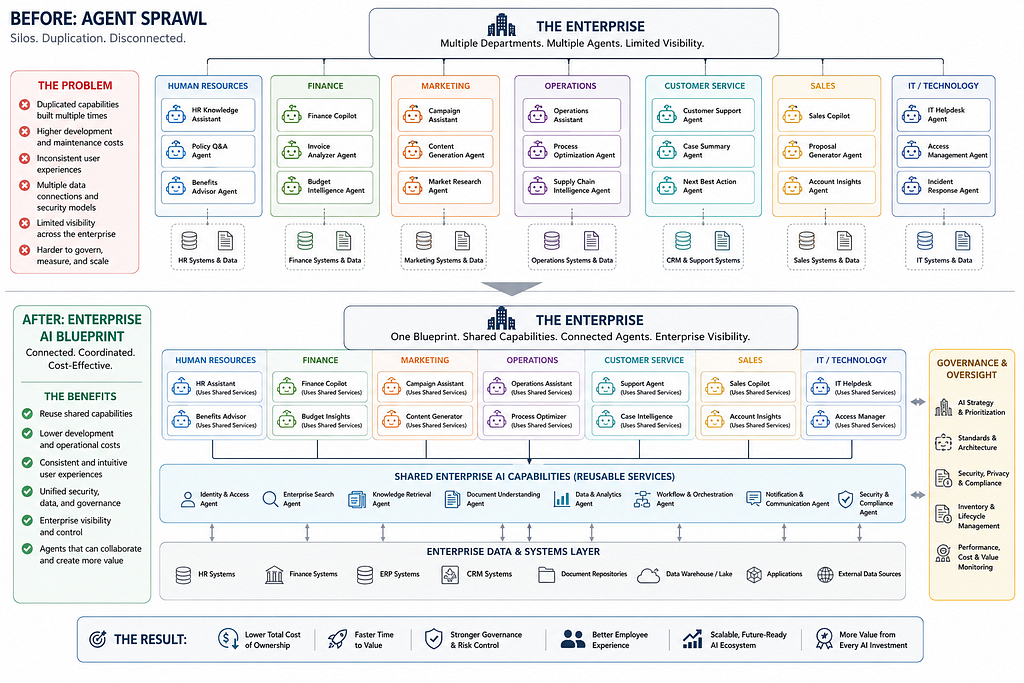
The Blueprint as an Early-Warning System
Imagine three departments independently proposing AI initiatives during the same quarter. Without enterprise visibility, all three projects may proceed through separate funding, discovery, design, development, testing, and deployment processes. With a Blueprint, overlapping capabilities can become visible before significant money is committed.
The AI Digital Project Manager can flag:
· Potential capability overlap detected.
· That does not automatically kill a project.
· There may be legitimate reasons for separation.
· Different security requirements.
· Different users.
· Different regulatory environments.
· Different data-access permissions.
But suppose analysis reveals that 60% of the proposed capabilities are essentially identical. That 60% represents an opportunity. Build the shared capability once. Let multiple agents consume it. The goal is not centralization for the sake of centralization. It is informed coordination.
From Blueprint to Enterprise AI Portfolio
Over time, the Blueprint becomes more than a diagram. It becomes an AI portfolio-management capability.
Leadership gains visibility into what agents exist, what is being developed, who owns them, what they cost, what systems they access, what capabilities they share, where duplication exists, and which components could be reused.
The organization can also identify agents with low adoption, excessive operating costs, overlapping functionality, or limited business value.
Instead of executives evaluating isolated departmental AI proposals, they gain a portfolio-level view of AI investment. AI spending becomes visible as an ecosystem rather than a collection of projects. And eventually, the Blueprint could incorporate operational metrics such as usage, performance, adoption, cost, risk, value realization, and lifecycle status. At that point, the Blueprint begins evolving into something closer to an Enterprise AI Control Tower.
A Different Kind of AI Leadership
The person responsible for connecting this ecosystem does not need to be the organization’s best machine-learning engineer. They need something different: AI fluency combined with enterprise communication and program leadership.
They need enough understanding of agents, LLMs, APIs, data, orchestration, security, product development, UX, governance, and business strategy to bring the right people into the same conversation. Their job is not to tell engineers how to code an agent.
Their job is to continually ask:
· Why are we building it?
· Who else needs this capability?
· Has another team already solved part of this problem?
· What can we reuse?
· How does this fit into the broader AI architecture?
· Who owns it after launch?
· And perhaps most importantly: Does this investment make sense for the enterprise, not simply the department requesting it?
As organizations move from dozens of agents to hundreds or thousands, that connective leadership becomes increasingly important. Someone needs to see the forest while individual teams are building the trees. Perhaps enterprise AI needs a simple operating principle:
Blueprint Before Build.
· Before funding another agent, map the requirement against the enterprise AI ecosystem.
· Find the overlaps.
· Find the reusable capabilities.
· Find the dependencies.
· Identify opportunities for agents to collaborate.
· Then determine what actually needs to be built.
This does not need to become another bureaucratic approval process that slows innovation. Done correctly, it should do the opposite. Reusable components can reduce development time. Known integrations can accelerate implementation. Established governance patterns can shorten reviews. Existing capabilities can eliminate unnecessary engineering. And cross-department visibility can direct investment toward genuinely new problems rather than unknowingly rebuilding old solutions. The purpose of the Blueprint is not to stop teams from building. It is to stop the enterprise from paying multiple teams to build the same thing.
AI Transformation Requires Organizational Transformation
Ultimately, enterprise AI is not simply a technology challenge. It is an organizational challenge. Companies can invest millions in platforms, developers, consultants, infrastructure, models, and increasingly sophisticated agents. But those investments cannot reach their full potential when departments continue operating as isolated AI ecosystems.
The more AI development accelerates without cross-department communication, the greater the risk of duplicated capabilities, fragmented experiences, unnecessary infrastructure, increased maintenance costs, governance complexity, and budgets quietly funding problems that have already been solved elsewhere in the organization. That is why enterprise AI needs both technical governance and organizational visibility.
A well-versed AI Digital Project Manager or Program Manager, supported by an Enterprise AI Blueprint, can provide that connective layer: bringing departmental needs into a common view of what exists, what is being built, what can be shared, what should remain specialized, and where the organization should invest next.
The goal is not to prevent departments from innovating. It is to ensure that innovation happening in one corner of the enterprise does not remain invisible to everyone else. And as specialized agents increasingly begin communicating with other agents in multi-agent ecosystems, that coordination will become even more important.
The companies that succeed with AI will not necessarily be those with the largest AI budgets or the greatest number of agents. They will be the organizations that create the communication, visibility, governance, and leadership necessary to make those investments work together.
So before an organization asks:
“Can we build this AI agent?”
Perhaps it should first ask:
“Should we build it and has someone else here already done it?”
Because the most expensive AI agent an organization builds may not be the one that fails. It may be the one that works perfectly only to discover that another department already built it.
Research Supporting This Perspective
Gartner — “Gartner Identifies Six Steps to Manage AI Agent Sprawl” (April 2026). Gartner predicts that the average global Fortune 500 enterprise will have more than 150,000 AI agents in use by 2028, compared with fewer than 15 in 2025, and reports that only 13% of organizations believe they have the appropriate AI-agent governance in place.
IBM — “From AI Governance to AI Assurance: What We Shared at Think 2026” (June 2026). IBM reports that only 18% of enterprises maintain a complete AI inventory, highlighting the challenge of maintaining organizational visibility as AI adoption expands.
McKinsey & Company — “A Data Leader’s Operating Guide to Scaling Gen AI” (September 2024). McKinsey recommends clearly defined capability maps, shared ownership, common infrastructure, reusable GenAI components, and centralized visibility to reduce duplicated development and disconnected AI initiatives.
McKinsey & Company — “How COOs Maximize Operational Impact from Gen AI and Agentic AI.” McKinsey describes centralized coordination as a mechanism for minimizing duplication and resource waste while creating a prioritized enterprise roadmap for GenAI and agentic AI investments.
Deloitte — “The State of Generative AI in the Enterprise.” Deloitte’s research discusses the transition from isolated GenAI initiatives toward scalable deployments, centralized governance, and interconnected enterprise processes.
The Hidden Cost of AI Agent Sprawl: How Organizational Silos Are Draining Enterprise AI Budgets was originally published in Bootcamp on Medium, where people are continuing the conversation by highlighting and responding to this story.

 点赞
点赞 收藏
收藏 点踩
点踩 分享
分享