Why we fear being too accessible

In pricing, in availability, in conditions. The fear of appearing accessible and how it makes us lose real opportunities
She has a consulting practice. She is excellent at what she does. But she has a rule: she never responds to a client inquiry on the same day. She waits at least twenty-four hours and sometimes more. Not because she is busy, but because she believes that if she responds too quickly, they will think she has no other clients. That her time is not valuable. That she is easy to get.
Last month, she lost a contract. The client told her they went with someone else. Someone who responded within the hour. Someone who seemed available. Someone who made them feel like a priority.
She still does not connect the two things.
The invisible layer of availability
There is something strange about how we value accessibility. We say we want things to be easy. We complain when processes are complicated, when people are hard to reach and when we have to wait too long for a response. We praise brands that make things simple.
But when it comes to ourselves, we do the opposite. We build barriers. We delay responses. We inflate our busyness. We make people work for our attention. We add friction to our own processes. Not because we want to, but because we are afraid.
The scarcity principle is real. We have all seen how limited availability increases perceived value. We have all felt the pull of exclusivity. We have all internalised the idea that if something is easy to get, it must not be worth that much.
But here is what the brain actually does: it evaluates availability in context and in many contexts, availability is not a signal of low value. It is a signal of reliability, of confidence, of respect.
The problem is not that we fear being too accessible. The problem is that we have never learned to distinguish between availability and desperation and those two things could not be more different.
Think about what happens when you make yourself hard to reach. Every unanswered email, every delayed response, every time someone has to chase you for an answer, these are not neutral moments. They are signals.
The brain is always interpreting signals
A delay is never just a delay. It is where people begin to explain your behaviour to themselves.
A slow response does not just feel like a slow response. It feels like you are not a priority. It feels like the other person does not matter. It feels like the relationship is not important and once that interpretation forms, everything else is filtered through it.
This is not about impatience. This is about how the brain manages energy. When something is easily accessible, the brain processes it with less effort. When something requires effort to access, the brain registers that effort as a cost and that cost becomes part of the experience.
People rarely remember how long they waited. They remember how waiting made them feel.
The brain does not separate “the effort to get a response” from “the value of the response.” It compresses them into one single conclusion: what is this relationship like?
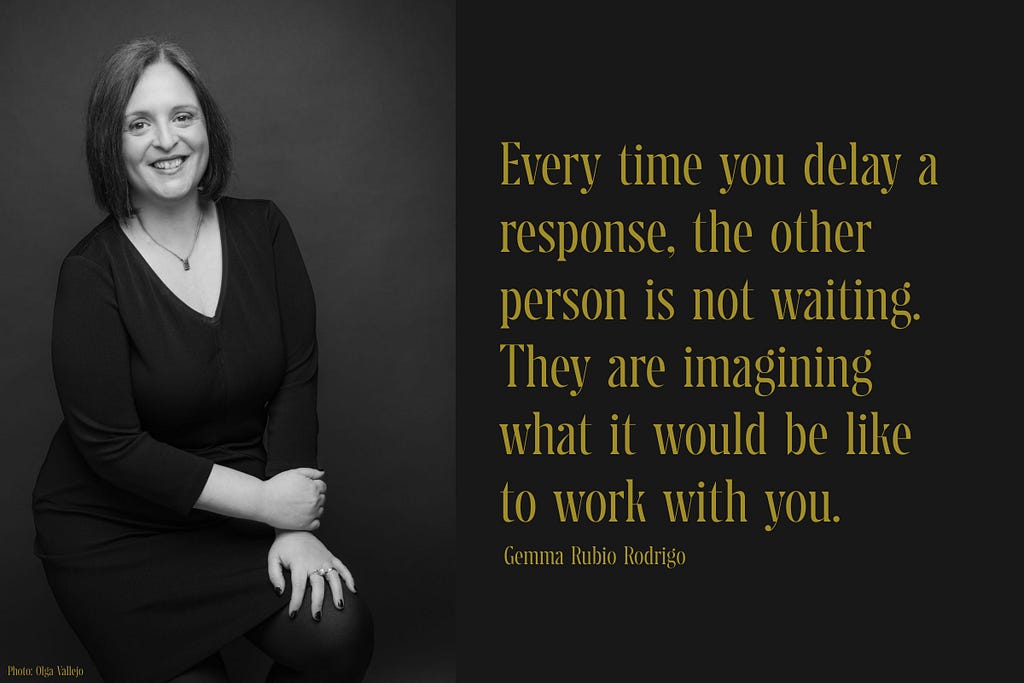
A client who has to wait three days for a proposal is not just waiting. They are building a story about what it will be like to work with you. While you are deciding whether to reply tomorrow or next week, the other person is not waiting. They are imagining what it would be like to work with you.
A candidate who never hears back after an interview is not just waiting for feedback. They are forming a permanent impression of your organisation. A colleague who always has to chase you for answers is not just frustrated. They are recalibrating their trust in you.
We often assume that inaccessibility signals importance. But what it actually signals is unpredictability and it is something the brain tries to avoid. Not because it is dangerous, but because the brain prefers patterns it can predict.
Predictability is not boring. It is the foundation of psychological safety
When effort becomes the message
Every interaction has an invisible price. Sometimes, that price is effort.
When you make yourself difficult to reach, you are increasing that price. And the brain does not compensate by assuming a higher value. It compensates by asking a different question: Is this worth my energy?
If the answer is no, the brain does not think about it. It simply withdraws. This is rarely a conscious decision. It is an automatic way of protecting mental energy.
That is why people abandon forms that are too long. Why they close websites that take too long to load. Why they stop pursuing relationships that feel too complicated.
The effort someone has to make to reach you becomes part of what they think of you.
Looking hard to get has a real cost. Let us trace what actually happens when we make ourselves difficult to access:
First, we lose people who do not have the time or energy to chase us. These are not unserious people. They are often exactly the kind of people we want to work with: busy, focused, efficient. They do not interpret inaccessibility as exclusivity. They interpret it as a waste of their time.
Second, we attract people who are willing to jump through hoops. But those people are not necessarily better clients. Sometimes they are just more persistent and persistence is not the same as quality.
Third, we create a culture of friction. When we make things hard for others, we normalise difficulty and that normalisation spreads. Teams become slower. Processes become more complex. Relationships become more transactional.
Fourth, we miss the opportunities we never see. Because the people who would have been our best clients, our best partners, our best collaborators, they never even got to the proposal stage. They moved on. Not because they did not value what we offer, but because they valued their time more.
What accessibility actually signals
Here is a different way to think about it: accessibility signals confidence. When you are secure in your value, you do not need to create artificial barriers. You know that people who need what you offer will find you and you know that you can deliver.
Accessibility also signals respect. When you respond quickly, you are saying: “You matter. Your time matters. This relationship matters.” That is not desperation. That is professionalism.
Accessibility signals reliability. When people know they can reach you, they trust you more. Not because you are always available, but because you are predictable and predictability is the foundation of trust.
Trust is not built in grand gestures. It is built on the small moments of consistency.
Accessibility does not mean being available all the time. It does not mean saying yes to everything. It does not mean undervaluing your time. It means being present when it matters. It means making it easy for people to connect with you. It means removing friction from the relationship.
There is a paradox of availability. The strangest thing about this fear is that it is self-defeating. The more we try to appear valuable by being inaccessible, the less valuable we actually become. Because we are not building relationships. We are building obstacles and those do not create loyalty. They create frustration.
Think about the people you trust most professionally. Are they hard to reach? Or are they present, responsive and clear? Think about the brands you love. Do they make things easy for you? Or do they make you work for it?
The answer is almost always the same. We value people and organisations that make us feel cared for. And caring is expressed through accessibility.
People do not always want exclusivity, but they want to feel like they matter.
The courage to be accessible
The fear of being too accessible is ultimately a fear of vulnerability. It is a fear that if we show up, if we respond, if we make ourselves available, we will be taken for granted. That people will not value us. That we will seem desperate.
But here is the truth: desperation is not about availability. It is about need. When you are desperate, you are not just available. You are anxious. You are trying too hard. You are seeking validation and that neediness is what people detect, not the availability itself.
When you are confident, you can be available without being desperate. You can respond quickly without seeming eager. You can be present without being pushy. The difference is internal. It is about why you are doing what you are doing.
If you are responding quickly because you are afraid they will forget about you, that is desperation. If you are responding quickly because you respect their time and value the relationship, that is confidence.
The same action, different internal state and the internal state is what people perceive.
Intentions are invisible. Behaviour is what people remember
What changes when you stop fearing accessibility?Imagine what would happen if you stopped playing games. If you responded to inquiries when you saw them, not when you decided enough time had passed. If you made your pricing clear and transparent. If you removed friction from your processes. If you made it easy for people to work with you.
You would not lose value. You would gain trust. You would not seem desperate. You would seem confident. You would not attract worse clients. You would attract better ones, people who value efficiency, clarity and relationships.
You would also save yourself a lot of energy. Because playing hard to get is exhausting. It requires constant calculation. It requires monitoring your responses. It requires managing perception and that energy could be spent on something more valuable: actually doing the work.
Maybe the opportunities she lost were never about competition. Never about expertise. Never about price. They were about how she made people feel before they ever became clients.
Every interaction starts shaping the relationship long before the relationship begins
The question is not whether you should be accessible. The question is whether you are confusing accessibility with desperation.
Why we fear being too accessible was originally published in Bootcamp on Medium, where people are continuing the conversation by highlighting and responding to this story.

 点赞
点赞 收藏
收藏 点踩
点踩 分享
分享