How to Write Better Suno AI Prompts: The Complete Prompt Formula

Stop guessing what to type into Suno AI. Learn a simple formula for writing prompts that produce more consistent, creative, and professional-sounding music.
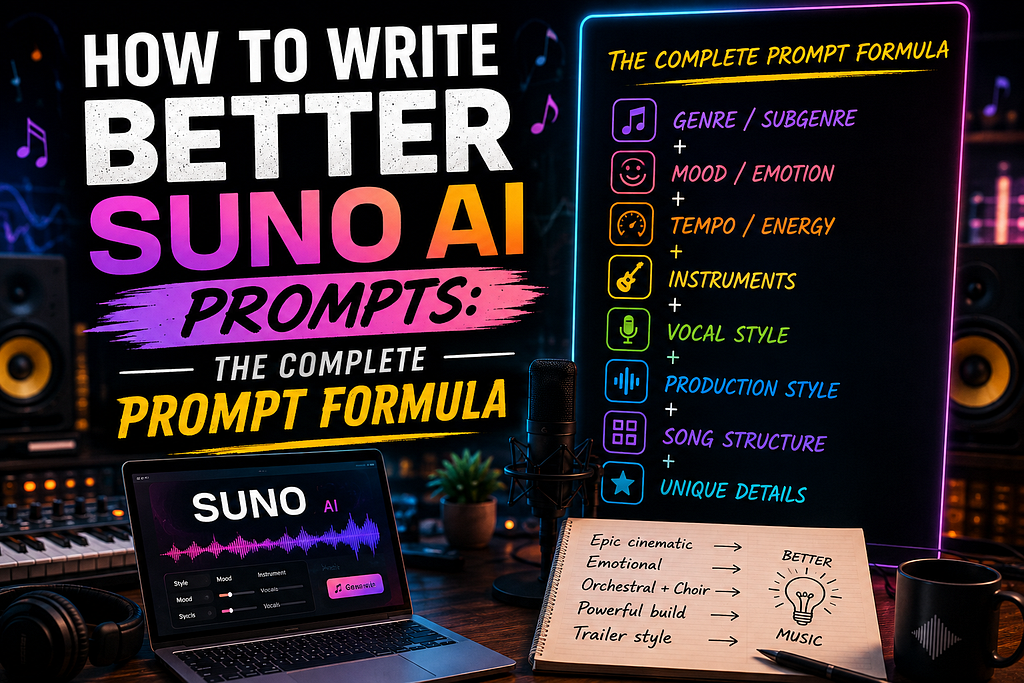
Two people can sit down with the same AI music generator, type for thirty seconds, and walk away with completely different results — not because one got lucky, but because one of them knows how to actually describe music and the other one typed a genre name and hit go.
That gap is almost entirely about the prompt. And once you see the pattern behind it, it’s genuinely learnable.
This is a practical guide to writing better Suno AI prompts — a simple, repeatable formula you can use whether you’ve never generated a song before or you’ve been experimenting for months and can’t figure out why your results feel inconsistent.
Why Suno AI Prompts Matter
Suno interprets language, not intention. It doesn’t know what’s in your head — it only knows what you typed. The more specific and musically descriptive your prompt, the more direction the model has to work with across genre, mood, instrumentation, vocals, energy, and overall style.
Worth saying plainly: a great prompt doesn’t guarantee a great result every time. Suno generation has real variability built in, and even a well-written prompt can produce a version that misses the mark. What a strong prompt does do is meaningfully shift your odds — more usable results, more often, and results that are closer to what you actually pictured instead of a generic version of the genre you named.
The Complete Suno AI Prompt Formula
Here’s the core formula this entire guide is built around:
Genre + Subgenre + Mood + Tempo + Instrumentation + Vocal Style + Production Style + Song Structure + Unique Details
An example of it in action:
“Cinematic dark synthwave, melancholic mood, mid-tempo, analog synths, deep male vocals, atmospheric production, dramatic build, futuristic night-drive atmosphere.”
Notice what each piece is doing: genre and subgenre (“cinematic dark synthwave”) narrow the sonic world far more than “synth music” would. Mood (“melancholic”) gives it emotional color. Tempo (“mid-tempo”) sets the pace. Instrumentation (“analog synths”) grounds the sound in something specific. Vocal style (“deep male vocals”) shapes the performance. Production style (“atmospheric”) describes the sonic texture. Structure (“dramatic build”) tells it how the song should move. Unique details (“futuristic night-drive atmosphere”) tie it all together with a specific scene, which gives the model a cohesive world to generate toward instead of a pile of disconnected tags.
You won’t always need all eight elements in every prompt — but the more of them you’re deliberate about, the less you’re leaving to chance.
The 8 Building Blocks of a Great Suno AI Prompt
Genre — the broad category. “Rock.” “Pop.” “Hip-hop.” Necessary, but never sufficient on its own.
- “Alternative rock”
- “Synth-pop”
- “Trap”
Subgenre — narrows the genre into something far more specific. This single addition often does more work than anything else in the prompt.
- “Late-90s alternative rock” (not just “rock”)
- “Dark synthwave” (not just “synth-pop”)
- “Melodic trap” (not just “trap”)
Mood — the emotional register. Go beyond “happy” or “sad” into something textured.
- “Restless optimism”
- “Quiet heartbreak”
- “Dark confidence”
Tempo / energy — how fast the track feels, and how much drive it has.
- “Slow-burning, contemplative pace”
- “Driving mid-tempo groove”
- “High-energy, fast-paced”
Instruments — not just what’s present, but how it behaves.
- “Muted electric guitar arpeggios with subtle delay”
- “Warm analog synth bass”
- “Sparse, brushed acoustic drums”
Vocal characteristics — type, texture, intensity, delivery.
- “Breathy, intimate female vocal”
- “Gritty, powerful male vocal with raspy edge”
- “Layered harmonized backing vocals”
Production / sound design — the sonic texture and mixing character.
- “Warm analog tape saturation”
- “Wide, spacious reverb”
- “Punchy, modern, radio-ready mix”
Structure and atmosphere — how the song moves, and the world it evokes.
- “Minimal intro building into an explosive chorus”
- “Verse-chorus-verse-bridge-final chorus with layered harmonies”
- “Late-night, rain-soaked city atmosphere”
Weak Prompt vs. Better Prompt
Weak: “Make a cool rock song.”
Better: “High-energy alternative rock, distorted electric guitars, punchy live drums, gritty male vocals, anthemic chorus, emotional verses, explosive final chorus, modern stadium production.”
Why the second version works better: it replaces a vague adjective (“cool”) with concrete musical decisions. It specifies a guitar tone, a drum character, a vocal quality, and — critically — a structural arc (emotional verses building into an explosive chorus). The model isn’t guessing what “cool” means anymore. It has an actual brief.
Weak: “Sad piano song.”
Better: “Intimate piano ballad, quiet heartbreak rather than dramatic sadness, close-mic vulnerable female vocal, sparse arrangement, brief string swell in the final chorus.”
Same pattern: an emotion word becomes a specific emotional register, and a static mood becomes a mood with somewhere to go.
15 Ready-to-Use Suno AI Prompt Examples
- Cinematic — “Sweeping orchestral cinematic piece, tense low string ostinato building gradually, brass entering at the midpoint, no vocals, dynamic range from near-silence to a full climactic finish.”
- Lo-fi — “Dusty lo-fi hip-hop beat, warm Rhodes chords, soft boom-bap drums, subtle vinyl crackle, mellow bassline, relaxed nostalgic atmosphere, no vocals.”
- Hip-hop — “Modern melodic hip-hop, warm 808 bass, crisp hi-hats, confident but laid-back male vocal delivery, atmospheric synth pads, minimal but punchy drums.”
- Pop — “Bright synth-pop, instantly catchy vocal hook, punchy drums, energetic chorus, playful verse melody, polished modern production, quick two-second intro.”
- Rock — “Late-90s alternative rock, overdriven rhythm guitars, melodic driving bassline, restrained verses exploding into a huge chorus, raspy emotional male vocal.”
- EDM — “Festival-style EDM, soaring synth lead, punchy sidechained bass, anthemic female vocal hook, tension-building pre-drop, massive wide drop with layered synths.”
- Synthwave — “80s-inspired synthwave, driving arpeggiated synth bass, gated reverb drums, wide analog pad chords, confident vocal with vintage chorus effect.”
- Jazz — “Late-night jazz trio, brushed drums, upright bass walking line, warm piano comping, relaxed intimate vocal with conversational phrasing, loose swung rhythm.”
- R&B — “Modern R&B, warm Rhodes keys, tight syncopated drums, smooth layered vocal harmonies, breathy lead vocal, laid-back spacious groove.”
- Metal — “Heavy modern metal, down-tuned palm-muted guitars, double-kick drums, aggressive but melodic vocal, huge gang-vocal backing in the chorus, tight rhythmic breakdown.”
- Ambient — “Atmospheric ambient soundscape, slow-evolving synth pads, no percussion, distant reverberant textures, minimal melodic movement, gradual dynamic swell.”
- Trap — “Dark trap, deep 808 sub bass, sparse rolling hi-hats, minor-key piano stabs, aggressive controlled vocal delivery, hard-hitting drop at the chorus.”
- Folk — “Intimate indie folk, fingerpicked acoustic guitar, soft brushed drums, warm double bass, close-mic vulnerable vocal, gentle string swells in the final chorus.”
- Acoustic — “Stripped-down acoustic ballad, single fingerpicked guitar, no percussion until the final chorus, vulnerable close-mic vocal, quiet room tone throughout.”
- Epic Orchestral — “Massive orchestral epic, powerful brass fanfare, driving percussion, soaring string melody, choir entering at the climax, triumphant dynamic build.”
None of these guarantee a specific output — think of them as strong, specific starting points to adapt and build from.
How to Control the Mood
Mood in Suno responds well to combinations of words rather than a single adjective. A few reliable pairings:
- Dark + mysterious + tense — for suspenseful or unsettling material
- Warm + nostalgic + intimate — for reflective, personal-feeling tracks
- Euphoric + energetic + uplifting — for high-energy, celebratory music
- Sad + cinematic + emotional — for dramatic, weighty ballads
- Peaceful + dreamy + atmospheric — for ambient or meditative pieces
Each combination narrows the emotional target far more precisely than any single word could on its own.
How to Describe Instruments More Effectively
There’s a real difference between naming an instrument and directing how it plays.
Weak: “Use guitar.”
Better: “Clean fingerpicked electric guitar with subtle delay, warm analog tone, gradually building into layered distorted guitars.”
The second version tells Suno how the guitar behaves — the playing style, the effect, the tonal quality, and how it evolves across the song. That’s the difference between an instrument as a name on a list and an instrument as an actual creative decision.
How to Describe Vocals
Vocal direction is one of the most commonly under-specified parts of a Suno prompt. Useful characteristics to include:
- Gender: male / female vocals
- Delivery: soft / aggressive
- Texture: breathier / cleaner
- Register: deep / high
- Intensity: intimate / powerful
- Arrangement: solo / duet / harmonized backing vocals
Example: “Breathy, intimate female vocal, restrained in the verse, stronger chest voice in the chorus, with layered harmonies in the final section.” Stacking several of these characteristics together gives Suno a genuine performance to aim for, not just a vocal type.
How to Create More Original Suno AI Music
Genre labels alone tend to produce fairly predictable results, because they’re pulling toward the most common version of that genre. Combining unexpected elements tends to push toward something more distinctive.
“Dark cinematic orchestral music, 1980s synthwave textures, tribal percussion, haunting female vocals.”
None of those four elements are unusual on their own. Together, they describe something genuinely harder to predict — and often more interesting than any single genre tag would produce alone. Treat genre combinations as a deliberate experiment, not a formula to lock in and repeat forever.
Common Suno AI Prompt Mistakes
- Being too vague. “Make it good” or “make it emotional” gives the model almost nothing to act on.
- Adding too many unrelated ideas. Five genres crammed into one prompt usually produces a muddled result, not a rich one.
- Using contradictory instructions. Asking for “minimal, stripped-down” and “huge, layered wall of sound” in the same prompt forces a compromise on both.
- Overloading with unnecessary adjectives. “Beautiful, amazing, stunning, gorgeous” stacked together adds length without adding information.
- Copying another artist’s exact style. Describe the musical characteristics you’re after instead of naming a specific performer.
- Expecting one prompt to control every detail perfectly. Suno generation has real variability — plan to generate more than once.
- Never experimenting with variations. Changing one element at a time teaches you what each part of your prompt actually controls.
The 3-Level Prompting Method
A useful way to think about how much detail to include, shown across the same song idea:
Level 1 — Basic (genre + mood): “Emotional indie pop.”
Level 2 — Detailed (genre + mood + instruments + vocals + energy): “Emotional indie pop, mid-tempo, acoustic guitar and soft piano, breathy intimate female vocal, gentle building energy.”
Level 3 — Advanced (full formula): “Emotional indie pop, dream-pop subgenre influence, bittersweet nostalgic mood, mid-tempo, fingerpicked acoustic guitar with soft piano layered underneath, breathy intimate female vocal growing into fuller tone by the chorus, warm analog production with light reverb, minimal intro building into an expansive final chorus, quiet late-summer evening atmosphere.”
Level 1 is fine for quick experimentation. Level 3 is where you have real creative control. Most useful prompts for serious work live somewhere between Level 2 and Level 3.
A Reusable Suno AI Prompt Template
[Genre/Subgenre] + [Mood] + [Tempo/Energy] + [Main Instruments] + [Vocal Style] + [Production Style] + [Song Structure] + [Atmosphere/Unique Element]
Five completed examples using this exact template:
- “Melodic trap, dark subgenre lean, brooding confident mood, mid-tempo with a heavy pocket, deep 808 bass and sparse piano stabs, aggressive but melodic male vocal, dark modern production, verse-hook-verse-hook structure, late-night city atmosphere.”
- “Indie folk, quiet Americana influence, wistful reflective mood, slow unhurried tempo, fingerpicked acoustic guitar and soft pedal steel, warm conversational male vocal, minimal analog production, sparse verses building to a fuller final chorus, small-town autumn evening atmosphere.”
- “Synth-pop, retro 80s subgenre, euphoric nostalgic mood, upbeat driving tempo, arpeggiated synth bass and bright pads, confident layered female vocal, polished vintage-tinged production, quick intro into an anthemic chorus, neon-lit night-drive atmosphere.”
- “Soul, classic Motown subgenre, warm hopeful mood, mid-tempo groove, live horns and Hammond organ, powerful gospel-influenced female vocal, warm analog production, call-and-response structure, sunlit Sunday-morning atmosphere.”
- “Ambient, cinematic drone subgenre, tense uncertain mood, very slow evolving tempo, layered synth pads and distant strings, no vocals, spacious reverberant production, gradual dynamic swell with no clear structure, vast empty-space atmosphere.”
Bringing It All Together
The formula, one more time, in its simplest form:
Genre → Mood → Tempo → Instruments → Vocals → Production → Structure → Unique Details
You don’t need to memorize all eight elements before your next generation. Pick two or three you’re currently skipping — vocal delivery, or song structure, or production texture — and add them to your next prompt. Notice what changes. Then build from there.
No single prompt is the “perfect” one. The real skill isn’t finding a magic sentence — it’s learning what each part of the formula actually controls, so you can shape the next generation deliberately instead of guessing.
So: what kind of music are you trying to create with Suno AI?
How to Write Better Suno AI Prompts: The Complete Prompt Formula was originally published in Bootcamp on Medium, where people are continuing the conversation by highlighting and responding to this story.

 点赞
点赞 收藏
收藏 点踩
点踩 分享
分享