One of the less-appreciated reasons for American success in WW2 is that our army and group commanders were really good.
Hitler, Tojo, and Churchill focused on loyalty and thus often kept men in charge (or removed men) who really didn't deserve it. Stalin didn't care about loyalty, but he DID worry about disloyalty, so while his army commanders were generally good, he murdered many qualified men (Zhukov, possibly Stalin's best general, escaped the purges by being stationed in Siberia, out of sight.) Of course even these regimes managed to get some talented generals and admirals at times anyway.
But the USA sought to follow a different methods. If a commander failed, he was generally immediately removed but assigned to a new job in which he was likely to succeed. For example, General Fredendall (the worst corps commander we had) and General Lucas were both yanked after battlefield disasters and sent home to manage training troops, for which they seem to have been competent. We relieved division commanders, corps commanders, and even army commanders. In one case - Eichelberger - he redeemed himself and kept his command. That was unusual in the American system. We always figured the guy on top was the easiest one to replace.
It's scandalous that our high commanders aren't better-known. Sure Patton and MacArthur were flamboyant, outspoken, and excellent, but Hodges, Devers, Patch, and Buckner were terrific leaders. Our worst army group commander was Mark Clark, and he wasn't even that bad - his main problem was that Italy was a bad fit for him.
MacArthur gets a lot of hostility, and he was personally an egomaniac jerk but he was a good commander, and was careful with the lives of his men. The New Guinea campaign, featuring almost impossible terrain and a dug-in enemy, cost us 35,000 American & Australian casualties. But it inflicted over 200,000 Japanese casualties and destroyed the Japanese 18th army. It's one of the greatest one-sided victories of all time and it's rarely talked about.
General Patch, whom few have heard of, led the final offensive on Guadalcanal and drove off the Japanese. He was then transferred to Europe and defeated the Germans in the Vosges and stopped the Nordwind offensive, all the while his reserves had been sent off to fight in the Battle of the Bulge. He led the only contested offensive in the Vosges that has ever succeeded, and he did it without air support. My father-in-law was under his command and fought in that campaign.
I'd put Hodges or Devers up against Rommel, Rundstedt, or maybe even Manstein any day. America really had great leaders. One of the reasons they were so fantastic was that all American officers were required to attend the Army Industrial College, so they all had a keen understanding of logistics. They knew how hard it was to ship a Sherman tank overseas, and that for every gallon of gas that reached the front line, 2-3 gallons were spent getting it there. The only high ranking American general who DIDN'T go to the Industrial College was Patton (due to age), and in fact he was the guy who famously outran his supplies several times!
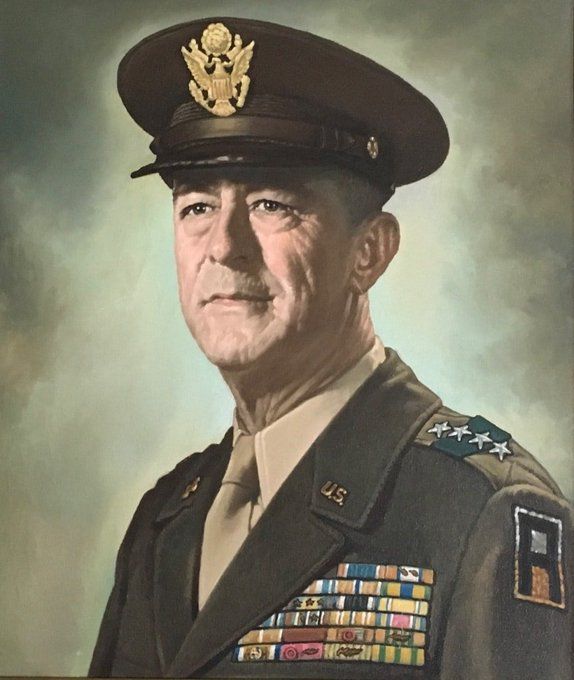
(Pictured: Hodges; an aggressive commander who made his way to general the hard way - getting promoted from Private all the way up.)

 点赞
点赞 收藏
收藏 点踩
点踩 分享
分享