A New Theory of Economics


Hi. I’ve thought about this idea for a while, and I think it’s come together almost to completion so, here it is. It’s somewhat related to Georgist theory but a bit different, you’ll see. It’s mostly based on the work of Acemoglu and Restrapo and Korinek and Stiglitz, but also many others.
To start, scarce resources. Scarce resources are the inputs to the economy, maybe your first thought is rare earth metals but I would like to divide them up in this way:
- Land
- Labor
Land because it contains most (but admittedly not all) our scarce resources. Iron ore is in the land, or it’s in the buildings on the land, or it’s in the scrapheap on the land. Crops grow on land. Oil is under the land. The exceptions are, well, air and water, and they matter, but I’ll return to them later.
Labor is scarce because there are only so many people on earth, and there are things we can do for eachother that land can’t (at least, not yet).
The economy uses money, but money doesn’t actually have any value intrinsically. We just use it as a medium of exchange. In theory though it represents value. One such representation is the wage. You are paid based on how much you contribute to the economy, paid more if you contribute more. How are wages set in aggregate? I would argue they are set by the subsistence level, the level needed to survive. That is an old argument and “wrong” for a few reasons, but it actually will serve us quite well for now. It’s wrong because if you look around many people are paid more than subsistence wages. In part, that is due to human heterogeneity (we are all different) and the fact that the economy is always changing, and that change can temporarily move prices. There is one more natural system though that raises the true minimum wage above subsistence, but I need to lay some groundwork first. However, our collective minimum wage is actually subsistence, i.e what we need to survive. Why? Because if it were less than that, we would die and then we can’t work, and if it were more than that, the economy would optimize it down to that. One last component worth considering is all our tax and redistribution systems we have, which lift people at the bottom up by pulling down those at the top.1
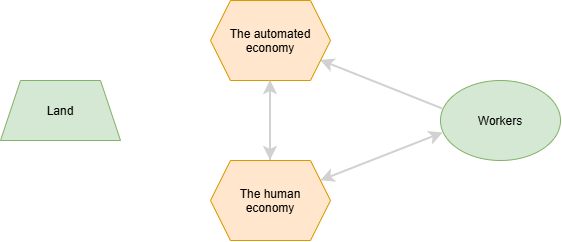
The thing is, this rule of subsistance-survival applies to the land, sortof. The most poetic example is climate change. Our earth (now including water and air alongside land) can also die if not treated properly by the economy. It currently does not really demand a wage beyond some token things our governments do (like a carbon tax), so it isn’t represented very well in the economy. Here is a diagram where I will include it for now but omit any connections for it (they are almost not there in the status quo, not in the way I want to talk about):
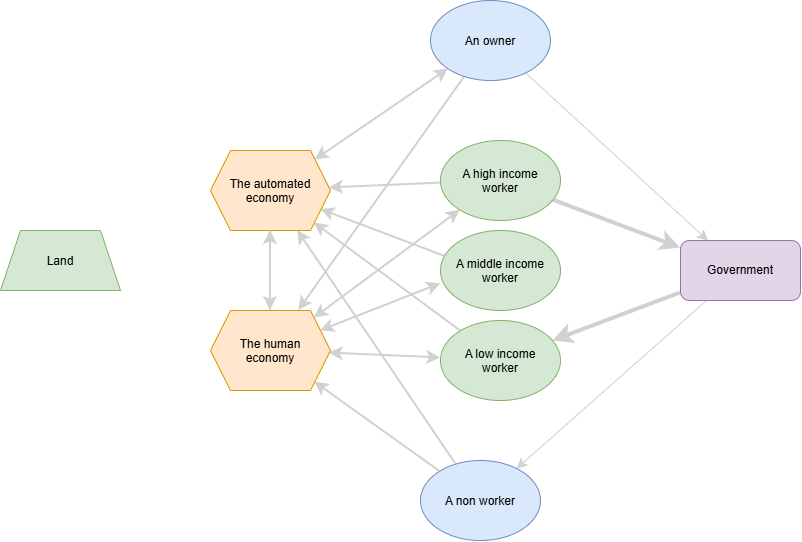
Each arrow is a flow of money, but more precisely, a flow of value. I get a wage for working, I buy a good from a company, an “automated company” purchases services from a human one, or vise-versa. Notice all are bidirectional except for one, because a worker is not paid for the work done by a machine. The two economies are conceptual, that “automated company” doesn’t actually exist (yet). Every company on earth is realistically a bit of both. One CEO and a billion dollars of machines, is mostly automated, but the CEO performs some labor by setting the correct direction for the company. A thousand farmhands using sickles is mostly labor, but the sickles are a form of automation. Before, I said humans are heterogeneous and redistribution plays a role, so here is that diagram:
What is extra notable here is the only arrows going out of the automated economy are the ones flowing to owners and to the human economy, I’ll return to that later. Once again, the human blobs here are conceptual and it is arguably impossible to be only in one of these blobs as an individual. If you work and own stock, you are somewhat owner and somewhat worker. Even if you own only the clothes on your back, you are an owner of the material in those clothes. That might seem strange but that material is scarce, and owning anything scarce makes you an owner. Clothes make you more productive at work (I assume), so when you wear them to work, they are representing the automated economy, and you extract their value through the fact that you own your clothes. I have colored owners and non workers as blue because they are not scarce resources like land and workers. Already from that, you may be able to see a faint glimmer of what this whole theory is about.
Government sits to the side, and it can collect from owners and workers, and distribute also however it wants. In a democracy, however we want. The arrows here, which way they point and their size, is dependent on policy. Our conceptual middle income worker is one who gets back what they contribute (definitionally, just so there are fewer arrows on this graph). In most countries, we tax high income workers and distribute to low income ones. What might surprise you is that the line from owners is (usually, in most countries) small, and the line to non workers is also very small. The short version of why is that most of our taxes have incidence on wages, and most our benefits are hypothecated (legally linked) to wages. Income taxes and pensions are the obvious examples. However I would include other less obvious ones. On the tax side, non exhaustively:
- Income tax, obviously
- Consumption taxes like VAT and sales tax – This is because most consumption is paid for by wages, or by benefits that are funded by taxes on wages. Not all VAT though, consumption from owner incomes (I own stock, collect dividends or use it as collateral on a loan, buy a thing) is not wage linked.
- Property/council tax – It taxes the labor that went into building the building or improvement. Like VAT though, it’s not a pure labor tax.
- Profit taxes, and even wealth taxes – Also not a pure labor tax, See below
Even a profit or wealth tax taxes a smart investor or decisionmaker, their cognitive work is labor, and therefore when we tax it we collect from labor. However, e.g wealth taxes also tax wealth gained from say, owning a global index fund. No thought is needed to do that, so that sub case is a pure tax on ownership, but since it’s entangled with a tax on the intelligent allocation of capital, wealth taxes aren’t pure. On the benefit side we can consider these as wage linked:
- Pensions – You have to have worked in most cases, and it grows if you worked more
- Unemployment benefits – You used to work, so it’s still wage linked
- Any benefit that dissappears if you start working, or get a higher wage, are also wage linked. Even free/supported education is wage linked because you are meant to start working at a certain age, and can only get free education for so many years in most countries. Free healthcare is wage linked if it’s payroll funded.
I am currently working on a separate project to put numbers on these flows as best I can across different countries and time, where essentially the question is “how much of consumption spending comes from wages, directly or through redistribution, and how much comes from taxes on pure ownership”. It’s hard due to the aforementioned entanglement, but the napkin math for the United States right now is around 20 to 1, or 95 vs 5 percent. Meaning, those big arrows are 20 times larger than the small ones. That number might feel surprising still. If it does, I would encourage going back and reading the definitions, and how most taxes and benefits are actually wage linked, and the big ones in most countries (income tax and VAT) tend to be also the more wage linked ones.
Let’s return to the two arrows coming out of the automated economy. One is to owners. Here, if you own something scarce and take value from it, that’s one of those arrows. Notably, I don’t pay myself for owning my clothes, so the arrow is representing value but not money per-se. The same is true of the arrow flowing to the human economy. In…