The rare quantum reason that neutral atoms are possible

Today, the CMB — cosmic microwave background — remains observable.
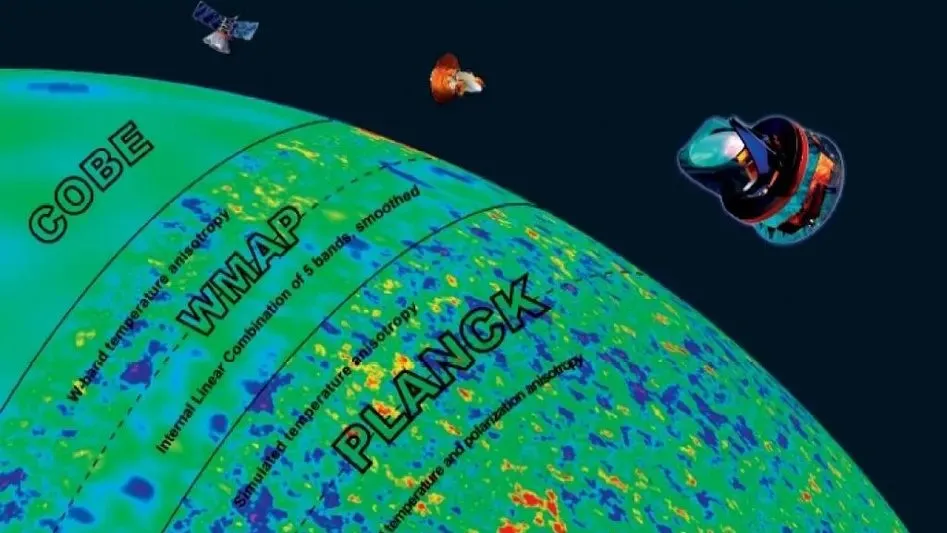
This composite image shows the microwave sky as imaged by three generations of spaceborne CMB missions: COBE (1990s), WMAP (2000s), and Planck (2010s). With time, we’ve become more sensitive to smaller-magnitude temperature and polarization features at progressively smaller angular scales. Credit: Smoot Cosmology Group/LBL/ESA
This leftover radiation from the Big Bang, 13.8 billion years on, measures 2.725 K.
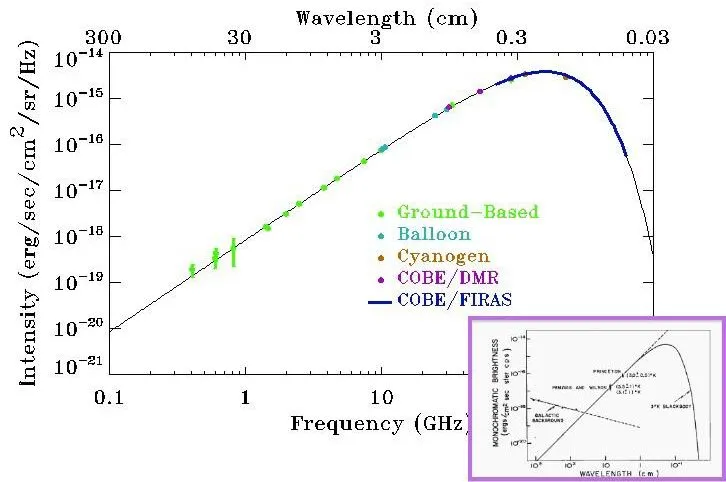
The unique prediction of the Big Bang model is that there would be a leftover glow of radiation permeating the entire Universe in all directions. The radiation would be just a few degrees above absolute zero, would be the same magnitude everywhere, and would obey a perfect blackbody spectrum. These predictions were borne out spectacularly well, eliminating alternatives, but pointing toward a very early, hot, dense state where these photons were energetic enough to, for a time, prevent the stable formation of any neutral atoms. Credit: NASA/GSFC/COBE team (main); Princeton group, 1966 (inset)
Emitted 380,000 years after the Big Bang, it redshifts with the expanding Universe.
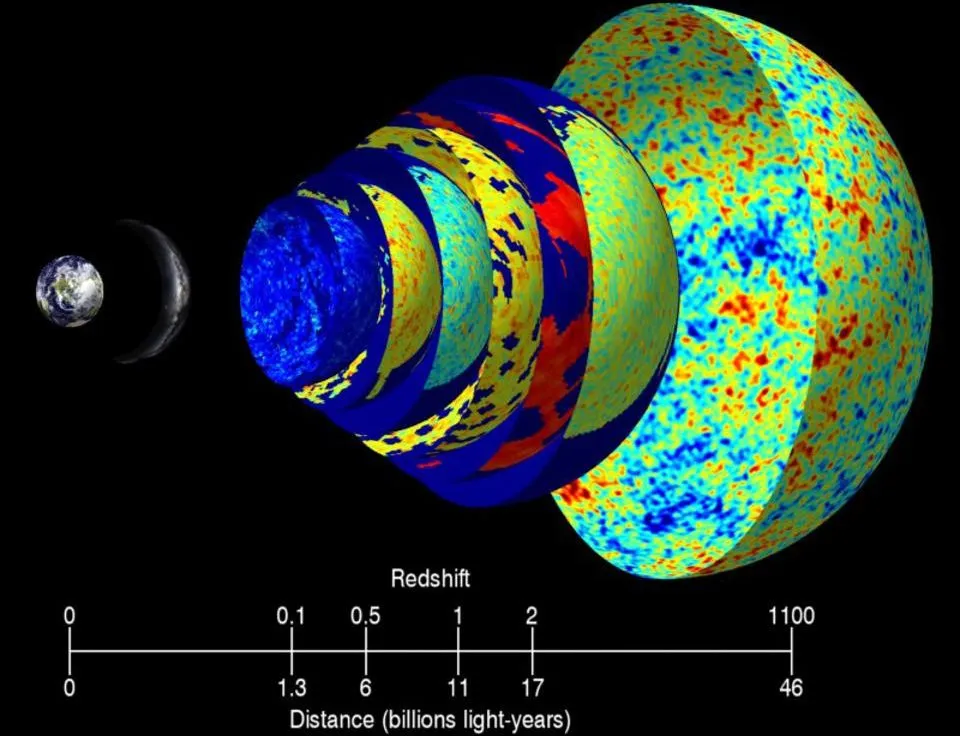
At any epoch in our cosmic history, any observer will experience a uniform “bath” of omnidirectional radiation that originated back at the Big Bang. Note that the CMB isn’t just a surface that comes from one point, but rather is a bath of radiation that exists everywhere at once. As each new year passes, the CMB cools down further by about 0.2 nanokelvin, and in several billion years, will become so redshifted that it will possess radio, rather than microwave, frequencies. The farther away we look, the younger of a Universe, and the hotter of a CMB temperature at that location, we increasingly find. Credit: Earth: NASA/BlueEarth; Milky Way: ESO/S. Brunier; CMB: NASA/WMAP
Early on, radiation scatters with electrons: preventing the CMB’s final emission.
As the Universe cools, atomic nuclei form, followed by neutral atoms as it cools further. All of these atoms (practically) are hydrogen or helium, and the process that allows them to stably form neutral atoms takes hundreds of thousands of years to complete. Credit: E. Siegel/Beyond the Galaxy
Only after neutral atoms form is that CMB radiation “released.”
In the hot, early Universe, prior to the formation of neutral atoms, photons scatter off of electrons (and to a lesser extent, protons) at a very high rate, transferring momentum when they do. After neutral atoms form, owing to the Universe cooling to below a certain, critical threshold, the photons simply travel in a straight line, affected only in wavelength by the expansion of space. Credit: Amanda Yoho for Starts With A Bang
However, it’s not necessarily easy to make — and keep — neutral atoms.
At early times (left), photons scatter off of electrons and are high-enough in energy to knock any atoms back into an ionized state. Once the Universe cools enough, and is devoid of such high-energy photons (right), they cannot interact with the neutral atoms, and instead simply free-stream, since they have the wrong wavelength to excite these atoms to a higher energy level. Credit: E. Siegel/Beyond the Galaxy
Whenever an atom forms, electrons combine with an atomic nucleus: e.g., protons.
This artist’s illustration shows an electron orbiting an atomic nucleus, where the electron is a fundamental particle but the nucleus can be broken up into still smaller, more fundamental constituents. The simplest atom of all, hydrogen, is an electron and a proton bound together. Other atoms have more protons in their nucleus, with the number of protons defining the type of atom we’re dealing with. Electrons and atomic nuclei that are bound together into neutral atoms have slightly less mass than free electrons and nuclei in unbound states. Credit: Nicole Rager Fuller/NSF
When the electron drops into the lowest (n=1) state, ultraviolet photons are typically emitted.
Electron transitions in the hydrogen atom, along with the wavelengths of the resultant photons, showcase the effect of binding energy and the relationship between the electron and the proton in quantum physics. The Bohr model of the atom provides the coarse (or rough, or gross) structure of these energy levels. Hydrogen’s brightest atomic transition is Lyman-alpha (n=2 to n=1), but its second brightest is visible: Balmer-alpha (n=3 to n=2), which emits visible (red) light at a wavelength of 656 nanometers. The energy lost by an electron cascading down the energy levels gets emitted in the form of photons, with the lowest energy (n=1) state representing the ground, or lowest-energy, state. Credit: OrangeDog and Szdori/Wikimedia Commons
However, that photon eventually strikes another (neutral) atom.
When a photon strikes an atom, if the atom has one or more electrons orbiting it, there’s a chance that the photon will be absorbed: if it has the right amount of energy to enable an allowable quantum transition. For a ground-state hydrogen atom, that energy is given by the Lyman series (or a photon above the Lyman limit in energy), where photons not of those energies will simply pass through the atom without interacting.
Credit: Sergey Nivens / Adobe Stock
The resulting excitation makes re-ionization easy; the net number of neutral atoms doesn’t increase.
When an atom is in an excited state, it becomes very easy to ionize: by low-energy photons or other collisions. In the early Universe, an excited-state hydrogen atom can be ionized by even common, low-energy photons, whereas a ground-state atom requires a rare, high-energy photon in order to achieve ionization. Credit: Jerine Victor/Wikimedia Commons
Standard Lyman-series transitions, excepting redshifts, don’t create neutral atoms.
This simplified animation shows light as it travels through the expanding Universe. If an ultraviolet photon generated by a hydrogen atom transitioning down to the ground state runs into another neutral hydrogen atom, it will excite it, making it easy to ionize. Only if the photon travels for long enough to redshift significantly will the “receiving” atom be unable to be excited: a slow and rare process when the Universe is only a few hundred thousand years old.
Credit: Rob Knop
But for 1 in every 100,000,000+ neutral atoms, a quantum two-photon transition occurs.
This diagram shows the quantum transition from an excited s-orbital state within an atom to a lower-energy s-orbital state: a quantum transition that’s only permitted through an intermediate state through a non-s-orbital (such as a p-orbital). Two photon transitions occur, importantly, in the hydrogen atom in the early Universe. Similar rules govern the transition between any two quantum states. Credit: T. Nieddu et al., Optics Express, 2018
Electrons can’t transition directly from one s-orbital to another.
In order to transition from one quantum state to another within an atomic nucleus, all sorts of quantum properties must be conserved: angular momentum among them. A one-photon transition from an excited s-orbital state to a lower-energy s-orbital state is possible, but a two-photon transition requires going through an intermediary (virtual) state: something forbidden without virtual states. However, although it’s rare, about 1 in 100 million to 1 billion times, the two-photon transition actually occurs.
Credit: Visualizing all things science/flickr
Through an intermediate (virtual) state, however, two equal-energy photons are produced.
When you transition from an “s” orbital to a lower-energy “s” orbital, you can on rare occasion do it through the emission of two photons of equal energy. This two-photon transition occurs even between the 2s (first excited) state and the 1s (ground) state, about one time out of every 100 million transitions, and is the primary mechanism by which the Universe’s atoms become neutral. Credit: R. Roy et al., Optics Express, 2017
These cannot be reabsorbed: increasing…

 点赞
点赞 收藏
收藏 点踩
点踩 分享
分享
