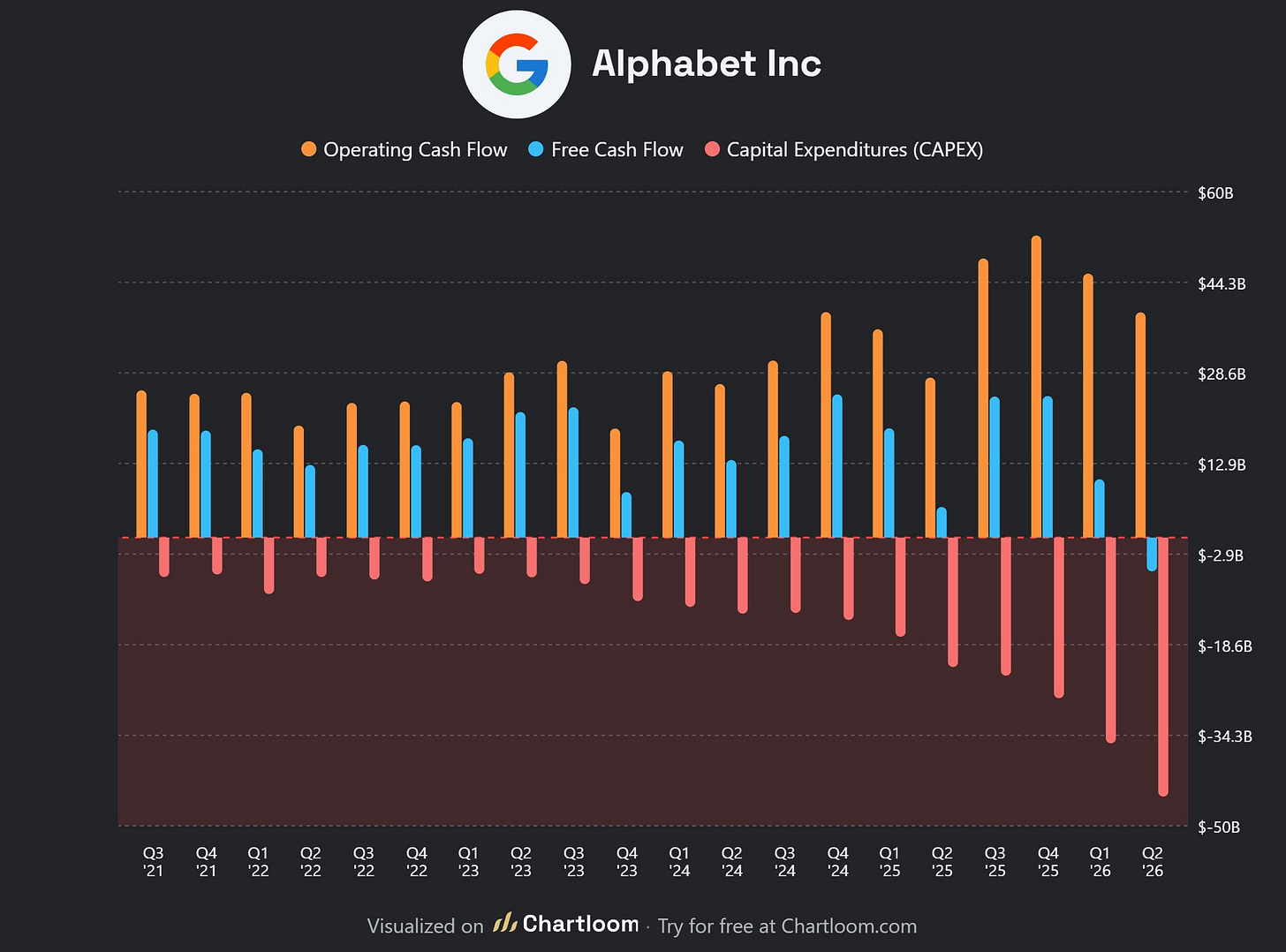
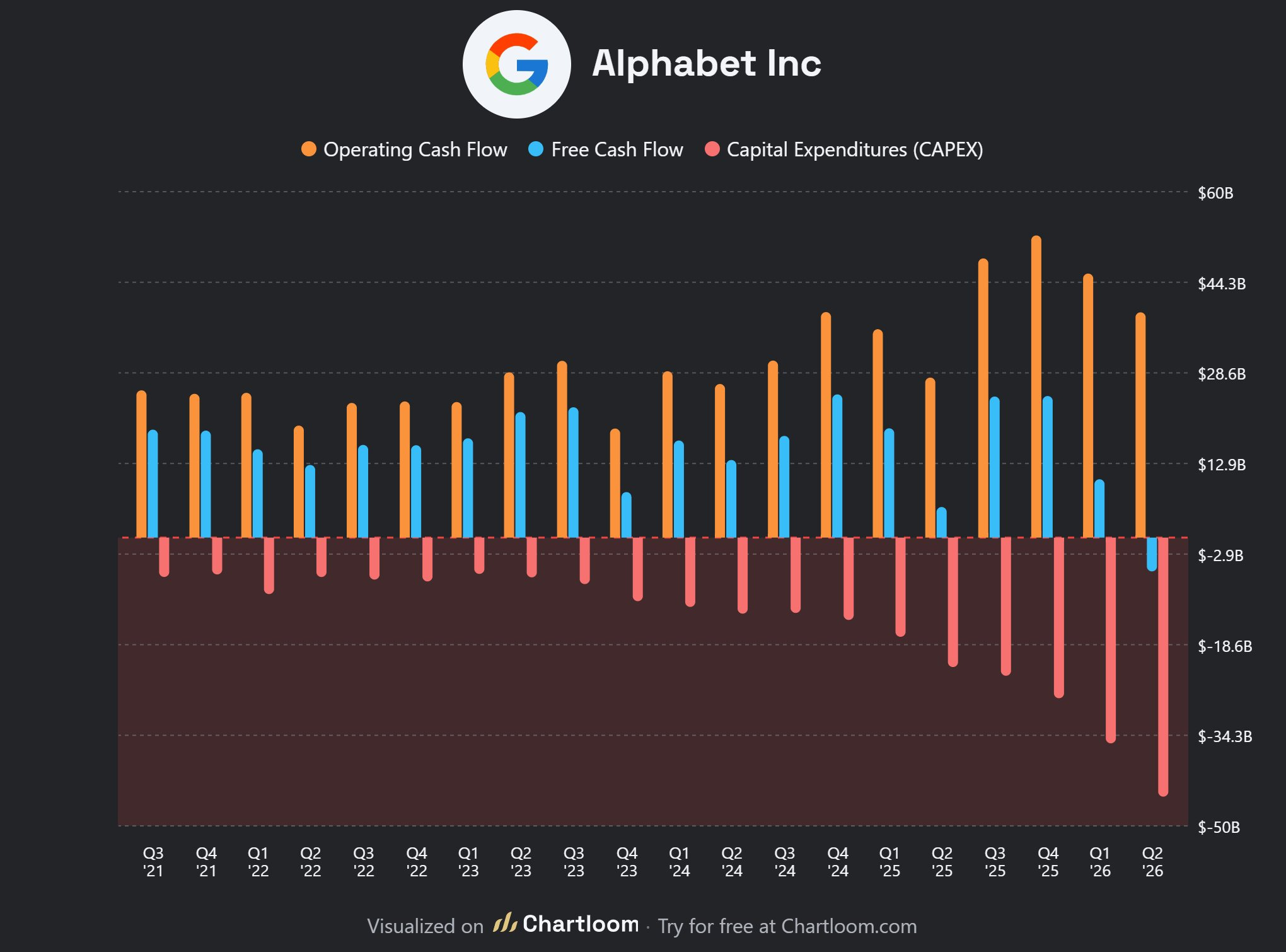
Why I am bullish the AI super cycle: Google just posted its first negative free cash flow quarter in 22 years. Here's why that's the wrong number to panic about


Alphabet's Q2 2026 print gave the market exactly the headline it wanted to be scared by: negative free cash flow, first time since the 2004 IPO. Cue the "AI bubble" posts. Cue the "even Google can't afford this" takes.
Here's the bear case, stated as strongly as it deserves to be stated, before I take it apart.
This Substack is reader-supported. To receive new posts and support my work, consider becoming a free or paid subscriber.
The bear case, in full
Capex doubled year over year to $44.9 billion in a single quarter — more than double what Alphabet spent in “any single quarter” over the past two years. Management didn't hold guidance steady; they raised it for the second time this year, to $195–205 billion for 2026, with 2027 flagged to go higher still. Alphabet is now renting Nvidia chips from SpaceX at roughly $920 million a month just to cover a supply gap. It has taken on close to $100 billion in new debt this year, plus a large equity raise explicitly earmarked for AI infrastructure. A company that has never once needed outside capital to fund its own growth is now doing exactly that. If the returns on this spend don't show up, this is how the AI capex cycle ends — good businesses bleeding cash to keep pace in a race none of them can afford to lose or leave.
That's a coherent case. It is not the case I hold.
What the bears are pricing off the wrong line
Free cash flow answers one question: is the company generating more cash than it's spending, “right now, this quarter”. It's the correct number for a mature, low-capex business. It's close to the wrong number for a company mid-buildout of an asset base that will earn for the next 5-10 years.
Operating cash flow answers a different, better question for this moment: is the underlying business throwing off more cash than it used to. Alphabet's answer is unambiguous — OCF grew 41% year over year to $39.1 billion. That is not a company running out of gas. That is the core engine getting stronger while a separate,…