Lessons from a high-fertility subculture


Sonja Trauss explains how Hasidic Jews have so many children and asks what, if anything, the rest of the world has to learn from them.
This piece was featured in Issue 24 of Works in Progress. Subscribe today to get Issue 25, and an issue every two months after, delivered straight to your door.
Artwork by Atalanta Arden-Miller. Photograph depicting an ultra-Orthodox family by David Grossman.
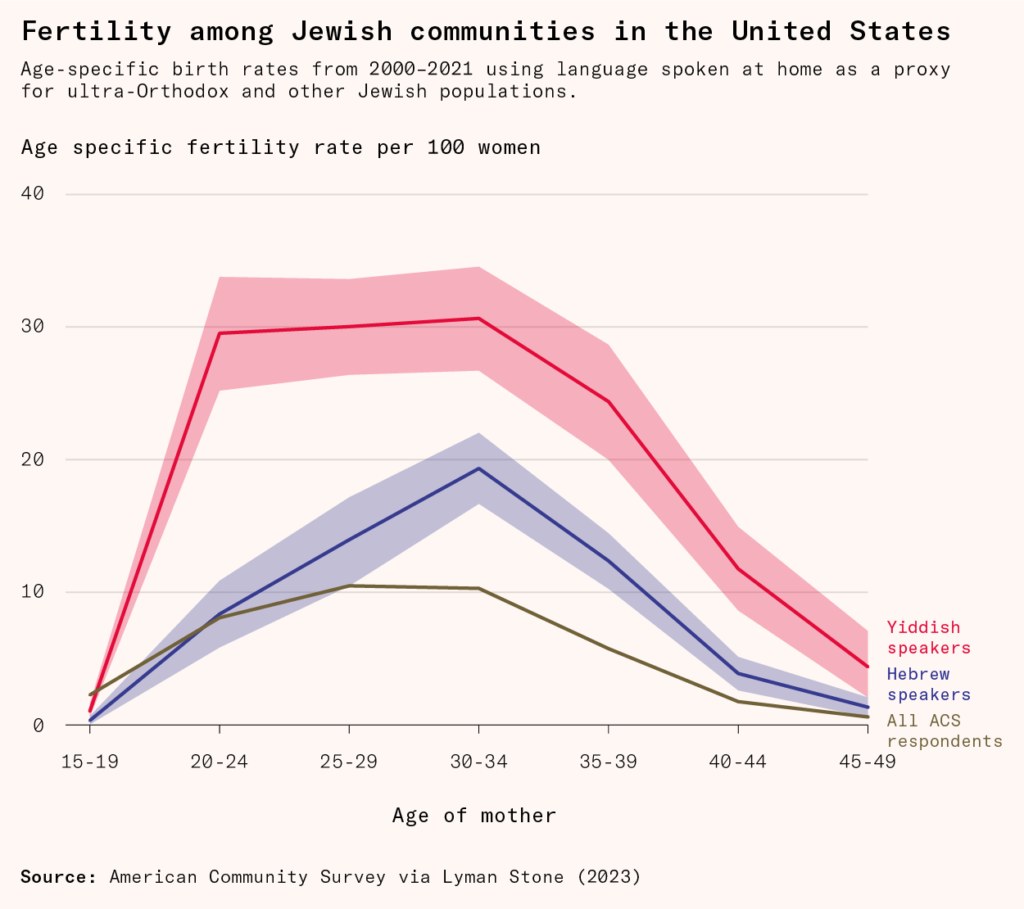
Ultra-Orthodox Jews may have something to teach us. They live squarely in the urban centers of the US and Europe, including 200,000 in New York City, but unlike most city dwellers, they have very high birth rates. Today, a Yiddish-speaking woman in the United States can expect to have 6.6 children, compared with 1.6 for the country as a whole.
Everything in ultra-Orthodox life is geared toward facilitating large families, from how children play to how couples have sex. In this piece, I’ll use the example of Chabad, the largest denomination of Hasidic Jews, although many practices mentioned here are shared by all the ultra-Orthodox.
It’s not clear that many modern people, Westerners or not, would want to adopt the family-friendly elements of Chabad life. What’s more, little of the Chabad lifestyle can easily be practiced in isolation. But understanding how this community encourages fertility can help to explain why it is falling in many other parts of the world today.Share
Before marriage
Chabadniks start having children young: there’s almost no way to have six or more children if you’re starting after 30. Yiddish-speaking men in America have a mean marriage age of 22 and women 21, and couples will almost always have children shortly after, partly because contraception is broadly discouraged.
Since lifetime mates are chosen at a young age, Chabadniks believe the selection can’t be left to the couple alone. I don’t mean to be rude, but 18-, 19-, and 20-year-olds don’t have a reputation for great judgment in any area. Even so, Chabadniks would object to characterizing th…

 点赞
点赞 收藏
收藏 点踩
点踩 分享
分享