
Oy, Canada Tariffs


The Trade Act of 1930, generally known as the Smoot-Hawley tariff, lost its standing as the worst trade policy action in US history when Donald Trump imposed his “Liberation Day” tariffs in April 2025. But Smoot-Hawley was widely recognized as a terrible mistake soon after its passage, as it provoked widespread retaliation and contributed to the downward spiral of world trade that accompanied and reinforced the Great Depression.
Recognition of Smoot-Hawley’s stupidity led to the 1934 Reciprocal Trade Agreements Act, under which the US began negotiating trade deals — we’ll reduce our tariffs if you reduce yours — that helped pave the way for the great recovery of world trade and the global economy as a whole in the decades that followed World War II.
Yesterday the Trump administration invoked an obscure and never-before-used provision of Smoot-Hawley — Section 338 — to impose 50 percent tariffs on a wide range of Canadian goods.
Why? Why now? The White House fact sheet claims that the new tariffs are a response to Canadian policies that discriminate against U.S. products, notably the moves by most Canadian provinces (not the federal Canadian government) to stop importation of US alcoholic beverages. But these policies were themselves a response to the tariffs on Canadian goods Trump had previously imposed, without justification. Canadians were also reacting to Trump’s repeated demands that Canada surrender its independence and become the 51 st state.
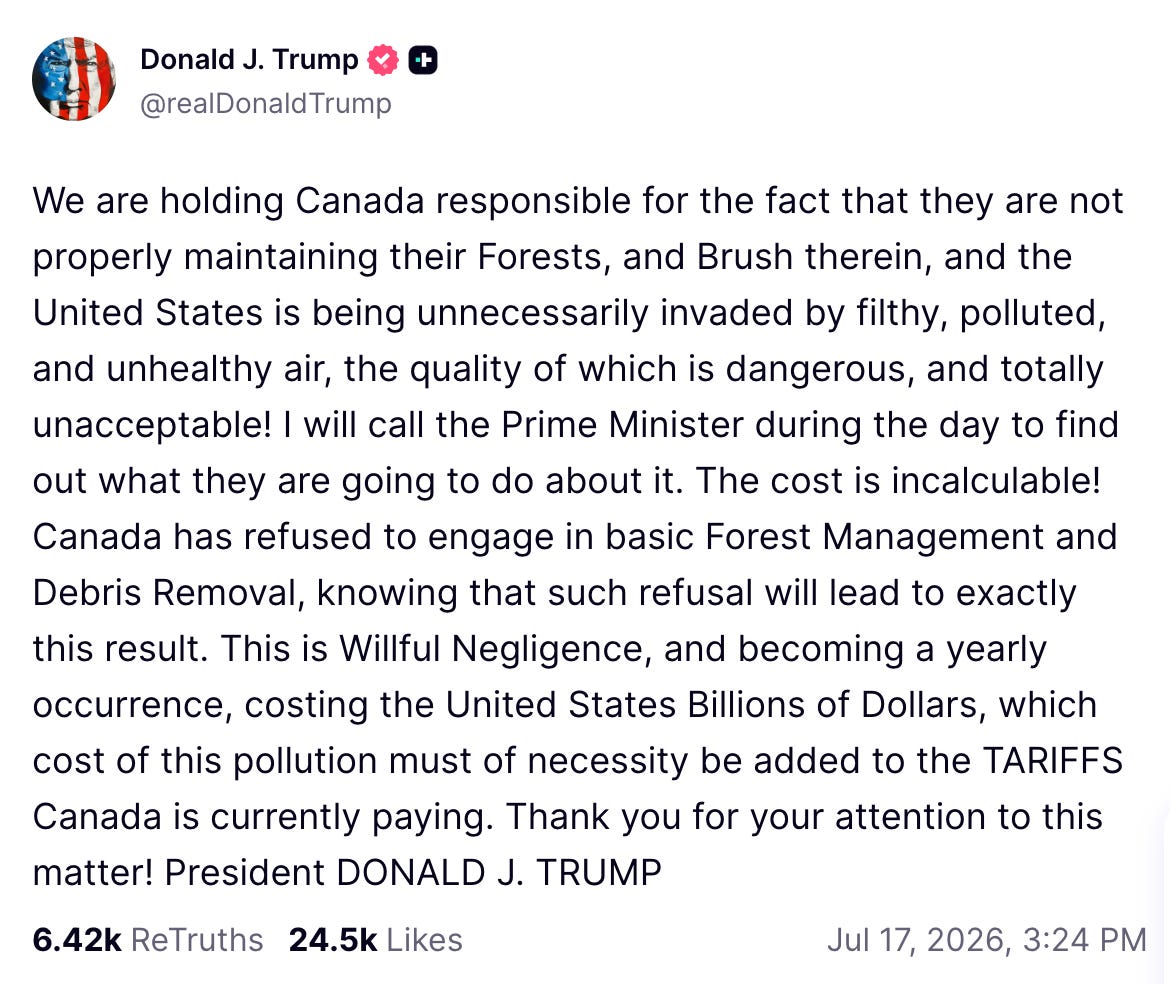
Were these complaints about Canadian policies the real reason for the new tariffs? On Friday Trump lashed out with the Truth Social post at the top of this article, threatening to impose tariffs on Canadian goods because of… wildfire smoke.
For the record, wildfires have been raging in Canada’s boreal forest, which covers 2 million square miles — the majority of Canada’s land area — and is mostly unmanaged because it’s completely inaccessible. Blaming Canada for not controlling fires that are, in reality, largely a…