Big Tech’s AI backstops risk ignominy

Five years ago, TeraWulf Inc went public via a blank cheque merger as a bet on bitcoin mining. When crypto prices crashed shortly thereafter, the Maryland-based company pivoted into another real estate trend that also required massive electricity consumption: AI data centres.
That bet is looking surprisingly solid. Last year, TeraWulf sold more than $3bn of privately placed bonds to finance data centre construction with a coupon payment of just above 7 per cent, despite the company itself still having scant revenue.
The reason TeraWulf was able to secure such cheap financing was that it has a handy benefactor: Google, the Silicon Valley digital advertising giant that wants to be a big player across the automation value chain. TeraWulf secured a backstop agreement with Google to ensure that its data centres would receive contracted lease payments.
Both parties benefit from such agreements. Google is just one of several Big Tech “hyperscalers” offering their balance sheet — not quite in upfront cash but rather as an emergency deep pocket — to give credit investors the comfort to lend at relatively low rates to unproven AI companies. Meta, too, has guaranteed data centre revenues.
The hyperscalers do that because they have an interest in the data centres being built. Take Google’s case, for instance. TeraWulf’s big direct customer is a start-up called Fluidstack which sells the actual computing capacity inside a TeraWulf data centre. The frontier lab Anthropic is a major client further downstream.
Fluidstack has pledged TeraWulf $3.7bn in lease payments over 10 years, with Google guaranteeing around half of that. At the time, the Silicon Valley stalwart took warrants in TeraWulf for nearly a tenth of the company. Google’s chip segment makes so-called “tensor processing units”, or TPUs, that are the backbone of AI computations, meaning that the success of TeraWulf and Fluidstack is in Google’s own pecuniary interests.
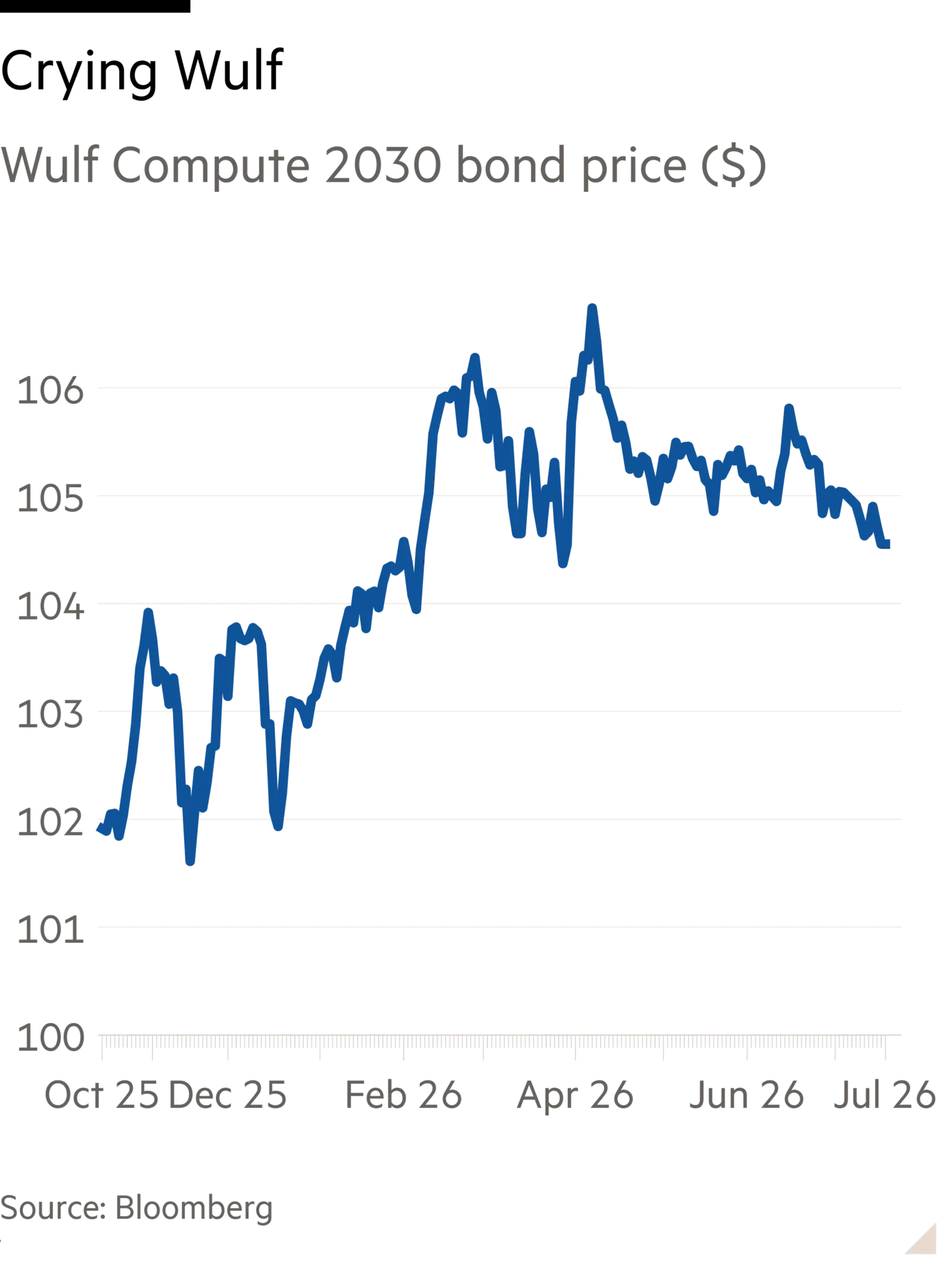
For those raising debt to build data centres, meanwhile, the attraction is clear to see. Despite the fact that the TeraWulf bond is officially junk-rated at BB, it has traded above par. Without Google’s support, its borrowing costs would probably be in the double digits.
Big Wall Street banks and private capital firms are beneficiaries too. Such guarantees allow them to raise and allocate hundreds of billions of dollars to loans that are marketed as safe and investment grade.
This is clever financial engineering. But the risk, of course, is that the revenue that AI technologies can actually generate turns out to be disappointing, affecting all of the parties involved.
Analysts say TeraWulf’s revenue will go from about $300mn this year to 10 times that by 2029. Hit those numbers and any Google backstop will merely be academic. Miss them badly, and — while Google’s $126bn cash pile will barely be dented — its ego will be sorely knocked.[email protected]

 点赞
点赞 收藏
收藏 点踩
点踩 分享
分享