In London, Wayve Launched Its Own Robotaxi a Few Hours Before Tesla's Big Reveal

After a decade of talking about it, Tesla has finally put a few driverless electric Cybercabs on the road for paying customers, though the launch in Austin, Texas, last Thursday was closed to the press and public. It was attended only by Tesla employees and superfans, and restricted to a small geofenced area of the city.

CEO Elon Musk, ordinarily the master of ceremonies at such high-profile company events, didn’t show up at all, despite frequently touting the car as one of Tesla’s biggest future products.

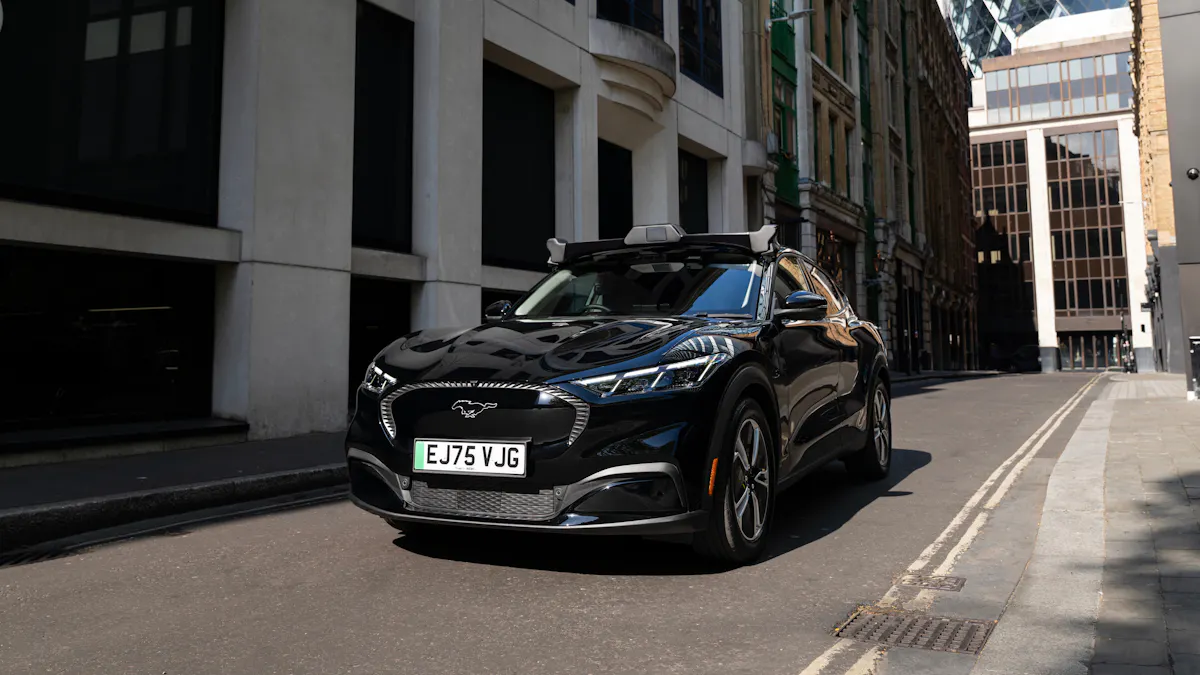
Once upon a time, such a launch might have drawn a huge reaction. But lots of companies are operating robotaxis, which have become commonplace in the U.S., China and the Middle East, something Tesla has to reckon with. Indeed, on the same day as the Cybercab launch, 5,000 miles away in London, U.K. startup Wayve launched its own small fleet of autonomous Ford Mustang Mach-Es that Londoners could order on their Uber app, as part of a collaboration between the two companies.

These Mach-Es included a safety driver in the driver’s seat, just as Waymo’s and Tesla’s robotaxis initially did. But Wayve plans to eventually remove the safety driver, and also plans to expand robotaxi service to Tokyo later this year. Next year, it will also offer self-driving cars that consumers can buy, as Nissan plans to release the first of several electric vehicles using Wayve’s driverless system. The EVs will start with the ability for drivers to take their hands off the steering wheel and gradually allow them to take their eyes off the road as well.

Wayve has raised $2.57 billion so far, including $1.2 billion in February, according to PitchBook, from a range of automakers, Nvidia, SoftBank and Uber. CEO Alex Kendall founded the startup in 2017 after he earned a doctorate in AI at the University of Cambridge. Kendall told me that the company moved quickly into the deep-learning research that led to the generative models that OpenAI brought into public view in 2022. The approach is a vision-language-action model that perceives the road and acts immediately rather than relying on collecting vast amounts of data.

He said Wayve’s model is a generalized one, meaning it can operate in almost any situation anywhere, in any car, on any road. “It’s one that does not require mapping, so it can drive anywhere, even places the cars have never been to before,” he said.

Wayve put 15 Mach-Es equipped with its driving system on London’s roads last Thursday.

Members of the public who opened their Uber app were offered the option of using one of the robotaxis. The Mach-Es are not equipped with the full suite of sensors, including lidar, that will be necessary to navigate without a driver, a company spokesperson said, but in its Tokyo rollout Wayve will move to the Nissan Leaf, which will include all the sensors. The company plans to use the Leaf in 10 additional cities after that but declined to name them.

In addition, London and the U.K. generally—made up of often narrow, weirdly curved roads, put down centuries ago when horses were the primary mode of transportation—presents a difficult case for robotaxis.

That became apparent on launch day, as the Wayve system continued to have bugs. A Bloomberg reporter who took one of the Mach-Es on a 40-minute ride said the safety driver had to intervene twice to ensure an accident-free trip.

Wayve’s business model differs from that of Tesla—which will build and own all or most of its Cybercabs—and Alphabet’s Waymo, which is installing its driverless system in models made by Jaguar, China’s Zeekr and South Korea’s Hyundai. Kendall told me he is licensing the driverless system for use in any car.

He predicted a battle between robotaxi companies over market share. “I can’t predict where Tesla will be in a year,” he said, “but we’re competing fiercely.”

Wayve isn’t alone. There is no shortage of deep-pocketed tech companies backing other robotaxi ventures:

  • Amazon-owned Zoox operates more than 50 driverless electric minivans in Las Vegas.
  • Alphabet-owned Waymo operates more than 4,000 driverless robotaxis in 14 U.S. cities.
  • China’s Pony.ai, led by billionaires James Peng and Tiancheng Lou, operates almost 2,000 robotaxis in four Chinese cities.
  • China’s WeRide, founded by billionaire Tony Han, operates 1,800 robotaxis in two Chinese cities in addition to Saudi Arabia and the United Arab Emirates.
  • China’s Apollo Go, owned by Baidu, operates around 1,000 robotaxis in 10 Chinese cities plus Dubai. Baidu’s founder and CEO is billionaire Robin Li.

The crowded market highlights the huge risk Musk took two years ago when he began to tell Wall Street analysts to stop evaluating Tesla as an automaker and instead view it as a company making products that use AI. In line with that dictum, Musk killed the fast-approaching launch of its next EV, a $25,000 car for the masses popularly known as the Model 2. Instead, he ordered his lieutenants to accelerate the development of the driverless Cybercab.

Musk tried to calm investors by arguing that AI-infused products like the Cybercab and the humanoid robot Optimus, which he had also been talking up, would produce vastly more revenue than the EV business could.

Today, no one can say with certainty how big the robotaxi and humanoid businesses will become. But Tesla will have to share whatever profits materialize with a wide range of competitors. Meanwhile, the company’s cash cow—its EV profits, which fund Tesla’s AI ventures—appears to be on track to shrink for the second straight year.

Tesla shares closed down 6% on Friday and are down 19% for the year to date. Even so, Gary Black, managing partner of The Future Fund, wrote in a post on X that Tesla shares remain overpriced and that there was too much competition for the robotaxi business: “I remain cautious on Tesla as 2027-’30 earnings estimates continue to decline and as unsupervised autonomous technology becomes more commoditized.”

Noteworthy

Western carmakers don’t believe that the 100% U.S. tariff on Chinese cars is sufficient trade protection; they want Chinese-made vehicles banned outright in the U.S. The Alliance for Automotive Innovation, which represents most major U.S., European and Japanese carmakers, is lobbying Congress to bar the sale of Chinese vehicles in the U.S. Multiple industry CEOs including Tesla’s Elon Musk and Ford’s Jim Farley have claimed that direct Chinese competition would crush Western carmakers.

Volkswagen cut 50,000 more workers as it attempts to navigate a world of greater competition from China and tariffs on the cars it exports to the U.S. That’s on top of 50,000 layoffs it announced earlier this year. The German carmaker has careened from one massive change of strategy to another over the last five or six years.

Recommended Newsletter

Start your day with Applied AI, the newsletter that uncovers how leading businesses are leveraging AI to automate tasks. for free to get it delivered straight to your inbox twice a week.

Upcoming Events

Wednesday, September 23—AI Agenda Live SF 2026: Join us to explore the real-world shifts, new architectures and enterprise strategies defining the next era of AI. Secure your spot today to hear directly from top minds at Google DeepMind, OpenAI, Atlassian and more (more details).

Steve LeVine is editor of The Electric. Previously, he worked at Axios, Quartz and Medium, and before that The Wall Street Journal and The New York Times. He is the author of The Powerhouse: America, China and the Great Battery War, and is on Twitter @stevelevine

添加评论
点赞收藏
点踩分享查看原文
评论
?
参与讨论