
Uber 3Q'26: Eats vs DoorDash, and the AV Math


Uber's 3Q'26 looked a lot like the last few quarters. Gross Bookings grew 20% in constant currency, and Delivery (+23%) outgrew Mobility (+17%) again. Mobility, however, came in slightly below management’s own expectations as elevated fuel prices and tighter driver availability held back supply in several international markets.
Instead of walking through the whole quarter, I want to spend this piece on primarily two things. The first is how Uber Eats compares with DoorDash on a per-order basis. The second is Uber’s AV pitch, which came with some new details this quarter.
Per Order Economics for Uber Eats vs DoorDash
Since Uber reports total Trips (4.06 billion in 3Q'26) but not how many were rides and how many were deliveries, I couldn’t do a per delivery order economics in my Uber Deep Dive. However, a reader recently pointed out that you can make some reasonable estimates to get to Uber Delivery’s per order economics.
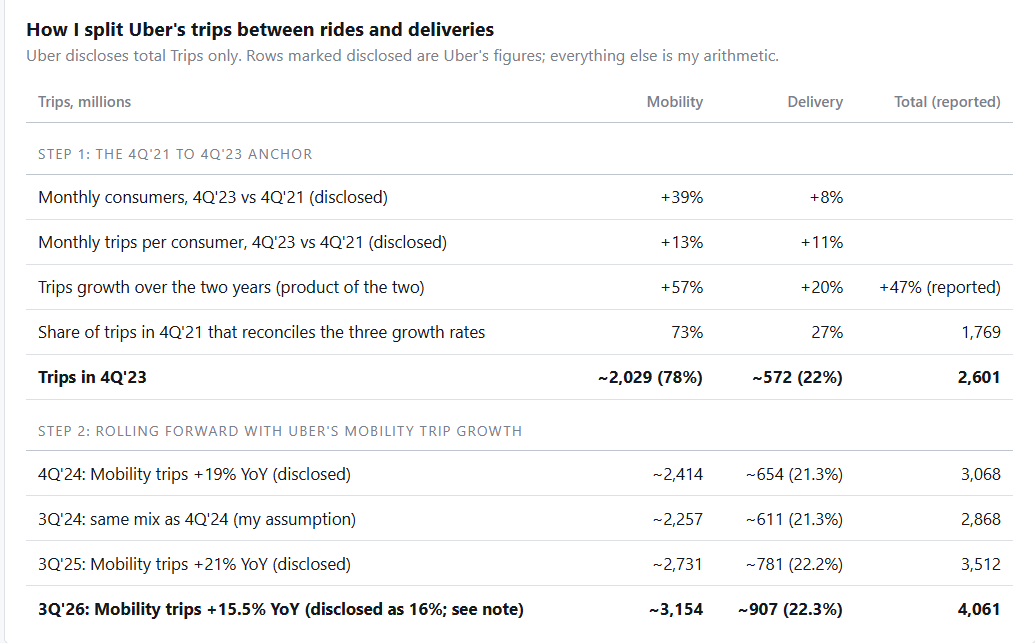
In Uber’s February 2024 Investor Update, they disclosed segment-level growth in consumers and trips per consumer between 4Q’21 and 4Q’23. Only one mix reconciles those with total trip growth, and rolling it forward with the Mobility trip growth Uber has disclosed since (with one assumption of mine, that the mix in 3Q’24 was the same as in 4Q’24) gets Delivery to ~22% of trips in 3Q’26, or ~900 million orders. The derivation is shown below. Please treat it as my estimate; a point of mix in either direction moves the per-order figures by ~4-5%.
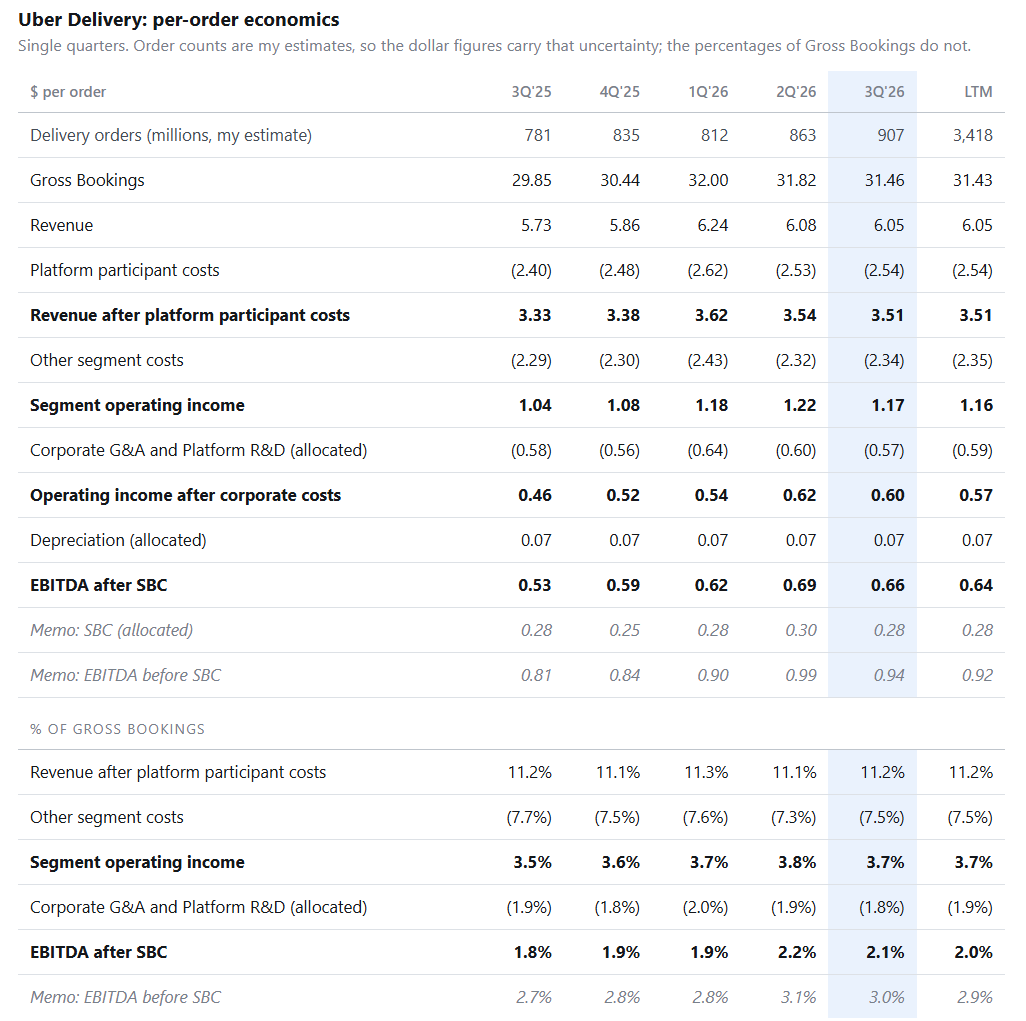
On my estimate, a Delivery order carried ~$31 of Gross Bookings in 3Q'26, of which Uber kept ~$3.51 after paying couriers and funding consumer incentives, and ~$1.17 after its other segment costs (up from ~$1.04 a year ago). Segment operating income, however, is before the ~$1.1 Billion a quarter of Corporate G&A and Platform R&D that Uber doesn't allocate to its segments. Allocating those by Gross Bookings costs Delivery ~$0.57 per order and, after adding back depreciation, leaves ~$0.66 of EBITDA after SBC per order in 3Q’26.
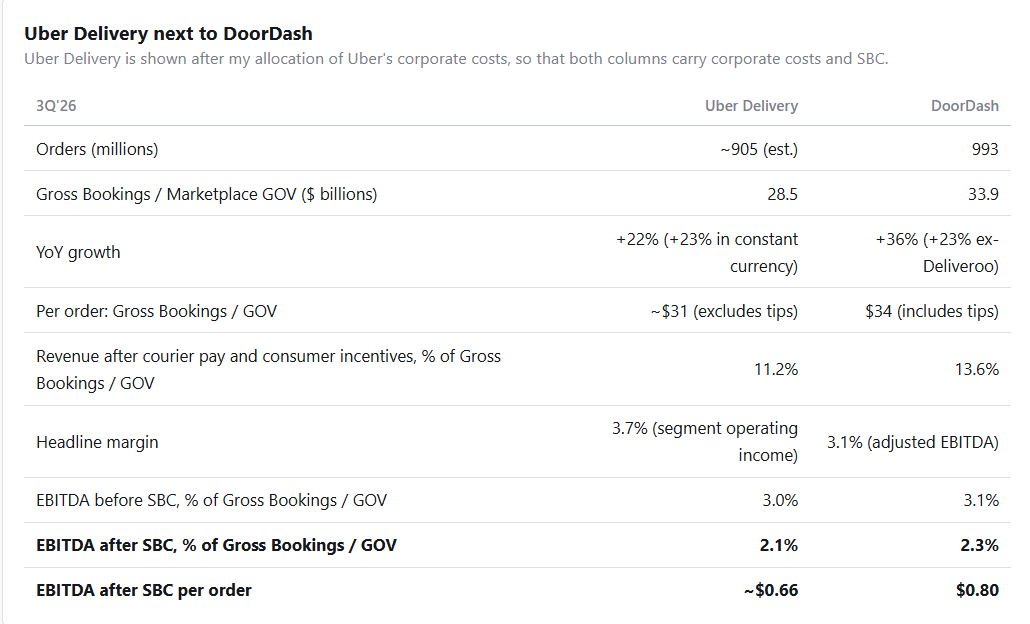
In my DoorDash 3Q'26 piece, I showed DoorDash made 76 cents per order, but that figure also deducted legal, transaction and restructuring costs, which Uber leaves out of its numbers. On Uber's basis (adjusted EBITDA less SBC) to make the comparison more apple-to-apple, DoorDash made 80 cents against 66 cents for Uber Delivery in 3Q’26.
As a percentage of the value of the orders, the two companies are close: ~2.1% for Uber Delivery vs ~2.3% for DoorDash after SBC, and ~3.0% vs 3.1% before SBC. That is not what the headline numbers suggest though. Uber reports a 3.7% Delivery margin against DoorDash's 3.1%, but Uber's number is before corporate costs and DoorDash's is before SBC. Once both carry their corporate costs and SBC, the two largest delivery platforms appear to earn more or less the same margin.
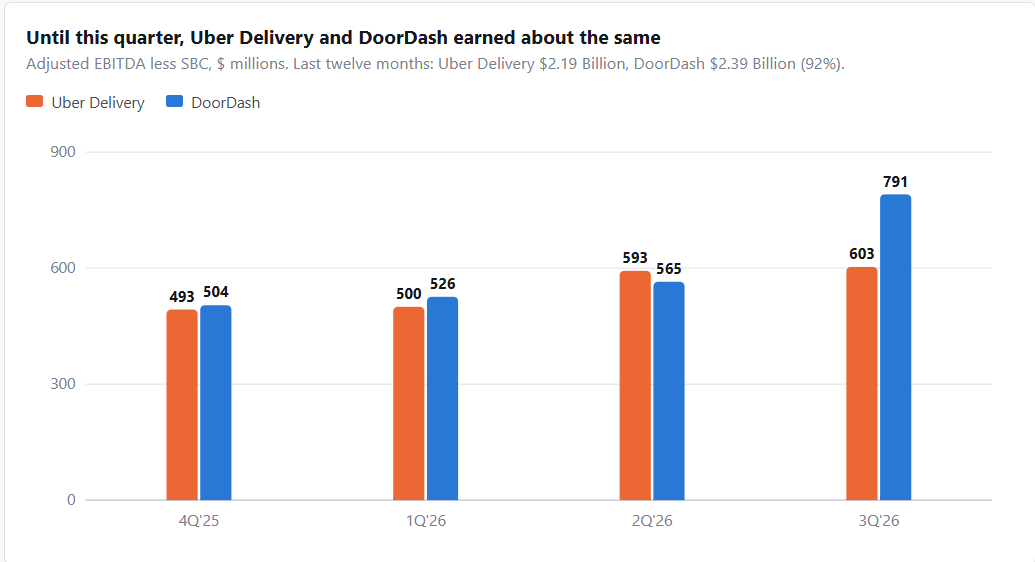
Since the two delivery businesses now earn similar margins and grow at a similar pace at somewhat similar scale, DoorDash's valuation is a reasonable yardstick for what Uber Delivery might be worth, and by extension for what the market is paying for Mobility. To keep the earnings apples to apples, I use each company's reported adjusted EBITDA less SBC. SBC is a structural cost, so it comes out, while legal, restructuring and acquisition-related items are excluded by both companies. Over the last twelve months, Uber Delivery earned ~92% of what DoorDash did.
DoorDash's enterprise value of ~$83 Billion was ~35x its adjusted EBITDA less SBC over the last twelve months, or ~26x the third quarter annualized. At those multiples, Uber Delivery would be worth ~$63-76 Billion, out of ~$138 Billion of enterprise value for all of Uber. That leaves ~$62-75 Billion for Mobility and Freight, or ~9-10x Mobility's adjusted EBITDA less SBC. Mobility earns about three times as much as Uber Delivery, but on this math the market values it at about the same.
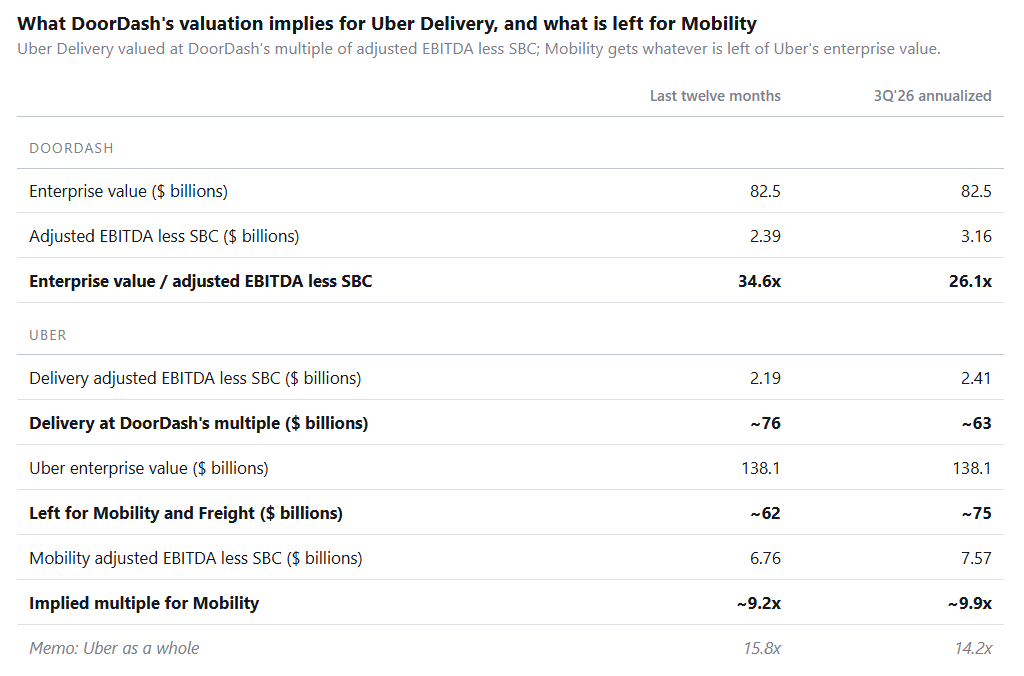
Of course, the most likely explanation is that the market is pricing in what AVs could do to Mobility, which is what I will discuss behind the paywall.
Subscribers get the daily journal and five+ years of Deep Dives, i.e. full-length analyses with financial models on 70+ companies. The daily is just how I think out loud between the Deep Dives!