
Amazon 3Q’26: Trillion Dollar Talks


Amazon rarely says much beyond the next quarter, yet in its 3Q’26 call management highlighted that AWS will grow over 40% in each of 2027 and 2028. Andy Jassy then added that Amazon “may have two of them”, i.e. trillion-dollar revenue businesses in AWS and stores, in the next 5-10 years.
In my mind, this unusual generosity is essentially Amazon asking investors for permission to keep spending. Cash capex will be ~$220 Billion this year and “meaningfully more” in 2027, LTM FCF is already -$42.4 Billion, and long-term debt has gone from $65.6 Billion to $173.1 Billion since the end of last year. Moreover, the 10-Q disclosed a new loan facility that lets Amazon borrow up to ~$80 Billion between early 2027 and 3Q’28 to pay for servers and other data center equipment.
Look, there is plenty of uncertainty around the long-term return profile of a buildout this size, especially given the increasing debt sloshing around the funding mix. Amazon is showing investors the revenue pathway in the near-term to assuage investors concerns. Jassy did acknowledge it might be “more convenient” if this opportunity played out over 25 years so the capex could be spread out, but “that's not the world that we live in”.
I will talk more about AWS, but as I typically do every quarter, I will first start with non-AWS segments of Amazon.
Amazon’s retail numbers may look pretty shabby at first glance, but before reading too much into the table below, remember that Prime Day moved from Q3 last year to Q2 this year in most large countries, which Amazon estimates took ~400 bps off its consolidated growth this quarter. That’s why 1P (online stores+ physical stores) grew just 1.6% YoY. Taking Q2 and Q3 together to wash out the timing, online stores grew ~8% and third-party seller services ~13% YoY.

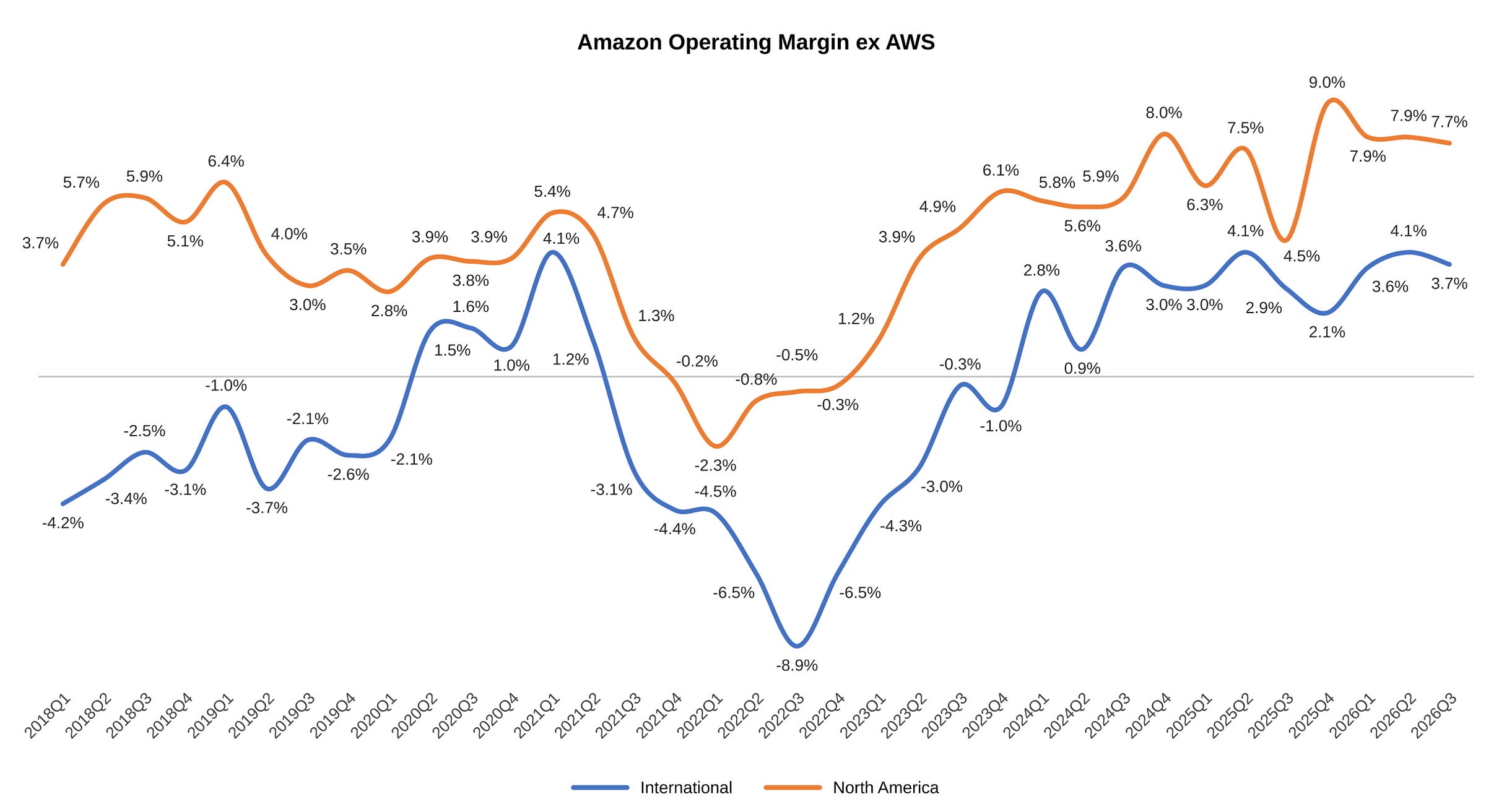
North America's operating margin was 7.7% and International's 3.7%. North America's jump from 4.5% a year ago looks dramatic on the chart below, but 3Q'25 included a $2.5 Billion FTC settlement. Excluding it, North America's margin was 6.9% last year, and the segment also absorbed part of the $1.8 Billion severance charge Amazon booked in 3Q'25 (Amazon didn't disclose the split). So the like-for-like expansion is probably well under 100 bps, which is still decent in a quarter with higher fuel and linehaul costs. Amazon also continues to expense most of Amazon Leo's costs. The CFO mentioned they now expect to start capitalizing some of them (production and launch costs) in Q1 next year, later than he had previously indicated, which should help reported margins in 2027.
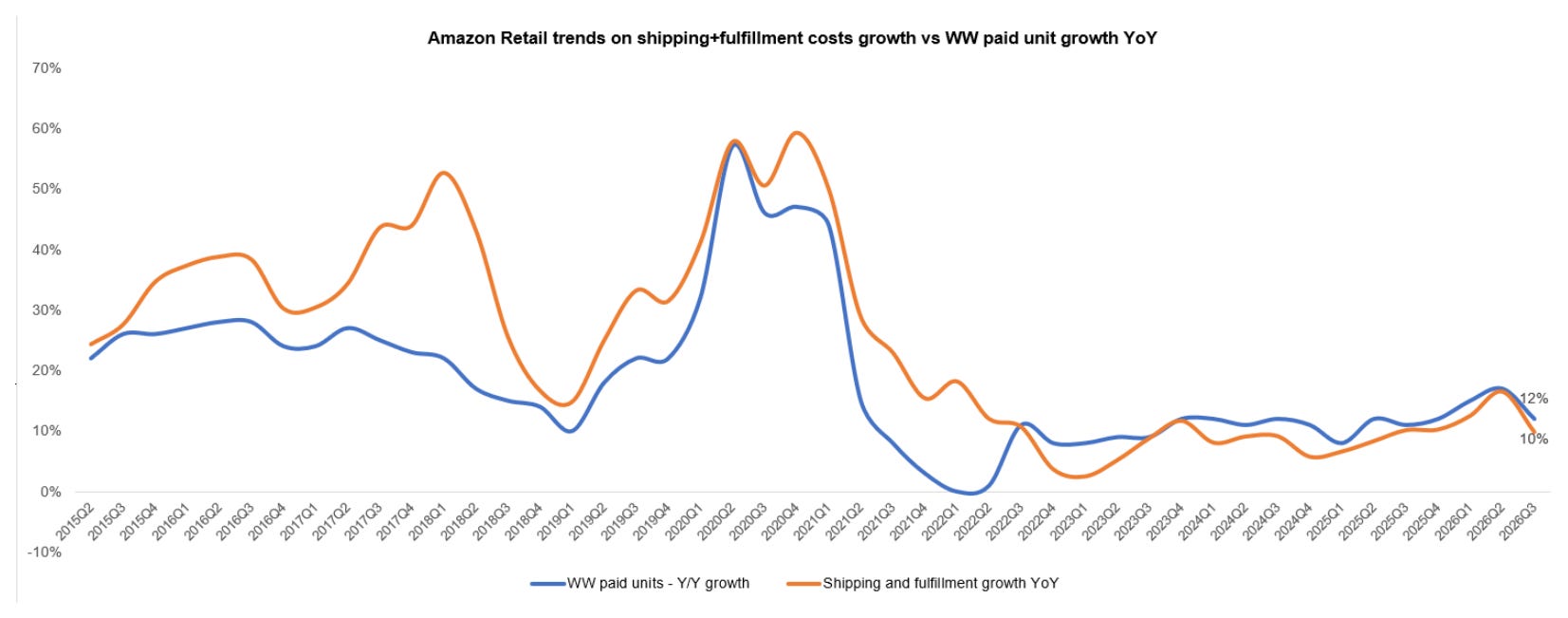
In 3Q’26, worldwide paid unit growth was 12% while shipping+ fulfillment costs grew ~10%. Amazon said that excluding fuel and linehaul inflation, shipping costs grew 8%, ~400 bps slower than units. The problem is that these cost pressures will be a bit higher in Q4 than they were in Q3, but there seems to more room for margin expansion if oil price comes down.
A big driver for retail profitability is advertising. Given Amazon ads are perhaps more of a competitor to Google than Meta, I pay close attention to Amazon's incremental share in advertising compared to Google Advertising. In 3Q'26, Amazon ads' incremental revenue was only 25% of Google Advertising's.
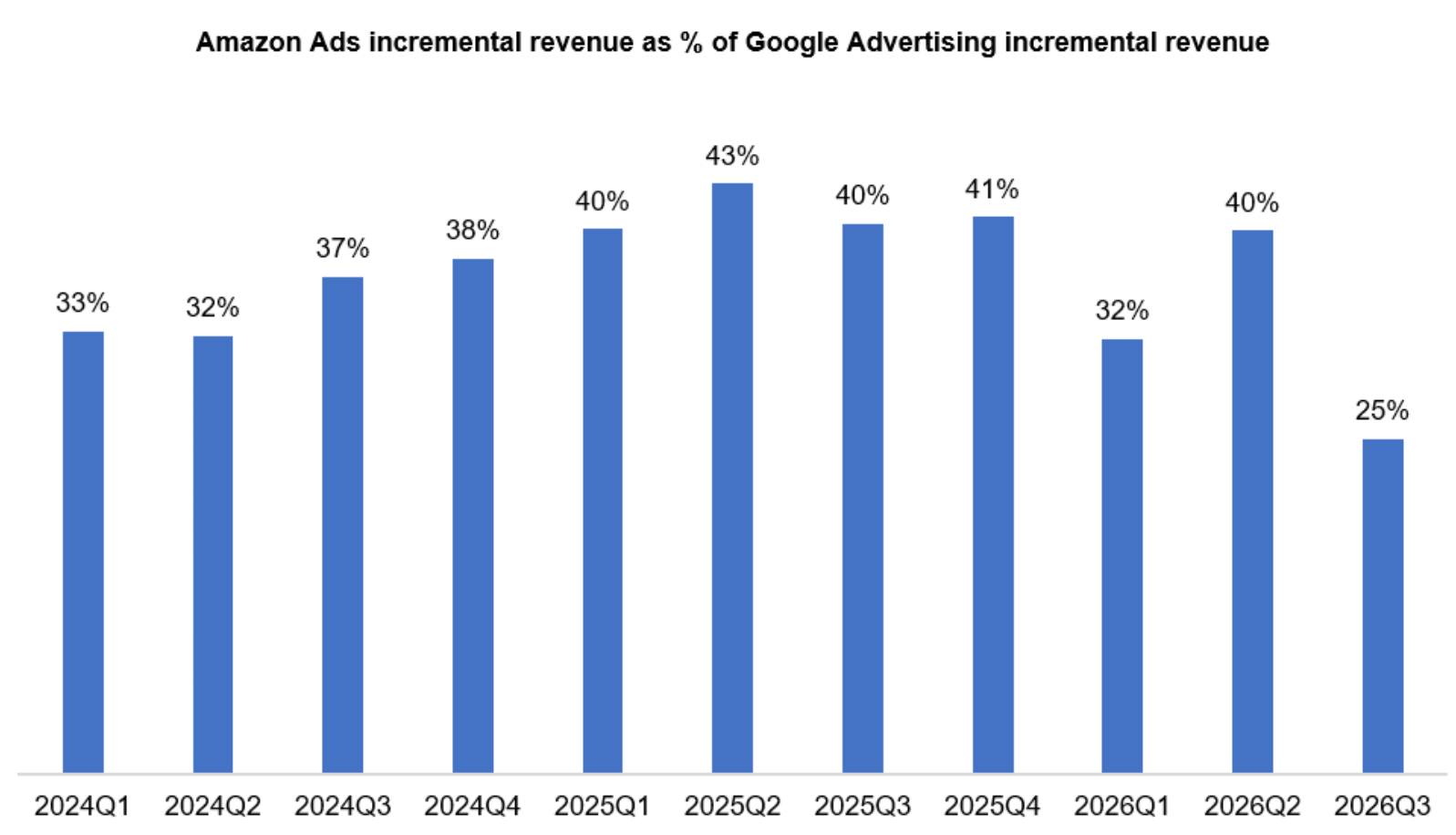
Prime Day explains a good chunk of it. Amazon ads grew 12% YoY (FXN) in 3Q'26, down from 26% in 2Q'26, and management walked through three items affecting the growth rates (emphasis mine):
“First, we shifted Prime Day into Q2 for most countries, moving significant sales and ad revenue that were in Q3 2025 into Q2 2026, a tailwind to our Q2 2026 rate and a headwind to Q3 2026. For advertising, that was 850 basis points sequential impact to Q3 year-over-year growth. Second, Q2 2026 included the first season of NBA on Prime, which last year's Q2 didn't have. Q3 does not include any NBA, it starts in Q4. Third, in Q3 2025, we changed our search engine marketing programs to drive more traffic to search pages on Amazon. It's a better experience for customers, and we also monetize that traffic at a higher rate. That helped accelerate advertising revenue growth starting a year ago, and we started lapping that in Q3. We expect year-over-year growth will return to the high teens in Q4.”
These explanations are reasonable, but it’s interesting that we are only hearing them now. On the 2Q’26 call, when ads grew 26%, the CFO did say Q2 results included the Prime Day shift and flagged its ~400 bps hit to Q3 revenue growth, but they didn’t bother to quantify what it did to ads. The search engine marketing change is more striking. I went back through the 3Q’25, 4Q’25, 1Q’26 and 2Q’26 calls and couldn’t find a single mention of it. Wouldn’t it be useful to know that for shareholders what was contributing to ads growth back then? Management explaining weak quarters more readily than strong ones may be commonplace in public markets, but nonetheless not a good look for Amazon management.
Anyways, when we look at Q2 and Q3 combined, which also nets out the World Cup that shifted some of Google's ad budgets between those two quarters, we can better compare Amazon and Google advertising:
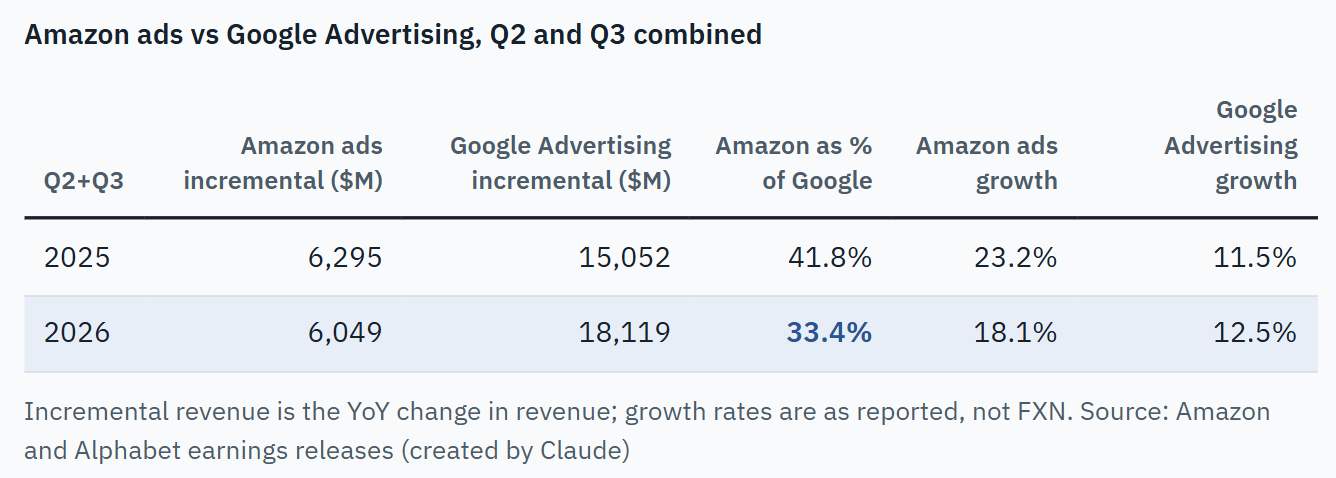
As you can see above, even on this basis, Amazon's incremental share vs Google fell from ~42% to ~33%, which is about where 1Q'26 was (32%). Over the last three quarters, Amazon's incremental share does appear to have stepped down from ~40% to the low 30s. What makes this stranger is that Google Search itself just had a poor quarter. So, it is telling that Amazon ads is looking a tad bit shabbier than Google!
In my 1Q'26 coverage, I speculated that Amazon ads may be structurally positioned worse than Google and Meta in this AI cycle, since sponsored products sit at the very bottom of the funnel where AI adds little, and Amazon's inventory is capped by search results and product page real estate that's already heavily loaded by ads. I said I would have more sympathy for that thesis if the incremental share kept declining. Three quarters is still a small sample, but the numbers are moving in that direction. Jassy did brush away the more existential concern though; external shopping agents are not meaningfully affecting Amazon ads because few customers shop that way yet, and Amazon believes Alexa for Shopping will be the primary agent customers use to shop on Amazon. Management guided ads to grow in the high teens in Q4 and given Google’s commentary for Q4 (tougher comp, larger FX headwind), Amazon ads may look much better in this comparison next quarter.
Okay, enough about non-AWS business. Let’s get into AWS which will be behind the paywall.
Subscribers get the daily journal and five+ years of Deep Dives, i.e. full-length analyses with financial models on 70+ companies. The daily is just how I think out loud between the Deep Dives!