
What people are prompting in PostHog AI


As a product marketer, I’m a bit nosy. Are you?
You must be seeing as you clicked on this post. In that case, let’s take a peek over PostHog AI’s shoulder into the past year of prompting.
See how we aggregated this data .
Shareholder value never sleeps
In local time, founders sent 20% of their prompts on weekends and 6.8% between midnight and 5 AM. For comparison, sales people sent 6.3% of prompts on Saturday/Sunday and 2.6% around the witching hour.
Marketers asked PostHog AI about revenue more than founders did (1.42% of prompts vs 0.88%), but founders made up for it by working later hours. More than a quarter of founder prompts (28%) arrived after 6 PM.
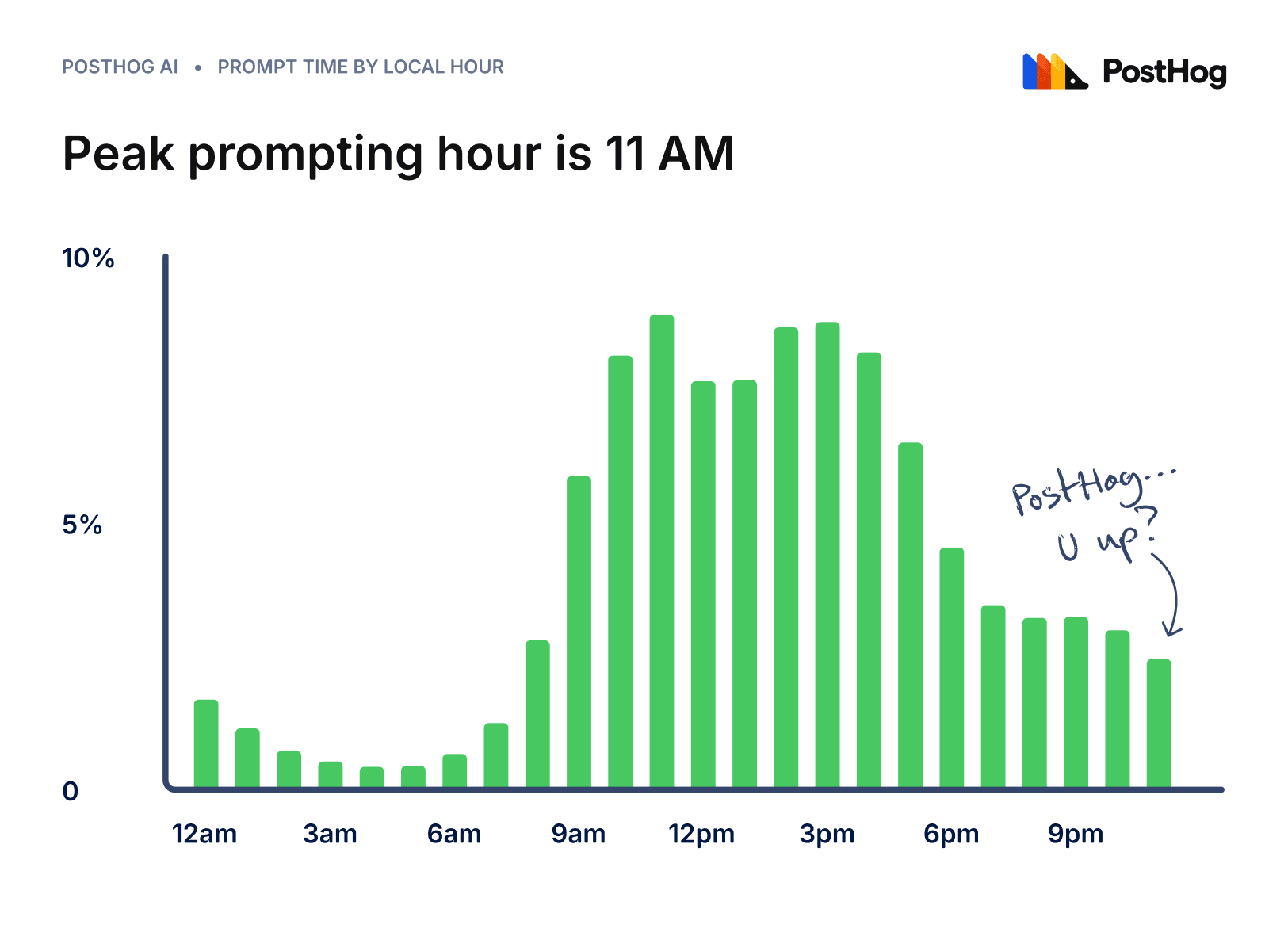
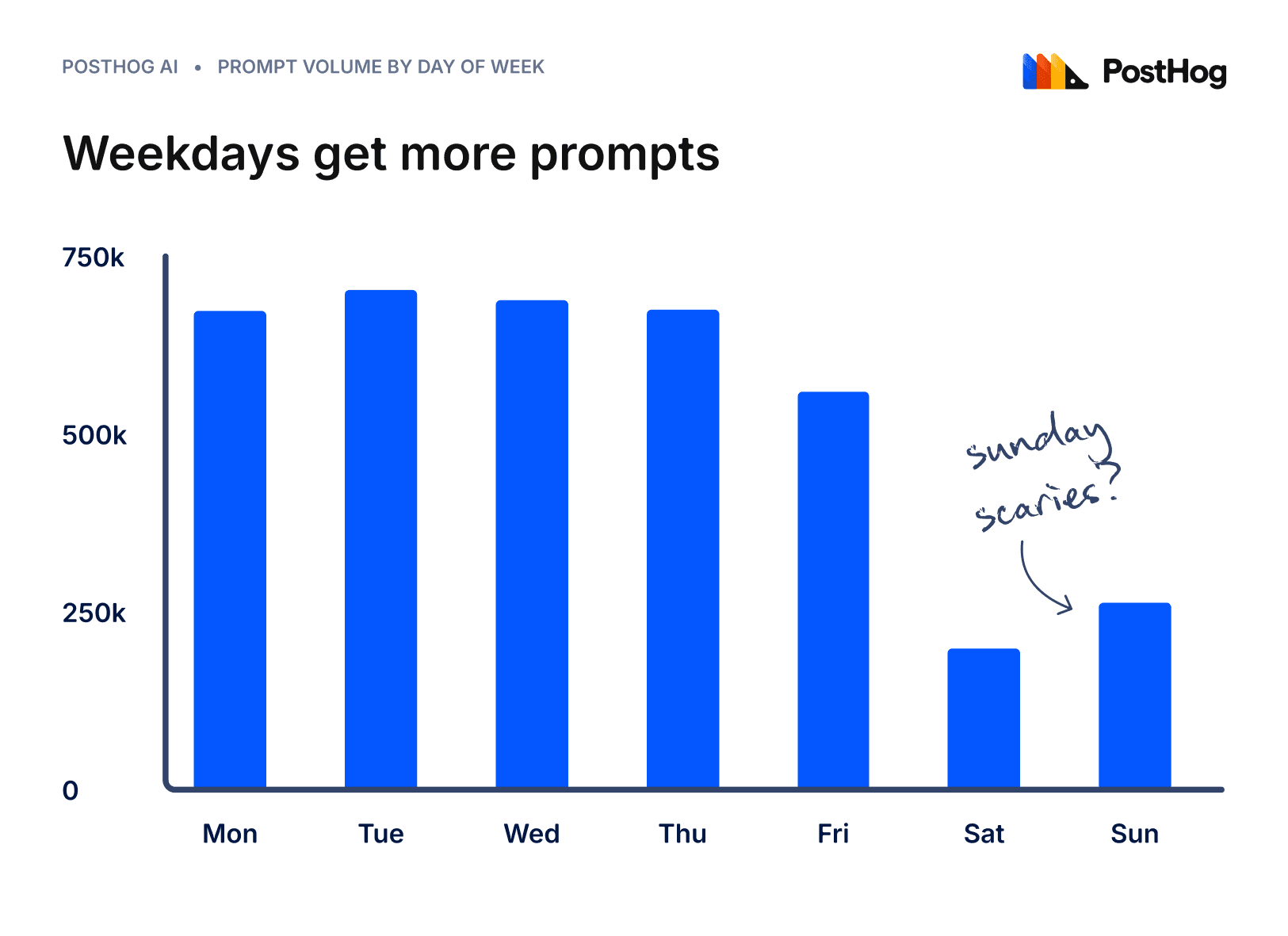
In aggregate, Tuesday is the busiest prompting day of the week, and the peak hour to prompt is 11 AM local time. Conclusion(?): PostHog AI pairs nicely with your second coffee.
Prompters mind their manners (mostly)
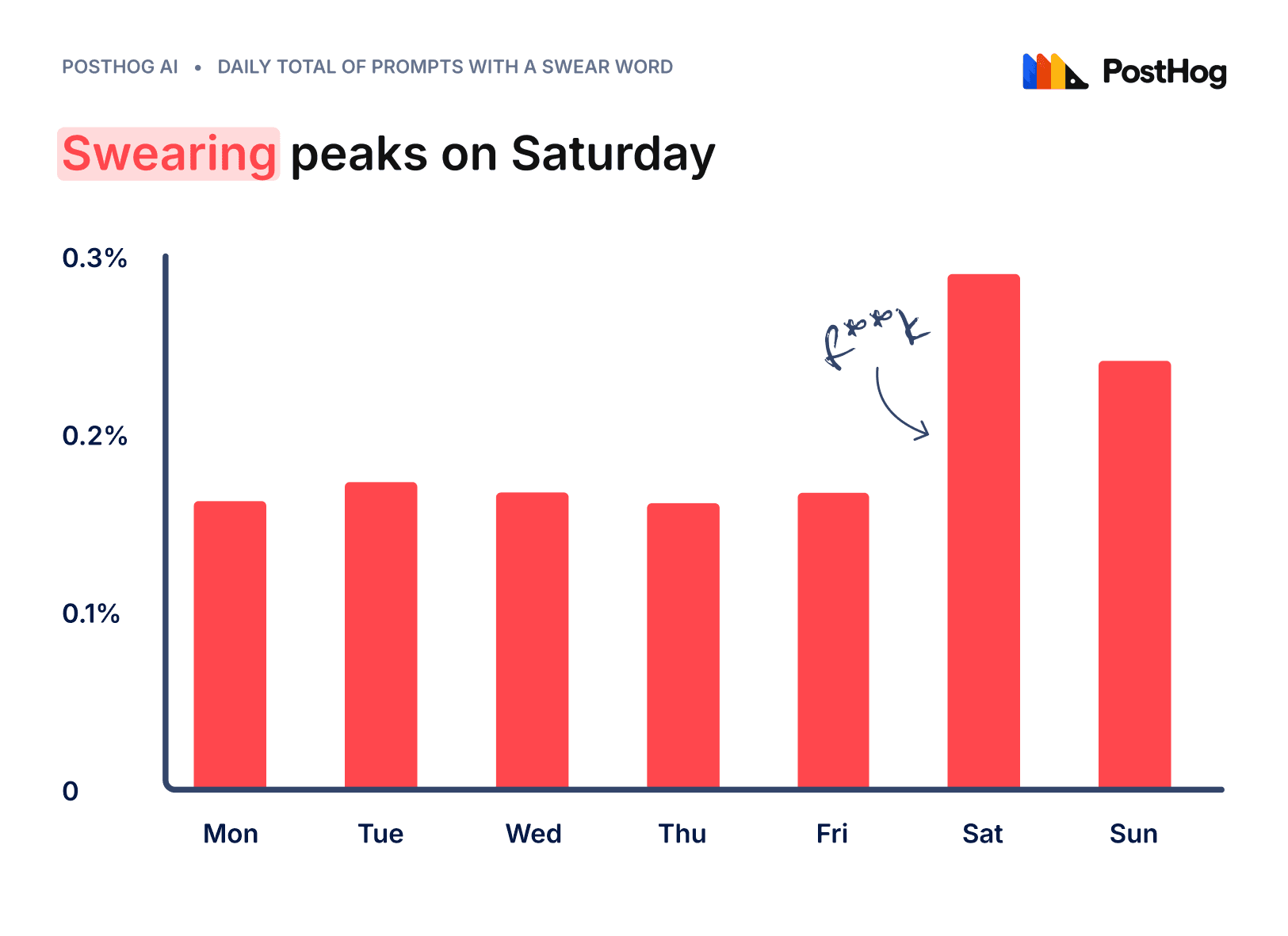
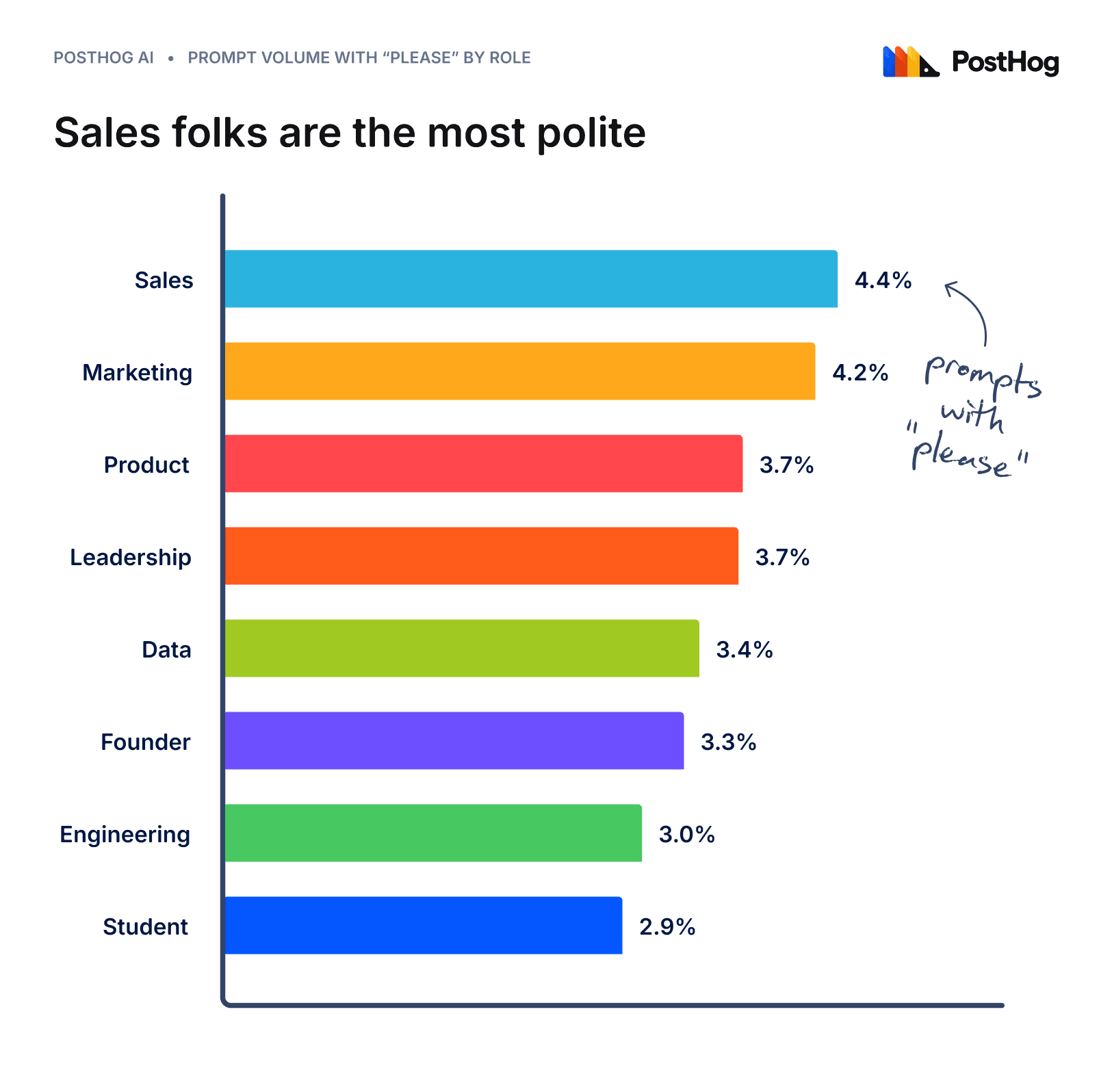
People treat PostHog AI like a new coworker. That is to say, formal at first, then friendly, then a bit rude. 15% of people said "please" at least once. Only 2.7% of prompters ever said thanks (including thanks, thank you, thx, ty). Month to month, politeness stays flat. But people loosen up the more they use PostHog AI: by their 101st to 500th prompt, they say please twice as often as in their first prompt, and they swear four times as often.
In fact, founders seem a bit stressed. They swear at PostHog AI the most (3x the rate of product managers). In the past 12 months, there were 6,716 apologies to the AI, 2,887 f-bombs, 1,037 "wtf"s and 4,324 all-caps rants.
PostHog AI: data analyst, career coach, therapist?
Prompters put their trust in PostHog AI, asking things like "what should be my goal if I wanna make this startup actually successful?" and "I want to create a weekly report and send it to my boss. Please help me".
1,424 people asked our AI how to pay us less (which we can definitely help with), and almost 800 people asked for help with something for their boss or investors. 734 just wanted to know "is this good?"
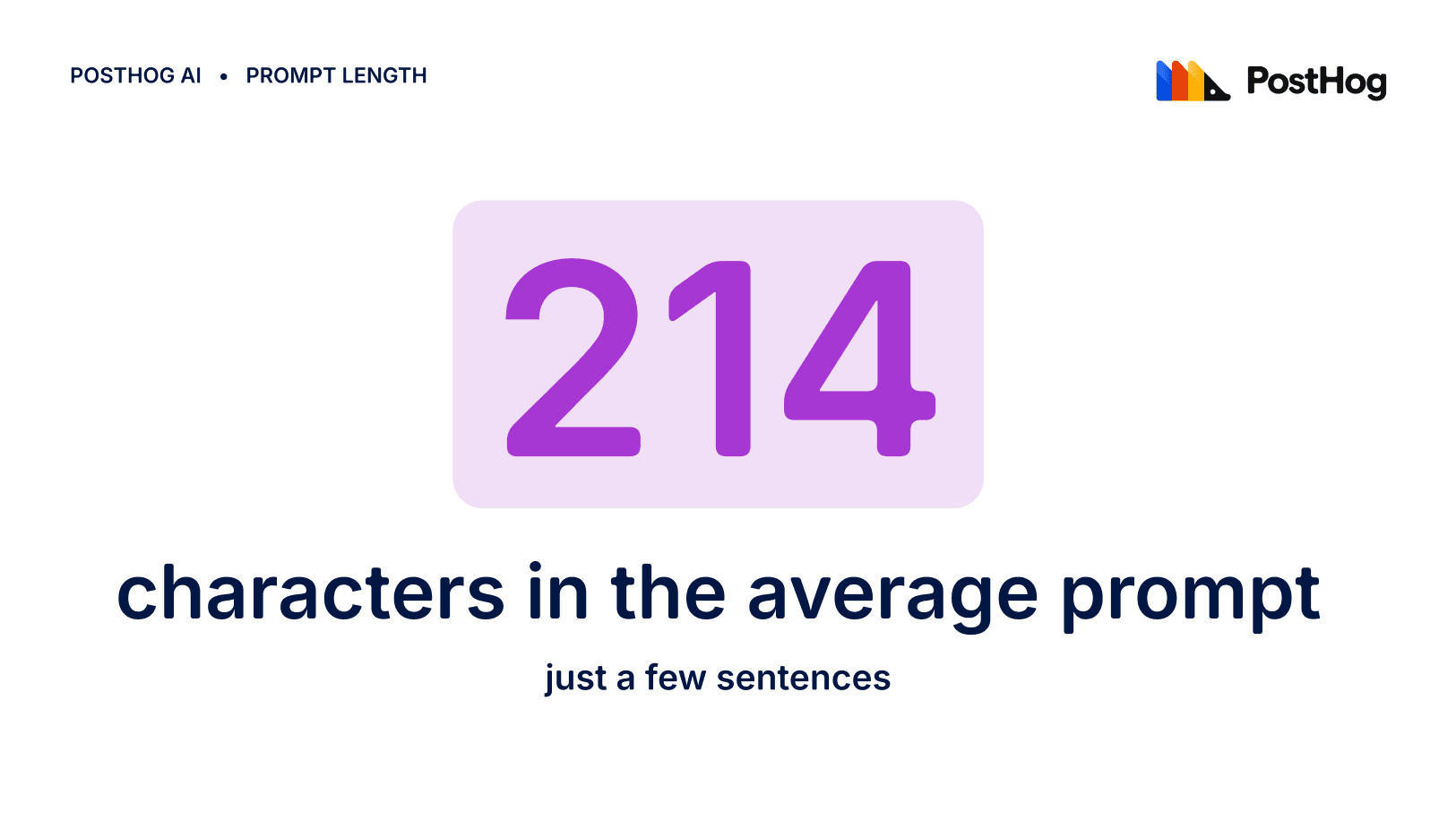
Even though more than 4 in 10 prompts have no capital letters, and sometimes contain a mild crash out like “I NEED A F*CKING USER FUNNEL CHART AAAAH”, PostHog AI was happy to help with (almost) every query.
Yes, and?
One prompt in four was a question. 8% started with a specific request ("show me", "create"), and 6% with "can you" or "could you". 56,548 prompts were a greenlight to whatever PostHog AI suggested, saying only "yes", "ok" or "go ahead".
A lot of people asked about PostHog Dashboards (more than 53,600). Next were session replay (45.1k), funnels (40.0k) and general web traffic (31.5k). Other popular topics included feature flags, retention, surveys, experiments, and error tracking.
All roles ask data questions
People with a data role are the heaviest PostHog AI users: an average of 29 prompts per person. When digging into the data, people asked about drops in their metrics 2.3x more than spikes.
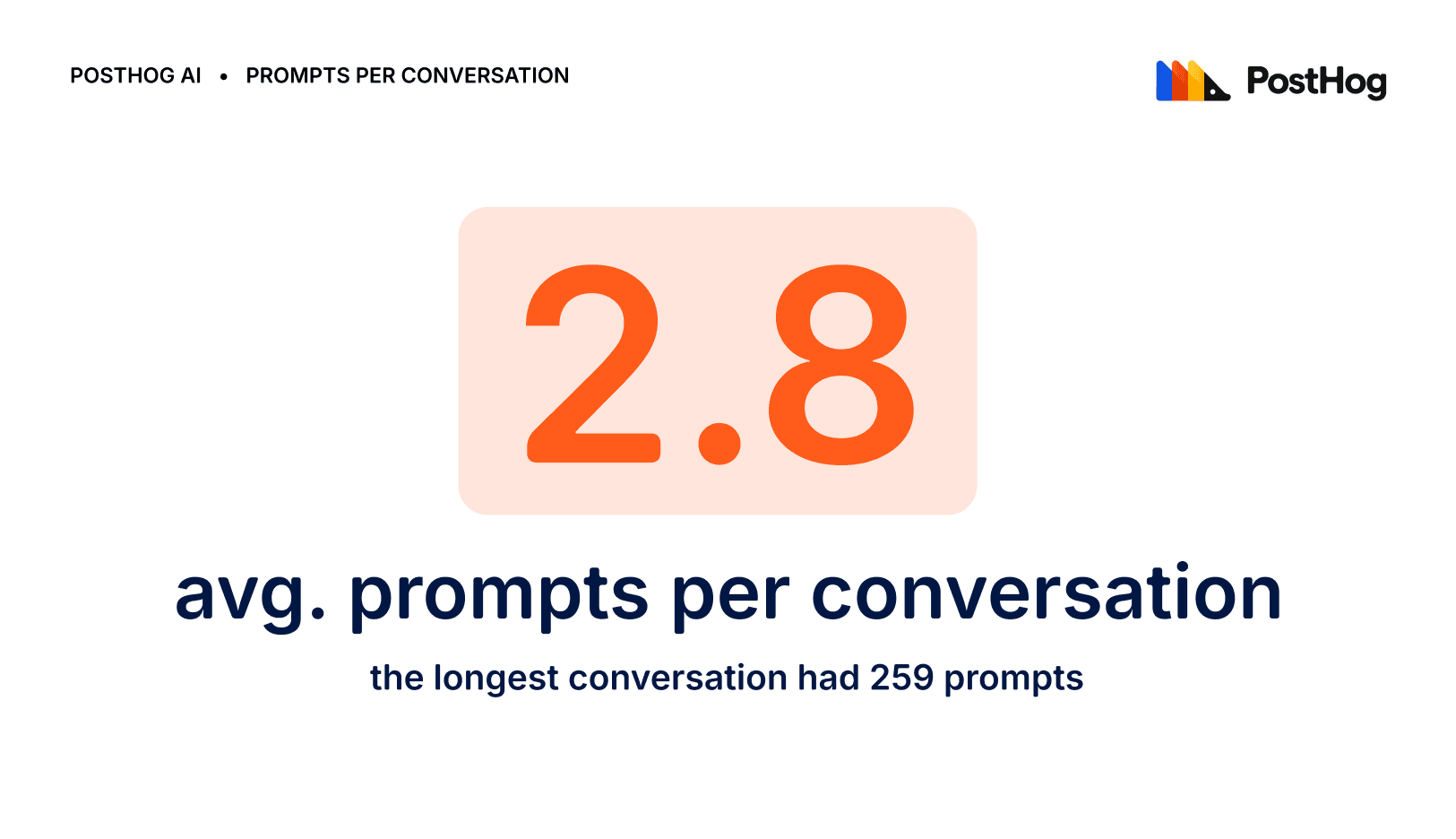
Founders ask about "the last 24 hours" or "right now" 2.5x more often than data people do. Marketers ask for "all time" and "top 10" more than anyone else.
For unknown reasons, engineers ask for pie charts almost 2x as often as data people. 414 people asked specifically for a Sankey diagram, but other people who wanted one didn’t know it was called that (PostHog AI inferred from their description).
Who are you, really?
Prompters misspelled "PostHog" in at least 29 ways. 2,916 people wrote "Post Hog" with a space. The top typos are poshog, posthug, psothog, and posthig. Only 350 people mentioned hedgehogs (which is shockingly low).
When asking PostHog AI about other tools, Claude was the most named (by 7.2k people, and 2.3k of them meant Claude Code), followed by Slack (6.2k), Stripe (5.5k), GitHub (3.2k), ChatGPT (2.9k), Vercel (2.8k), and Supabase (2.4k). We did not count ad and social platforms, like Google Ads and Facebook. More than 270 people asked PostHog AI who it is or which model it uses. 99 people still call it Max, its old name before it became PostHog AI.
Celebrating data all year round
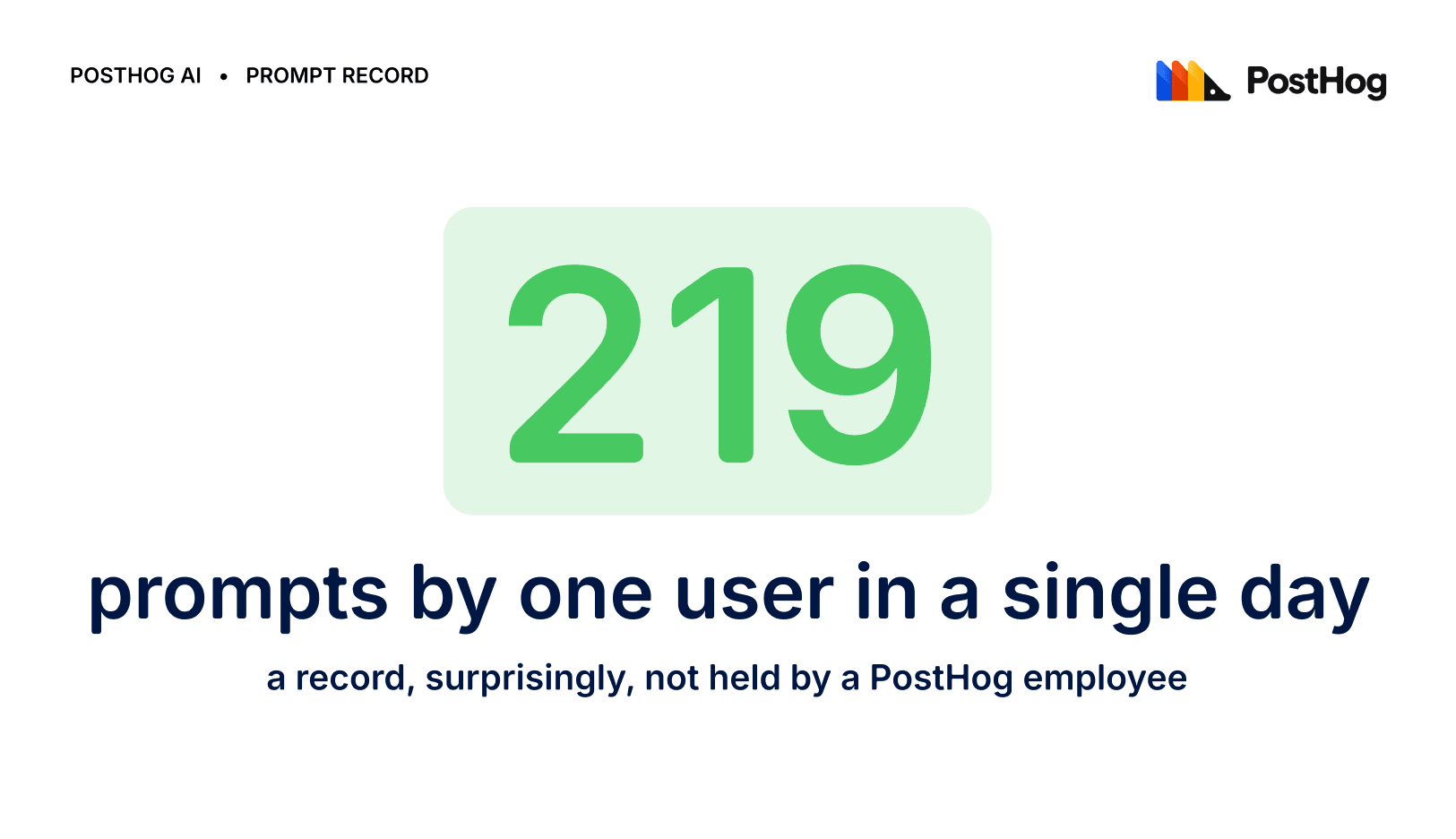
People prompted PostHog AI every single day of the year. The longest streak of consecutive days with prompts from a single person was 49.
Compared with a normal day, New Year's Day 2026 was the quietest day of the year, with only 29% of the people of a normal Thursday. Plenty of people were still prompting, though. Over the past year, 1,218 people sent the exact same prompt 5 or more times in one day. It wasn’t Groundhog Day (or maybe it was?).
What each role actually asks
- Founders: "Is anyone real, and are they paying?" Their signature phrases are hard paywall, RevenueCat, Lovable app, running ads, exclude myself, real people, users yesterday, week growth. They ask about retention and churn more than any other role.
- Engineers: debugging. Source maps, captureException, node sdk, network error, staging project, dev env, flag fully rolled out. They ask the most about feature flags, errors and things that are broken.
- Data people: the database. Events table, persons table, sql editor, count distinct, distinct ids. They ask "how many" the least of any role, maybe because they write the SQL themselves.
- Marketers: ad spend. Paid social, paid search, google cpc, linkedin ads, campaign name, form submissions. They ask about web traffic and UTMs more than twice as often as any other role.
- Sales: customer research. Top users, most active, power users, company name, email domain, find recordings. They use session replay more than any other role, and experiments the least.
- Product managers: adoption rate, NPS survey, test group, entry points, details page.
- Leadership: traffic sources, website visitors, total revenue, conversion rates, stacked bar.
How we pulled this data
What: We used every message that people sent to PostHog AI in the PostHog web app from October 28, 2025 to October 27, 2026: 3.67 million messages from 230,000 people, on US Cloud and EU Cloud.
This does not include PostHog AI in Slack or the prompts that people send to their own AI tools (like Claude Code or Cursor) through the PostHog MCP server. Those go to a different agent: the MCP server only runs tool calls in PostHog, and the prompt stays in the person's own tool. If you want to know what those agents get up to, we watched them too.
Where it comes from: We did all of the work in PostHog:
- Product Analytics: PostHog records an event each time a person sends a message to PostHog AI. Product analytics connects each message to a person, with their job role and time zone. People can choose their job role when they sign up (it is optional), and the time zone comes from their IP address.
- SQL and Python: Every number in this post comes from a SQL query. For the local-time and holiday stats, Python did the math on the SQL results.
- Notebooks: All of the queries were dumped into four PostHog notebooks, with SQL and Python cells, so any person on our team can run them again.
- PostHog Slack app (with the PostHog MCP): This started as an idea in Slack, where I tagged our trusty agent to write and run the queries.
What we removed:
- Test scripts. 315 accounts sent the single word "hi" 100 or more times, about 157,000 times in total. One of them said hi 1,613 times in 15 days. We removed every message that was only "hi" just to be safe.
- All prompts from PostHog employees. We use PostHog AI all day, so our messages might skew important things like pineapple on pizza prompt volume.
- Identifiable information. The source data has person IDs, but totals are anonymous. For each quote, we removed names, company names, emails, web addresses and IDs. We kept the spelling mistakes. We did not use a quote if it could identify a person or a company (but if it was Joe, I’d definitely tell you).
Limits:
- We counted messages, not conversations. People who send many messages have a bigger effect on the percentages. Some messages come from suggestion buttons, not typing (for example, "Explain this insight"). We removed those from the topic counts.
- Location data has a gap. From March to July 2026, the location data for many people showed server locations, not real locations. We removed those months from all time-of-day stats, and we do not show stats by country.
- Daylight saving time: our local-time conversion uses two reference dates (January and July), so some hours near a time change can be off by one.
- Role comparisons cover the seven main job roles: founder, engineering, product, marketing, sales, data, and leadership. Small groups, such as students, are not in these comparisons.
- Keywords are not perfect. They do not find typos or sarcasm. For example, "please make it work" counts as polite (even if it was meant as snarky).