
Two Crows Took a Classic Psychology Test. Their Decision-Making Skills Left Ours in The Dust.


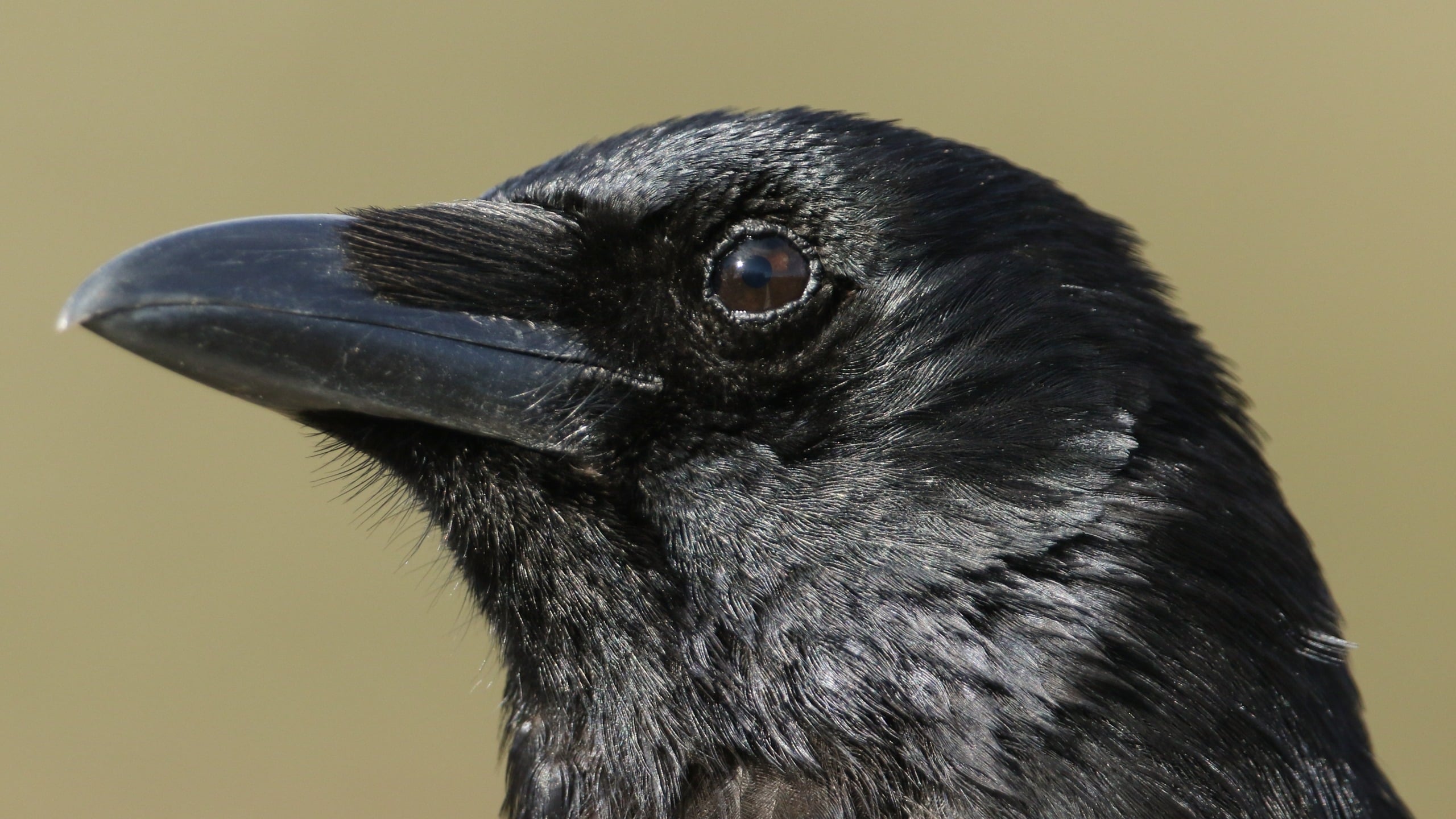
Two male crows have performed better than humans and monkeys in a classic psychology task designed to test how the brain makes decisions based on what it sees.
In prior experiments, corvids (a family of birds that includes crows, ravens, rooks, jackdaws, and jays) have shown a range of remarkable mental abilities once thought unique to primates.
New Caledonian crows build compound tools and plan three steps ahead; western scrub jays have episodic-like memories; ravens are "smart enough to be paranoid".
Now, two neurobiologists from the University of Tübingen in Germany have tested the decision-making prowess of carrion crows (Corvus corone), and the results kind of leave our primate brains in the dust.
The research is published in Science.
The researchers Philipp Schmidbauer and Andreas Nieder are not only interested in demonstrating crows' intelligence. They want to understand how the birds manage such intellectual feats with such fundamentally different brains from ours.
"Such behavioral flexibility might seem unexpected because a layered cerebral cortex, the highest integration center in the mammalian brain, is not existant in birds," Nieder wrote in a paper almost a decade ago.
Instead of layers, he explained, bird brains rely on circuits that originate from a different part of the pallium. Their brains are smaller than ours, but so are their neurons, which means less distance for information to travel, and more processing power per square inch.
"With this independently evolved endbrain design, the corvid brain affords twice as many neurons as a primate brain of equal mass, adding up to enormous processing powers in a small and densely packed 'birdbrain'," he added.
The new experiments demonstrate just how powerful those 'birdbrains' can be.
Two male adult crows were put to the test. That's a very small sample size, which makes it impossible to know if the results can tell us much about crows in general. But it's a start.
Each crow was placed in front of a touch-sensitive screen. In each session, the screen displays lots of dots, and then some of those dots move in one direction, left or right. The crow indicates which direction the dots are moving by pecking at a target on the corresponding side of the touch screen.
A correct response is rewarded with a tasty mealworm.
The task is self-paced: the crows were given a wide window of time to choose their response, because the idea is that the animals express their decision once they are confident in their choice, not just for the sake of speed.
Both crows were trained in this test across more than 100 sessions each before the real data were collected, to make sure they had it down.
Humans and monkeys have previously demonstrated their perceptual decision-making via this random-dot motion discrimination task, but this is the first time crows have been tested.
The birds made deliberate decisions "with unprecedented speed, reporting choices in approximately 235 milliseconds on average, which is roughly twice as fast as has been observed in monkeys or humans," Schmidbauer and Nieder report.
And that speed came at no cost to accuracy.
Next, the researchers implanted electrodes into the crows' brains. They were specifically placed to monitor the nidopallium caudolaterale (NCL), which contains neurons involved in perceiving motion direction (like the dots on the screen).
On waking from surgery, the crows once again performed the random-dot task, this time with the activity of 248 individual neurons on record.
These neurons fired signals related to the crow's imminent decision just 70 milliseconds after the dots started moving, and about 170 milliseconds before making the decisive peck.
These results suggest the crow brain has "primate-like computational dynamics within a distinct neural architecture, with markedly higher temporal efficiency," Schmidbauer and Nieder write, adding that crows' decision-making speed may be the result of specific pressures birds have faced in evolution.
"Birds rely on their vision to carry out precise, rapid maneuvers during flight and to guide their beaks toward objects when foraging," Nieder says.
'Birdbrains' is starting to sound more like a compliment after all.
The research has been published in Science.