
A Happy 6th Birthday to the Computer Architecture Student Association


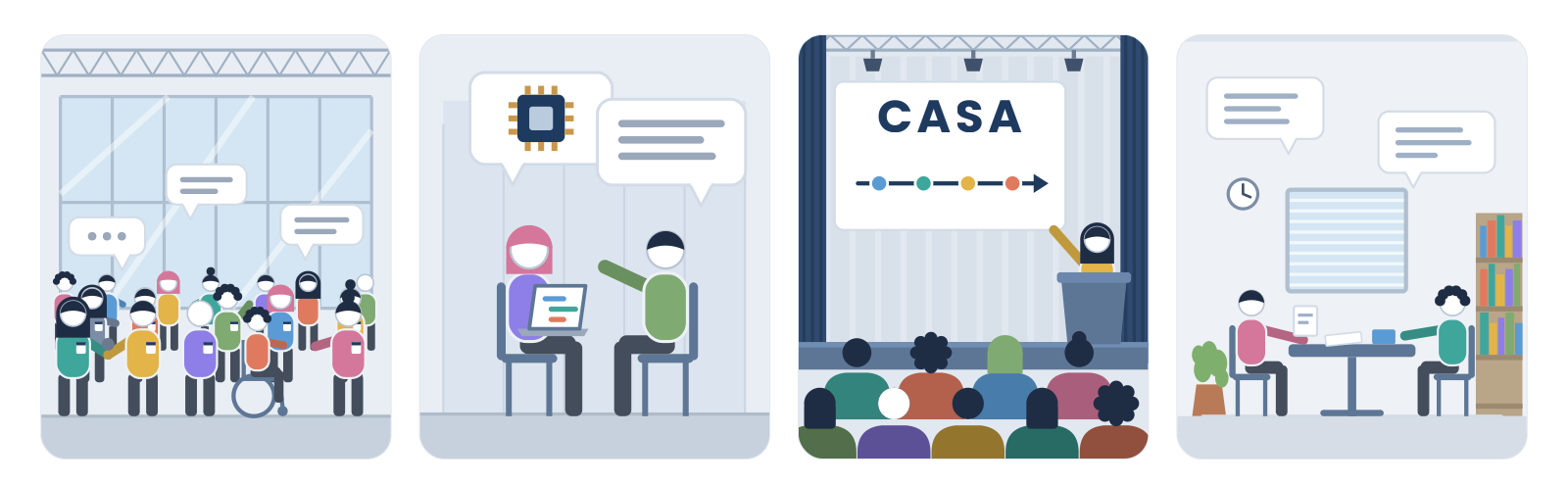
As we approach Computer Architecture Student Association’s (CASA) 6th birthday, we want to take a step back and reflect on the previous years’ contributions, as well as highlight the exciting programming that CASA is bringing in the upcoming year. Our mission continues to ensure student wellbeing and foster a sense of belonging across the greater computer architecture community.
CASA continuously runs a variety of student programming throughout the year (see below for more detailed information), and getting involved in CASA is easy. For students, there are no strict eligibility requirements, so join the slack via this form and get involved. For the broader computer architecture community, your participation is central to the success of many of the programs we run throughout the year. If you would like to support us, please reach out at comparchsa@gmail.com.
Recap of CASA’s 6th Year
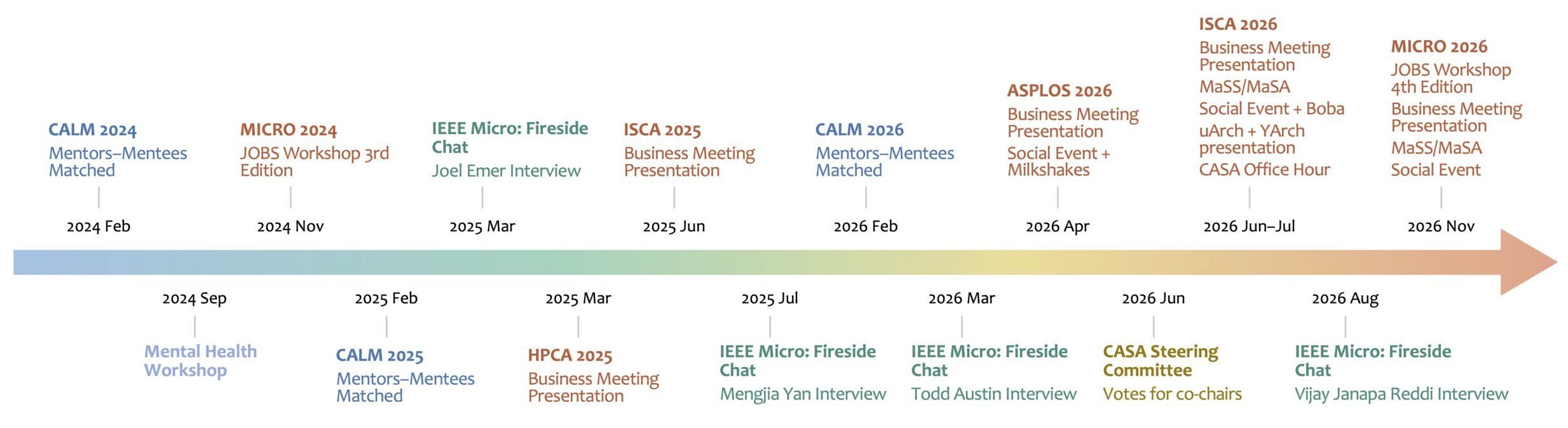
A Refreshed Student Organization. Originally founded in 2020, by Elba Garza (UW) and Raghav Pothukuchi (UNC), CASA is a student-led organization designed to ensure student wellbeing and foster a sense of belonging across the greater computer architecture community. Our programming is mostly geared towards graduate (and undergraduate) students, however, there are no limitations or eligibility requirements for participating or joining in our programs. Our activities focus on three major areas: community, mentorship, and student wellbeing. The success of many of these activities would not have been possible without the support, including time and expertise, from senior members in our community, or financial support from professional organizations.
Student Community/Events. At conferences, CASA holds student social events to help students meet each other and build up the student community. Some examples from 2026 include a milkshake event at ASPLOS 2026 and a bubble tea social at ISCA 2026. These events have been graciously sponsored by SIGARCH, SIGMICRO, TCCA, and TCuArch. Stay tuned for our upcoming event at MICRO 2026 in Athens and if you’re interested in helping organize more of these events (or have fun ideas), please feel free to reach out. Here are some photos to commemorate 🙂
MaSS/MaSA. Want to meet someone new at a conference, or someone you might be reluctant to approach directly? Participate in Meet-a-Senior-Student (MaSS) and Meet-a-Senior-Architect (MaSA). MaSA was originally started by Joel Emer at ISCA 2016 to help connect junior researchers (i.e., students) to senior architects (e.g., professionals, professors, researchers who self-identify as willing to mentor) for a single casual 1:1 mentoring session. In the same spirit, MaSS was launched at MICRO 2020 to help connect senior PhD students and postdocs to junior PhD students and undergrads. Throughout the years, the MaSS/MaSA program has been positively received, spurring interest across the different computer architecture conferences, as well as at HotChips in 2026. This year, CASA took responsibility for leading MaSS/MaSA and successfully ran the full program at ISCA 2026 with 470 participants. Additionally, we prototyped a new website system, developed by Nathan Bleier (UMich), to create long-term profiles for pairing participants across conferences. Thanks to the 2026 MaSS/MaSA team: Ryan Wong (Illinois), Shashank Nag (UT Austin), Nathan Bleier, and Joel Emer. Be on the lookout for MaSS/MaSA participation at future conferences, including MICRO 2026!
CALM. Beyond conferences, CASA aims to provide opportunities for students to receive and build long-term mentor-mentee connections through Computer Architecture Long-term Mentoring (CALM). CALM is a year-long program that matches mentees, i.e. graduate and undergraduate students, with mentors who are senior members from industry and academia (non-students) for 1:1 mentoring. The frequency and structure of the meetings are decided by the mentor-mentee and are typically low overhead. Depending on their stage, students have the opportunity to gain new perspectives and ask about topics such as career advice, high-level research directions, and PhD applications. Over the years, we’ve had success with growing the program globally and this year is CALM’s biggest year to date with 51 mentors and 82 participating mentees (2x the pilot program in 2021)! Thanks to Khyati Kiyawat (UVA) and Haiyue Ma (Princeton) for all their efforts in running CALM this year. For a more detailed overview of CALM, we encourage you to visit our 2023 SIGArch blog. CALM runs from January through December, with signups in late November/December, so be sure to keep an eye out for the call for participation!
IEEE Micro Fireside Chat Interviews. The Fireside Chat column was launched by Hsien-Hsin Sean Lee when he was appointed Editor-in-Chief of IEEE MICRO magazine in 2024. Sean generously invited CASA students to take an active role in the column by interviewing leaders and luminaries in our field. The columns take an interview format, and aim to share the interviewees’ stories on their career paths and achievements, as well as their vision and advice to the future generations of architects. So far, CASA has conducted more than five interviews, and four of them are already published, which you can find here: Joel Emer (MIT/NVIDIA), Mengjia Yan (MIT), Todd Austin (UMich), and Vijay Janapa Reddi (Harvard). More to come!
Representing Student Voices. CASA is proud to represent student voices and relay them to technical committee leadership and the broader computer architecture audience. One opportunity that we observed is after completing their PhD, graduates are often asked to participate in program committees for computer architecture conferences, sometimes with minimal guidance. To improve the training process, CASA, represented by August Ning (EPFL), worked in collaboration with SIGARCH/SIGMICRO/TCCA on the Recommended Best Practices for PhD Student Participation in the Peer Reviewing Process for Computer Architecture Conferences. Today, ISCA, MICRO, and HPCA have incorporated student reviewers, in different capacities, to bring them into the peer review process. Technical committee leadership also turned to CASA for student perspectives, allowing us to represent a sizable yet underrepresented cohort in conference organization, business meetings, and community affairs.
JOBS Workshop. To support senior PhD students and postdocs as they navigate the next steps in their careers, CASA has organized the JOBS workshop biennially at MICRO since 2020. JOBS is designed to help senior PhD students and postdoctoral researchers prepare for their upcoming job searches, whether in academia or industry. Our goals are: (1) to provide advice and mentorship to graduate students through panel discussions, talks, and an interactive mini-workshop for students to get feedback on their application materials (e.g. CVs, research statements, teaching statements); (2) provide visibility to JOBS candidates, where we feature students on our JOBS workshop “on the market” website page that stays live after MICRO. This year, CASA is running the 4th edition of the JOBS: Accelerating Your Job Search Workshop at MICRO 2026 in Athens (you can check out past editions here). If you are going on the market soon, make sure to sign up here for JOBS!
Leadership Structure. CASA’s primary focus is to serve and represent students in the broader computer architecture community. Our leadership structure consists of a steering committee made up completely of student volunteers. For 2026-2027, CASA’s steering committee elected two co-chairs: Mariam Elgamal (Harvard) and Ryan Wong (Illinois). The steering committee is also supported by three sages, who are CASA alumni, to provide feedback on our emerging ideas and proposals. If you are interested in helping organize these programs, or want to design your own, we are actively recruiting for the steering committee – sign up form here!
The success and growth of CASA throughout the past 6 years would not have been possible without the support of many members in our community. Thanks to Joel Emer, Margaret Martonosi, Adrian Sampson, Tim Sherwood, Babak Falsafi, Natalie Enright Jerger, Daniel Jiménez, Akshitha Sriraman, Emily Ruppel, Udit Gupta, Sihang Liu, SIGARCH, SIGMICRO, TCCA, and TCuArch. Thank you to all our former steering committee members, current steering committee members (Alenkruth Krishnan Murali, Shashank Nag, Khyati Kiyawat, Jianming Tong), sages (Elba Garza, Saugata Ghose, Abdulrahman Mahmoud), and congratulations to our recently graduated steering committee alumni (August Ning, Haiyue Ma, Yueying Li, Zishen Wan).
About the authors:
Mariam Elgamal is co-chair of CASA and a PhD candidate at Harvard University. Her research interests are at the intersection of computer architecture and circuit design, with a focus on optimizing computing systems for energy efficiency and environmental sustainability across multiple layers of the computing stack.
Ryan Wong is co-chair of CASA and a PhD candidate at the University of Illinois Urbana-Champaign. His interests are in developing memory and storage systems capable of efficiently processing scientific workloads, such as scientific machine learning (SciML). He is currently on the academic job market.
Disclaimer: These posts are written by individual contributors to share their thoughts on the Computer Architecture Today blog for the benefit of the community. Any views or opinions represented in this blog are personal, belong solely to the blog author and do not represent those of ACM SIGARCH or its parent organization, ACM.