
We're a Step Closer to Quantum Computers That Can Correct Their Own Mistakes
 6



Quantum computers promise an incredible leap forward in terms of performance, but a lot of that promise is still locked away as potential. The quantum computers we have today are relatively small-scale, limited prototypes of what might eventually be possible.
One of the major challenges to scaling up and expanding quantum computer technology is the need to build in fault tolerance: being able to spot and fix errors at the same time as the computer is running through its calculations.
Now, researchers from the US have published a new study in Nature Physics that partly demonstrates how real-time error correction could work. The team set up a two-stage system designed to both introduce chaos and then correct for it, which is the same basic mechanism that's going to be needed for fault tolerance.
"To build a fault-tolerant quantum computer, we have to make these checks and corrections not just once or twice, but a huge number of times during a calculation," says physicist Jedediah Pixley, from Rutgers University in the US.
"This experiment is a landmark on that road. It says, okay, we've taken another important step to get there."
Classical computers run on bits, which are set as either 1 or 0. The qubits inside quantum computers can be 1, 0, or anywhere in between (existing in a superposition), until they're measured – and that's where the exponential upgrade in calculations comes from.
Qubits are also incredibly delicate, and very susceptible to interference from environmental variables like heat or motion. That's why error correction is so important.
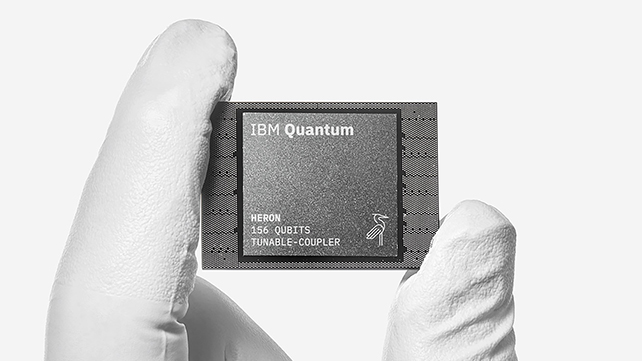
To test their new approach, the researchers used a 156-qubit IBM Quantum Heron processor, connecting together as many as 100 qubits at once. The system was then configured with two alternating tasks: scrambling (spreading chaos through the system), and controlling (resetting qubits where needed).
"The challenge was not simply to measure a qubit, but to do it repeatedly while the rest of the processor continued to operate," says physicist Maika Takita, from IBM.
"This experiment shows that present-day hardware can coordinate quantum operations, measurements and resets thousands of times across a large system."
The researchers shifted the balance between scrambling and resetting during the course of their experiments. Across nearly 5,000 qubit operations and almost 5,000 checks and resets, order was resumed when the checks and resets made up more than half of the operations overall.
As more qubits were added, the tipping point became more well defined in the data – evidence that this is a true quantum effect and a phase transition, like water turning into ice in a unified way.
"The agreement between the experiment and the theory showed that this was not an accidental feature of a small circuit. It was collective behavior emerging across the quantum system," says physicist Haining Pan, from the University of Florida.
Quantum computers won't become standard household gadgets like regular computers any time soon, but they will help in high-level, incredibly complex information processing tasks: testing drug development, forecasting the weather, simulating materials, powering AI, and much more.
Now we know that the same mathematical checks and balances for chaos theory – the idea that the flap of a butterfly's wings in Brazil can ultimately set off a tornado in Texas – can work in a quantum as well as a classical setting.
The system of checking and resetting demonstrated here is going to need to be scaled up, using rules of greater complexity, to actually be of use in quantum computing – but it works as a stress test of feedback loops that can keep quantum systems running smoothly and in an ordered way.
"Out-of-control behavior can be brought under control by randomly intervening, and there is a sharply defined rate at which that happens," says physicist Justin Wilson, from Louisiana State University.
"It wasn't obvious that this transition between chaos and control would survive in quantum physics, but our results show that it does."
The research has been published in Nature Physics.