Early Voting Data Shows Democratic Edge in Midterm Elections

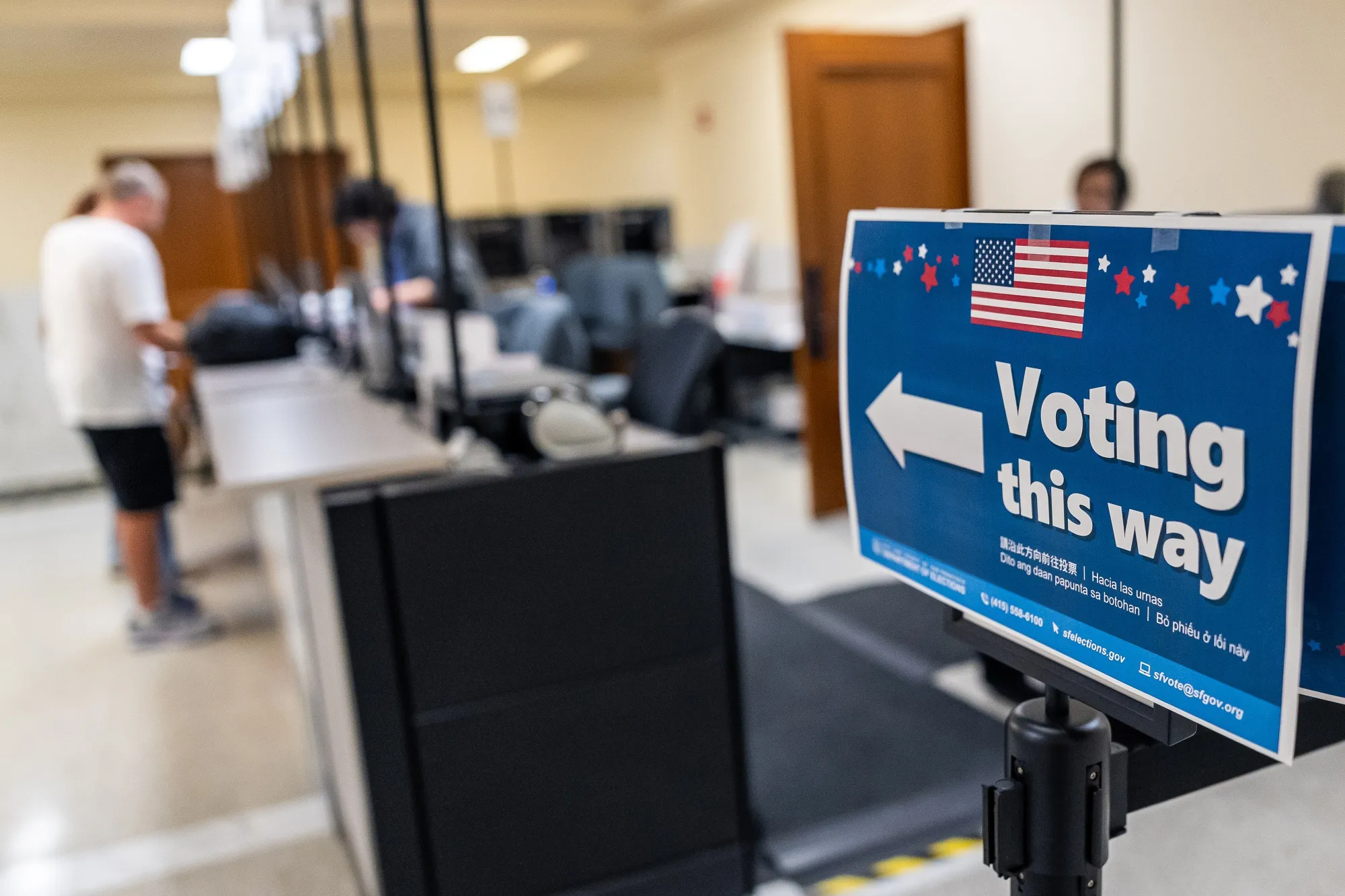
This is Washington Edition, the newsletter about money, power and politics in the nation’s capital. Today, domestic policy reporter Gregory Korte takes a look at early voting statistics. Sign up here. Email our editors here.
What We Know
For decades, political data junkies looking to predict the results of the next election had to rely on polling data to figure out the answers to two important questions: Which party has the most support, and whose voters are more likely to show up?
The first question was easy. The second was harder.
But the post-Covid surge in early and absentee voting means that we no longer have to wait until Election Day to get a good idea of who’s turning out to vote. Many states provide that data — even down to the voter level — on a daily basis.
And with two weeks to go before midterm elections, those numbers look good for Democrats.
Across 24 states that track the party registration of early voters, Democratic voters have cast 48.7% of all ballots. Republican voters have cast 28.9%, according to the University of Florida Election Lab.
Democrats are pressing that advantage in states where they’ll most need it.
Nebraska is an example: In a state with 290,482 more registered Republicans than Democrats, it’s Democrats who have already returned 3,161 more mail-in ballots. That’s one factor making the US Senate contest between incumbent Republican Pete Ricketts and independent candidate Dan Osborn surprisingly competitive, forcing Republicans to spend heavily in a deep-red state.
Iowa has about 183,000 more active registered Republicans than Democrats. But judging by returned mail ballots, you’d think it was the other way around: Democrats account for 60% of them, Republicans only 26%.
In Ohio, Republican-affiliated voters outnumber Democrats by 386,623. But as of yesterday, 49,153 more Democrats had returned mail-in ballots than Republicans. That gap has the Ohio Republican Party revisiting its 2024 social media campaign to get its voters to warm up to voting early in person or by mail, telling them “It’s Okay to Vote That Way.”
The party’s standard bearer, President Donald Trump, has had a more muddled message. “ELECTIONS CAN NEVER BE HONEST WITH MAIL IN BALLOTS/VOTING, and everybody, IN PARTICULAR THE DEMOCRATS, KNOWS THIS,” he said on social media last year. But this month he’s urged early voting as the party needs every ballot it can get.There are plenty of caveats in interpreting early voting statistics: States differ on systems, deadlines and quality of data. Not all states track party registration — and even where they do, it’s a strong but not conclusive predictor of how people actually vote.
Perhaps most importantly, Covid upended the usual patterns of absentee voting. Before 2020, Republicans were more likely to vote absentee. But that changed after Trump blamed his 2020 election loss in part on mail-in votes.
Michael McDonald, a University of Florida political scientist who tracks the daily data, is wary of reading too much into the figures two weeks before Election Day. Many of the earliest voters are strong partisans who would have voted no matter what, so they don’t tell us much about turnout. But the early voting numbers are consistent with other data showing a favorable environment for Democrats.
“The polls aren’t lying to us,” McDonald said. “There’s definitely something going on, even in places like Nebraska and Kansas, and certainly in Iowa and Maine.”
Today’s Top News
Pending sales of existing homes plummeted to a record low in September as high mortgage rates continued to weigh on demand.
Seven Boeing jets, bought by Homeland Security for hundreds of millions of dollars and meant to ramp up Trump’s deportation campaign, have barely left the ground.
The US and India are close to finalizing a trade deal after more than a year of negotiations, Trump said.
Ukrainian President Volodymyr Zelenskyy sought to draw a line under the escalating feud with the US, citing positive talks following a meeting with Trump’s envoys in Oslo.
Nvidia spent nearly $2.2 million on federal lobbying in the third quarter, a record for the chipmaker, filings show.
The Trump administration is being sued over the president’s imposition of 50% tariffs on an array of Canadian goods.
After successfully disrupting Oracle’s data center plans in New Mexico, environmental activists say they’ve now got a blueprint for waging similar campaigns across the US.
Senior Democratic lawmakers warned CEOs of the largest US tech firms that their platforms were failing to crack down on disinformation ahead of the midterm elections.
Black voters were more likely to have been shifted into new congressional districts to create more safe seats for Republicans ahead of the midterm elections.
Must Reads From Bloomberg Government
Senate Democrats released an investigation into five major companies that build and operate Medicaid systems, alleging they continuously make errors.
Representative Lisa McClain plans to run for the same job as chair of the House GOP conference after the midterms, clearing up one aspect of what could be a complex leadership shuffle if Republicans lose the House.
Market SnapshotUS 10-year Treasury yield5.11%-0.03S&P 5007,712.57+0.3%Brent Crude Futures$108.99-0.5%Market data as of 04:29 PM ET. Data is subject to provider delays.
Watch & Listen
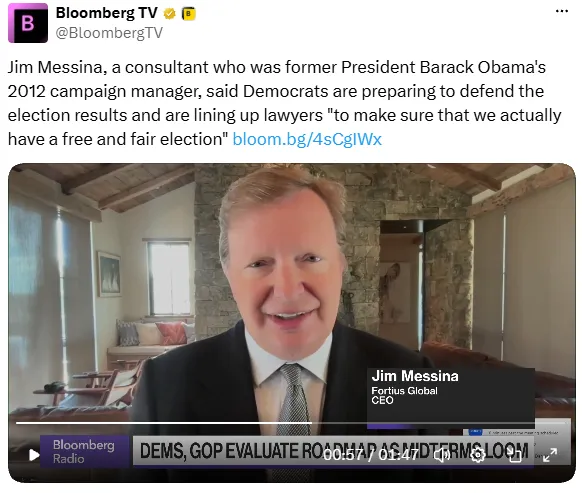
Today on Bloomberg Television’s Balance of Power early edition at 1 p.m., hosts Joe Mathieu and Kailey Leinz interviewed Jim Messina, a consultant who was former President Barack Obama’s 2012 campaign manager, about the midterms.
On the Big Take podcast, Bloomberg credit reporter Katherine Schwartz and AI infrastructure reporter Dina Bass join host Sarah Holder to make sense of the CoreWeave selloff and the future of the AI build-out. Listen on iHeart, Apple Podcasts and Spotify.
Chart of the Day
Americans hoping to pick up some work around the holidays are set to be disappointed. Seasonal retail hiring will likely fall below last year’s 450,000 jobs, which would mark the lowest holiday recruitment since 2008, according to outplacement firm Challenger, Gray and Christmas. Large retailers like Walmart and Target have so far refrained from announcing their seasonal recruiting plans, marking a departure from pandemic-era hiring sprees. Seasonal hiring for logistics and warehouse companies will be about flat from a year ago, Challenger, Gray and Christmas estimated. But there is one outlier in the lackluster holiday jobs market: Amazon plans to hire more than 300,000 workers during the holiday shopping season, up 20% from a year ago. — Spencer Soper
What’s Next
Trump holds a rally in Greenville, North Carolina, tonight.
Initial jobless claims will be out tomorrow.
Michigan Senate candidates will debate for the last time tomorrow night.
More From Bloomberg
Like Washington Edition? Check out these newsletters:
Balance of Power for the latest political news and analysisFault Lines from Bloomberg Economics for daily research on how geoeconomics is reshaping business and marketsCongress Tracker for BGOV clients to stay on top of the action on the HillFOIA Files for Jason Leopold’s weekly newsletter uncovering government documents never seen beforeMorning Briefing Americas for catching up on everything you need to know
Explore all newsletters at Bloomberg.com.

 点赞
 收藏
 点踩
 分享