Author Complaints at Starfish Bay Publishing

I first heard of Australian children’s publisher Starfish Bay Publishing (SBP) in 2024, thanks to a question from an author about the advisability of investing in SBP’s Author Supported Traditional Publishing Programme. Implemented, SBP’s website explained, because of “the severe effect the pandemic had on our publishing business”, this program–despite using the word traditional–required authors to come up with a “temporary loan” of AU$6,000.
Here’s how SBP’s website described the Author Supported program at the time I received the question, from an October 2024 archive of the SBP website (thank you, Wayback Machine).
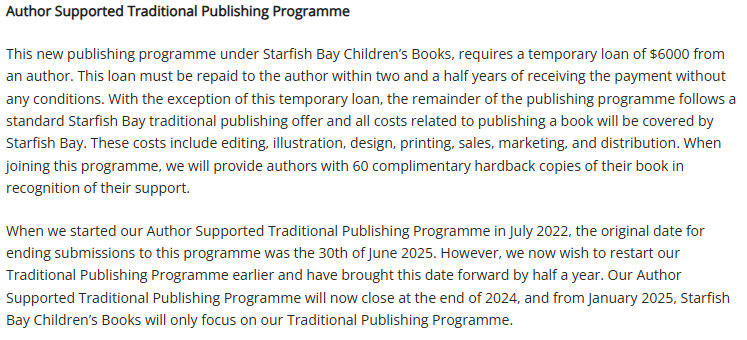
I told the author that including words like “traditional” and “loan” and “temporary” in your demand for money doesn’t change the fact that a large amount of cash is due upfront as a condition of publication. Pay to play is pay to play. Even if SBP sincerely intended to pay the money back within two and a half years, what guarantee was there that it would still be in business at that point? Maybe not terrific odds if, a full four years after the pandemic, its business was still so precarious that it had to rely on its authors for financing. The whole thing seemed highly questionable to me.
Interestingly, SBP wasn’t always a fee-charging publisher. Archived versions of its website from late 2021 and earlier don’t mention fees at all. By March 2022, however, it had introduced a “hybrid publishing model” under its Tiny Seed imprint, requiring authors to “make a contribution [of several thousand AU$] by purchasing 200 hardback copies of their title at a 20 per cent discount.” Sometime before February 2023 the Author Supported plan appeared, with the Tiny Seed hybrid plan now dubbed “a “Secondary Publishing Programme”.
The Author Supported program did not, in fact, close at the end of 2024, as claimed in the screenshot above (it’s hard to give up easy money). Along with the Secondary Publishing Program, it can be seen in a March 2025 archive of the SBP website, and I got a question about it in August 2025. Also, per documentation shared with me, SBP was running a “signed author program” (guaranteed publication of one book a year provided the author submitted at least two manuscripts annually) at least through mid-2025, requiring a four-figure “refundable advance payment”–though I couldn’t find that this was ever mentioned on the website.
By November 2025, the Author Supported and Secondary Publishing programs appear to have been discontinued. All imprints are described as “traditional.”
Qustionable Contracts and a Plethora of Business Names
Starfish Bay Publishing Pty Ltd. was registered as an Australian Private Company in June 2014 by Liang (Luke) Hou. Hou incorporated Tiny Seed Publishing in the UK in June 2017 (as Tiny Seed Publishing Limited), and registered it in Australia the following May (as Tiny Seed Publishing Pty Ltd.). Together, these two business entities have published several hundred children’s books.
In 2025 and 2026, Hou’s holdings abruptly ballooned, with at least eight new business names, several with registered or pending trademarks. Here’s the full list, as far as I know it (I’m indebted to the SBP writers who contacted me with complaints, who put all of this together; I really only double-checked and added links).
Imprints and business names:
- Starfish Bay Publishing (registered in Australia, incorporated in UK [dormant company], 2014)
- Starfish Bay Publishing LLC (registered in USA 2025)
- Tiny Seed Publishing (incorporated in UK [dormant company] 2017, registered in Australia 2018)
- Little Fern Publishing (registered in USA 2025)
- Magic Window (does not appear to have published anything, domain registered 2026)
- Magic Seed (named as part of “our global publishing family” but no other evidence of its existence)
- Joyspring Books (UK “partnership” publisher, with required book purchases; no evidence of published books; domain registered 2025)
- Everlight Tales (“partnership” publisher; no evidence of published books; domain registered 2025)
- Tiny Thinkers (no evidence of website or publications)
- Flying Light Publishing Group (“parent company” of SBP, Tiny Seed, Tiny Thinkers, Little Fern, Joyspring; domain registered 2026)
- Pocket Rainbow (no evidence of website or publications)
Trademarks: live, dead, and in between (all owned or applied for by Starfish Bay):
- Starfish Bay (US trademark registered; Australian trademark registered)
- Little Fern (US trademark application dead)
- Joyspring (US trademark pending)
- Tiny Thinkers (US trademark application dead; Australian trademark registered)
- Flying Light (US trademark application dead)
- Everlight (US trademark pending)
- Pocket Rainbow (US trademark pending, applied for in 2025)
Additional note: all three pending US trademarks were applied for on the same day, November 19, 2025.
Contracts:
I’ve seen a number of SBP contracts from 2023, 2024, and 2025. The language, which is largely identical except for clauses related to fees, includes some undesirable elements, such as a sweeping, exclusive claim on subsdiary rights that I could find little evidence to suggest SBP is or was capable of exploiting, an editing clause making it possible for the publisher to edit at will without author input, and a life-of-copyright grant of rights without adequate provision for rights reversion. Royalties (9-10% of net for print, 12.5% of net for ebooks) aren’t optimal, and the subsidiary rights split, with just 25% for the author, is seriously substandard.
The payment-related clauses either require the author to purchase a varying number of books (always several hundred, with a four-figure “non-refundable” payment due within weeks of contract signing) or to front the “temporary loan” described in the screenshot above. Several contracts also include a bizarre guaranteed royalty clause (maybe to make the author feel better about handing over a lot of cash?), with SBP pledging to make up the difference if actual royalties don’t match a benchmark amount within a designated timeframe (I’ve redacted the figures in this screenshot to avoid possibly identifying the author):
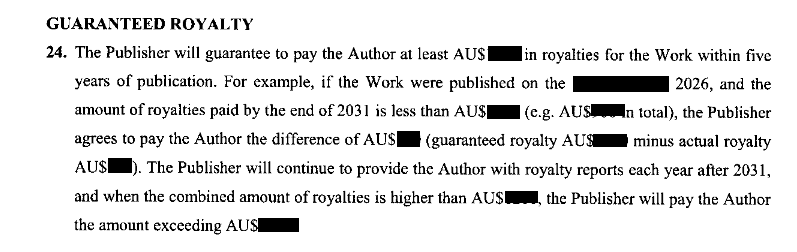
The writers who signed SBP’s contracts and agreed to invest thousands in their careers relied on SBP’s promises, which they assumed were made in good faith: that their loans would be repaid, their purchased books delivered, their earnings guaranteed. In reality, the only guarantee was money in SBP’s bank account: cash today in exchange for obligations to be fulfilled…some other time. But what if SBP wasn’t in business in 2031? What if the paid-for books were never published? What if SBP wasn’t able to reimburse the loans? What if it didn’t have the resources–or maybe the desire–to make any payments at all?
Which in fact is exactly what happened.
Lied to, Stiffed, and Abandoned
I began hearing from SBP authors last month. Angry and disappointed, their books in limbo and their dreams devastated, they’d been finding each other and connecting online. Documented complaints they’ve shared with me include:
- Failure to hire illustrators, despite a contractual requirement and claims to do so (several authors contacted the illustrators when illustrations failed to appear months after they were told the illustrator had been engaged; the illustrators confirmed that they were not in fact under contract or that the projects had been put on hold, with some illustrators not paid for work they did)
- Books never published (authors say SBP provided misleading claims for why projects were delayed)
- Unpaid royalties and absent royalty statements
- Failure to repay refundable loans by the contractually-stipulated deadline
- Failure to pay guaranteed royalties by the contractually stipulated date
- Extreme communication difficulties, with questions not responded to despite repeated attempts (That’s not to say there were no emails from SBP; I’ve seen a whole series of generic updates from Hou over the course of several months in 2026, in which he claims responses got stuck in his Drafts folder, attributes non-response to being busy with international travel, and repeatedly promises that he’s clearing his email backlog)
Many of the same complaints can be seen in this lengthy Facebook discussion thread.
Authors told me that Hou has “disappeared into thin air”, with a new office address that is actually a virtual office, and an email address that’s a black hole where communications go to die. Demand and termination letters sent by registered mail receive no reply. Some authors said they believe Hou has been signing contracts and taking money for books he never publishes for several years now (shades of L.R. Price). The payment problems also seem to go back years: for example, this Facebook comment from an author whose “temporary loan” reimbursement was due two years ago. Some authors have filed claims in court. I’m told that some have hired debt collectors.
The number of people affected appears to be massive. A private Facebook group for SBP authors and illustrators has 190 members as of this writing.
What Happened to Starfish Bay Publishing?
Sometimes when a publisher falls apart it’s possible to figure out the cause, or at least to surmise it by reading between the lines of the excuses and fabrications. But often it’s just not possible to know.
A dynamic I see a lot with publisher collapses is that authors put up with a tremendous amount of abuse before some sort of critical mass is reached and the abuses explode into public view. Often the catalyst is the discovery, by writers who believed they were suffering alone, of others in the same situation. This really is something I see over and over again, and it seems to be the case with SBP as well.
Although there are indications of earlier problems, SBP seems to have really begun going off the rails in 2025. To me, it doesn’t seem coincidental that this timeline aligns with the burst of new company names and trademark applications that happened in 2025 and 2026. Did Hou become overextended? Otherwise get into financial trouble? Did he become too distracted by dreams of a publishing empire to actually run a publisher? Honestly I think that the various pay to play schemes Hou put in place at SBP in 2022 may have proved as disastrous for him as for his authors, whether from bad management, financial misfortune, or something else. Regardless, he seems to have simply washed his hands of the obligations authors trusted him to fulfill.
A feature at the beginning of October on Australian TV program A Current Affair has brought some public attention to the SBP situation. The Australian Society of Authors has posted an alert. Hopefully Australian authorities will also take an interest.
As of this writing, Starfish Bay and its imprints are still calling for submissions. On the Starfish Bay submissions page, there are indications some new scheme may be afoot:
Please note that in 2026, we have reserved 30 publishing slots for solicited authors and 70 slots for signed authors under our Traditional Publishing Programme. As our solicited author network grows, we will increase the number of slots reserved for solicited authors.
Whatever that means. I’ll be following this story as best I can, and will post updates if there are any developments.
The post Author Complaints at Starfish Bay Publishing appeared first on Writer Beware.

 点赞
点赞 收藏
收藏 点踩
点踩 分享
分享