More Rights Grabs from Must Read Magazines

In early 2025, a group called Must Read Magazines (MRM) acquired a suite of six well-known genre fiction magazines: Asimov’s Science Fiction, Analog Science Fiction and Fact, The Magazine of Fantasy & Science Fiction, Alfred Hitchcock’s Mystery Magazine and Ellery Queen’s Mystery Magazine. My July 2025 blog post about the acquisition, and the ensuing backlash over unfriendly contract terms, has all the details, but here’s the TL;DR.
The Backstory
News of the acquisition came out of the blue. But despite how little was known about MRM and its founders, as well as concerns about consolidation, there was hope that the new ownership might help the magazines survive. Analog, Asimov’s, and F&SF had been steadily losing print sales and subscriptions over recent years, and F&SF had been the subject of complaints of contract and payment delays for some time.
It soon became clear, however, that MRMs’ new contracts were significantly author-unfriendly, with sweeping claims on a large menu of rights (including rights, such as merchandising, that aren’t typically part of magazine contracts), no provision for rights reversion, and, troublingly, a moral rights waiver (for more on moral rights, and why such waivers are contract red flags, see my blog post). Although MRM was willing to negotiate changes, some writers described the process as unduly time-consuming and convoluted, with the moral rights waiver being a particular sticking point.
To its credit, MRM was willing to engage with the concerns (no doubt due in part to the blowback in the spec fic community and the public involvement of SFWA), and the contracts did get better–though the lengthy and cumbersome negotiation process continued to be an issue. As I wrote in November 2025,
Must Read seems to have arrived at something like a boilerplate. The grants of publishing, archiving, anthology, and translation rights are essentially the same as in the original contracts, but the moral rights waiver is gone, as is the morality clause. Termination language requiring Must Read to publish within 30 months of contract signing or else return rights has been added, as has a clause enabling the author to demand that the publisher cure a breach of its obligations. Though the bulk of the language, from August on, is identical, each contract includes variations that appear to be the result of negotiation. Must Read seems determined to keep the merchandising clause, but will remove it if the author requests (most did). One contract added an AI training clause. Several authors chose to insert, delete, or substitute multiple words and phrases.
All pretty positive developments. This week, though, we learned that MRM’s changes to its writing contracts don’t seem to have propagated to its contracts for other creators, thanks to social media posts from two well-known artists who were approached by Asimov’s to provide cover art.
Rights Grab Redux
In a post on Facebook, Donato Giancola describes being contacted by the Asimov’s art director, and how, in the time between accepting the commission and receiving the contract, he began work on the project. But when the contract arrived, it turned out to be a work-for-hire agreement–not a contract arrangement Giancola had encountered in any of his previous work for Asimov’s–that stipulated, among other things, that he sign an NDA and could not include the artwork in his portfolio or on his website without requesting permission. His attempts to negotiate better terms seem to have bogged down in the same torturous process others have described:
I went back and forth in contract revisions with Asimov’s SF legal department five times over three months. Nearly as much time was spent on these negotiations, legal revisions, and emails then what I would put into creating art for a final illustration. All for a $1200 fee on a commission who’s legal contract issues were settled in a five minute digital handshake six years ago. At the end of June, while their legal department was still soliciting me to supply a Non-Disclosure Agreement I would be fine signing after stating I would not sign one, I told Asimov’s SF to find another artist. Their legal department was not negotiating in good faith to get me to work on their magazine – they were looking for an artist to exploit…. Other professionals have also turned down these exploitative contracts, I am not alone.
In a thread on Bluesky, John Picacio shared the memo he sent to MRM upon receiving an Asimov’s contract with terms he deemed unacceptable. It’s not clear to me from the memo if this too was a WFH contract, or a non-WFH contract with a moral rights waiver (which, remember, MRM eliminated from its writing contracts under great pressure), but it’s a rights grab either way. Pay particular attention to the third paragraph:
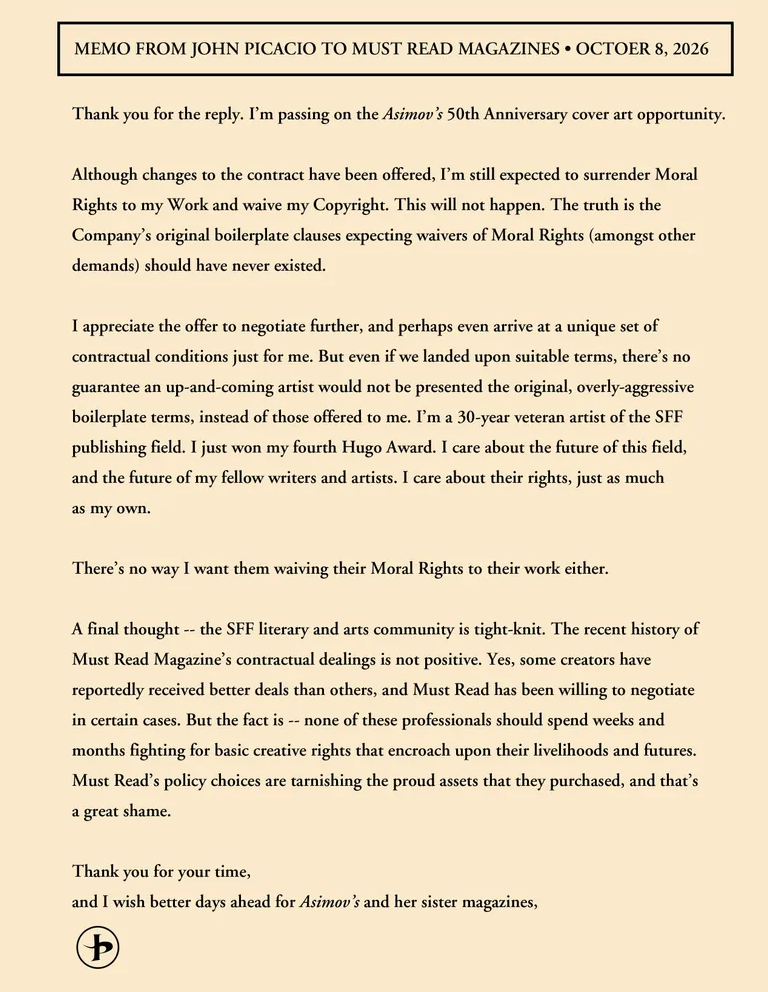
As Picacio points out, the problem of bad contract language isn’t mitigated by the publisher’s willingness to negotiate on a one-off basis: the changes benefit that one writer, but all succeeding writers still face the same unfriendly boilerplate. Author Scott Edelman, who has written about the impasse he encountered in attempting to make a modest (though significant, from the author’s perspective) change in indemnity language, makes a similar point:
To start, one of the problems with the Must Read Magazines business model is that any progress achieved by a single author doesn’t accrue to all authors. Each author must start from scratch, negotiating from the same flawed boilerplate, and even if they do manage to arrive at a contract they can comfortably sign, they have in effect ended up with a unique contract unlike those signed by any of the other writers with whom they share a Table of Contents.
Contracts Tell a Story
Both artists were approached by Asimov’s, which is just one of the six magazines in MRM’s portfolio. Might other magazines offer better terms to their artists? But MRM has offered basically the same writing contract for all six magazines, and it seems likely that would be the case with art contracts too. So my guess is no.
In my original post on the MRM contracts, I quoted Kristine Kathryn Rusch:
On her Patreon, Kristine Kathryn Rusch has published several articles about the Must Read contracts, including the archiving language and the moral rights waiver. “As I’ve told writers for years,” she writes, “contracts are a story. They must be read in their entirety to understand the intent behind them.”
These are wise words, which creators should commit to memory. Writer Beware often hears from authors who’ve been offered poor or exploitative contracts, and I always advise them that even if the publisher is willing to make changes, they must think about what it says about the publisher, and its attitude toward its writers, that it would offer a bad contract to begin with. I actually think failing to do so is an inherent risk of the negotiation process: winning victory on individual contract clauses can make it harder to consider the contract as a whole. Don’t get me wrong: writers shouldn’t be afraid to negotiate, and publishers should be open to change. It’s just really important not to let the details obscure the big picture.
Public pressure convinced MRM to make what appear to be fundamental changes to its writing contracts (I say “appear” because as far as I know, MRM has never shared an official boilerplate). Hopefully Giancola’s and Picacio’s decisions to go public–and maybe other artists’ as well–will persuade MRM to do the same for artists and illustrators.
One last thing: both Giancola and Picacio emphasize that they don’t fault the magazines’ staff.
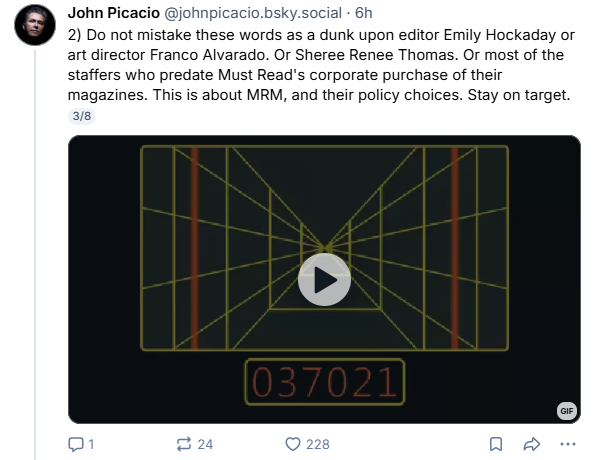
UPDATE: MRM has responded, in a post on Bluesky.

Tags: Moral rights, Must Read Magazines
The post More Rights Grabs from Must Read Magazines appeared first on Writer Beware.

 点赞
点赞 收藏
收藏 点踩
点踩 分享
分享