Trump’s ‘Potential Destruction’ of Presidential Records Revealed in New Emails

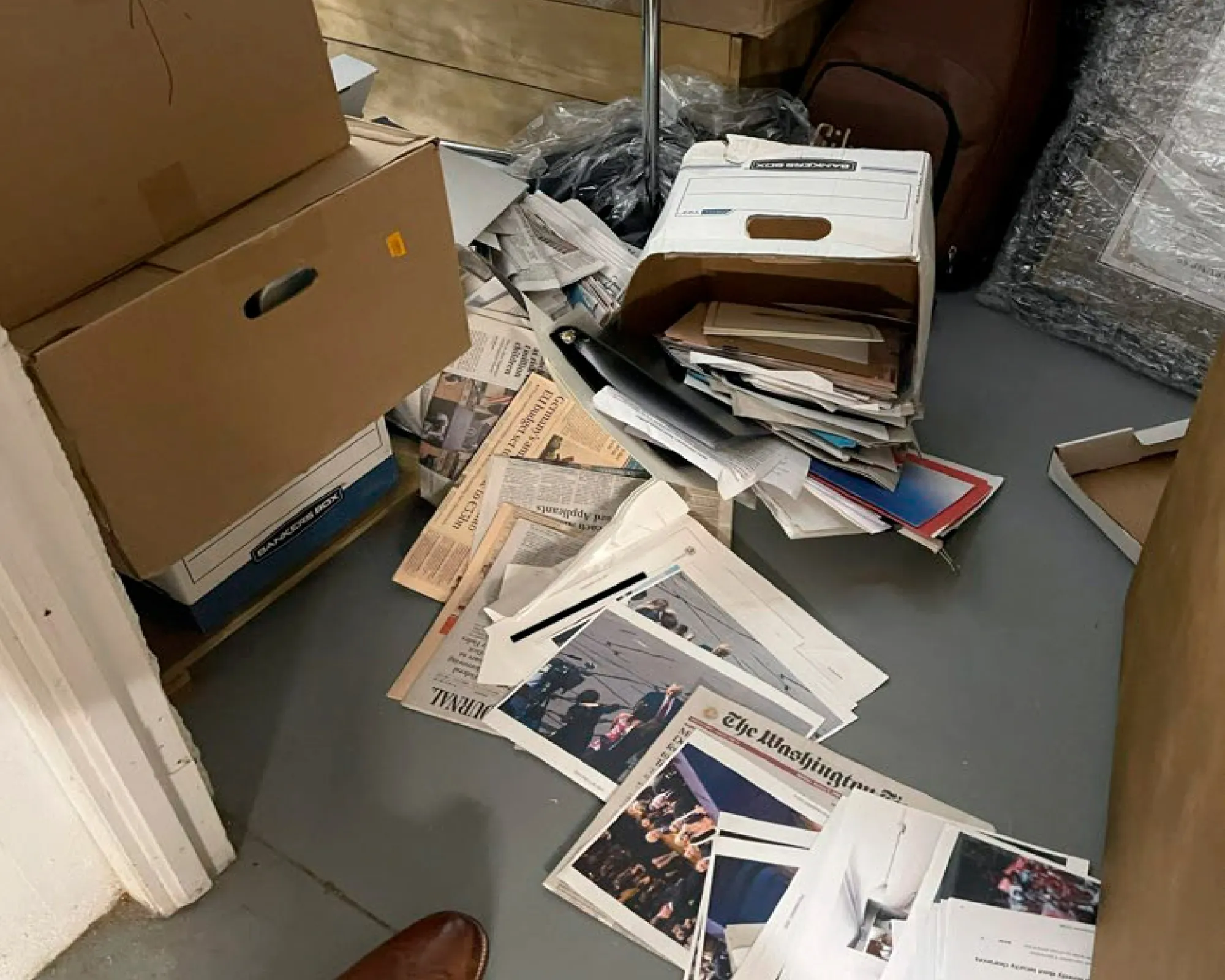
Welcome back to FOIA Files! This week, I’m returning to the scene of the alleged crime: the “potential destruction of presidential records.” That’s the subject line from a set of emails I finally obtained from the Federal Bureau of Investigation and the Department of Justice in response to my four-year-old Freedom of Information Act lawsuit against the agencies. The emails center on records then-former President Donald Trump removed from the White House and stored at Mar-a-Lago, which later formed the basis of former special counsel Jack Smith’s prosecution of Trump. They also cover what the National Archives and Records Administration discovered when investigators retrieved 15 boxes of documents, many of which were highly classified. The emails contain intriguing new details about an aspect of the case that has received little scrutiny. It’s also the topic of the first episode of season two of my podcast, Disclosure, which dropped yesterday! If you’re not already getting FOIA Files in your inbox, sign up here.
These emails landed in my inbox just as Smith and FBI agents are being targeted by the Trump administration for their roles in prosecuting Trump over his retention of classified documents.
But before I dive into the emails, a little recap. In February 2022, I filed a FOIA request with the FBI, a few weeks after the news broke that Trump took presidential records to Mar-a-Lago in potential violation of federal law and that he may have also destroyed records by flushing them down the toilet.
I was particularly interested in any documents that would shed light on the alleged destruction of presidential records. During Trump’s first term, I obtained records from NARA that showed officials at the agency had to routinely remind the White House of their obligations to preserve records under the Presidential Records Act. Apparently, Trump had a habit of ripping up records.
The FBI responded to my FOIA a month later with what’s called a Glomar, meaning that the agency could neither confirm nor deny that records existed. (I also filed similar requests with the DOJ, NARA, and other agencies.)
Later that year, as the case evolved into a criminal investigation, I sued the bureau to compel the release of records. In June 2023, newly appointed special counsel Smith charged Trump with the unauthorized retention of classified national security documents and obstruction. Then, after Trump won the 2024 election, Smith dropped the charges.
That provided my lawyers with the ammunition they needed to argue that the FBI should drop their Glomar. In an extraordinary opinion in February 2025, US District Judge Beryl Howell directed the FBI to do exactly that — and begin searching for documents in response to my FOIA request. Howell ruled that the end of Trump’s criminal case, along with the Supreme Court’s 2024 decision granting Trump immunity from prosecution for official acts, opened the door to public scrutiny.
“With the far dampened possibility of any criminal investigation to gather evidence about a president’s conduct and of any public enforcement proceeding against a president,” the Supreme Court’s decision “has left a FOIA request as a critical tool for the American public to keep apprised of a president’s conduct,” Howell wrote.
Torn up
Since Howell issued her opinion, the FBI, NARA, DOJ and other agencies have been trickling out documents. But until now there hasn’t been anything substantive related to the potential destruction of presidential records.
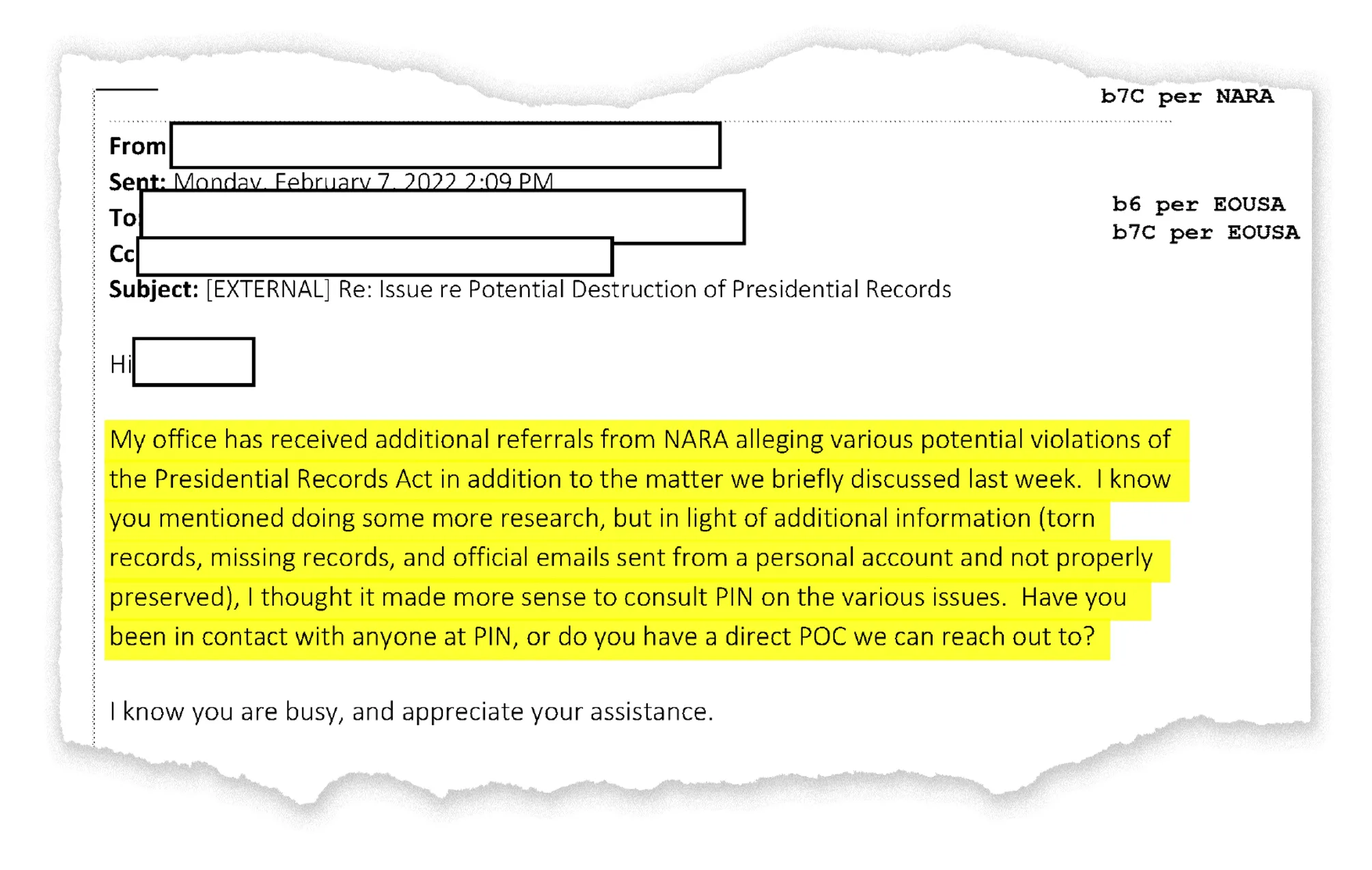
The cache of emails the DOJ and FBI released to me shows that three weeks after NARA retrieved 15 boxes of presidential records from Mar-a-Lago, a special agent with NARA’s Office of Inspector General contacted John Keller, then deputy chief of the DOJ’s public integrity division. (This division investigates, oversees and provides guidance on public corruption cases.)
The agent, whose name was redacted, asked whether Keller’s office would be interested in taking on a criminal investigation involving “three separate matters.” One of them: “President Donald Trump destroyed presidential records in violation of the” Presidential Records Act and another federal law, according to an email the agent sent Keller on Feb. 9, 2022.
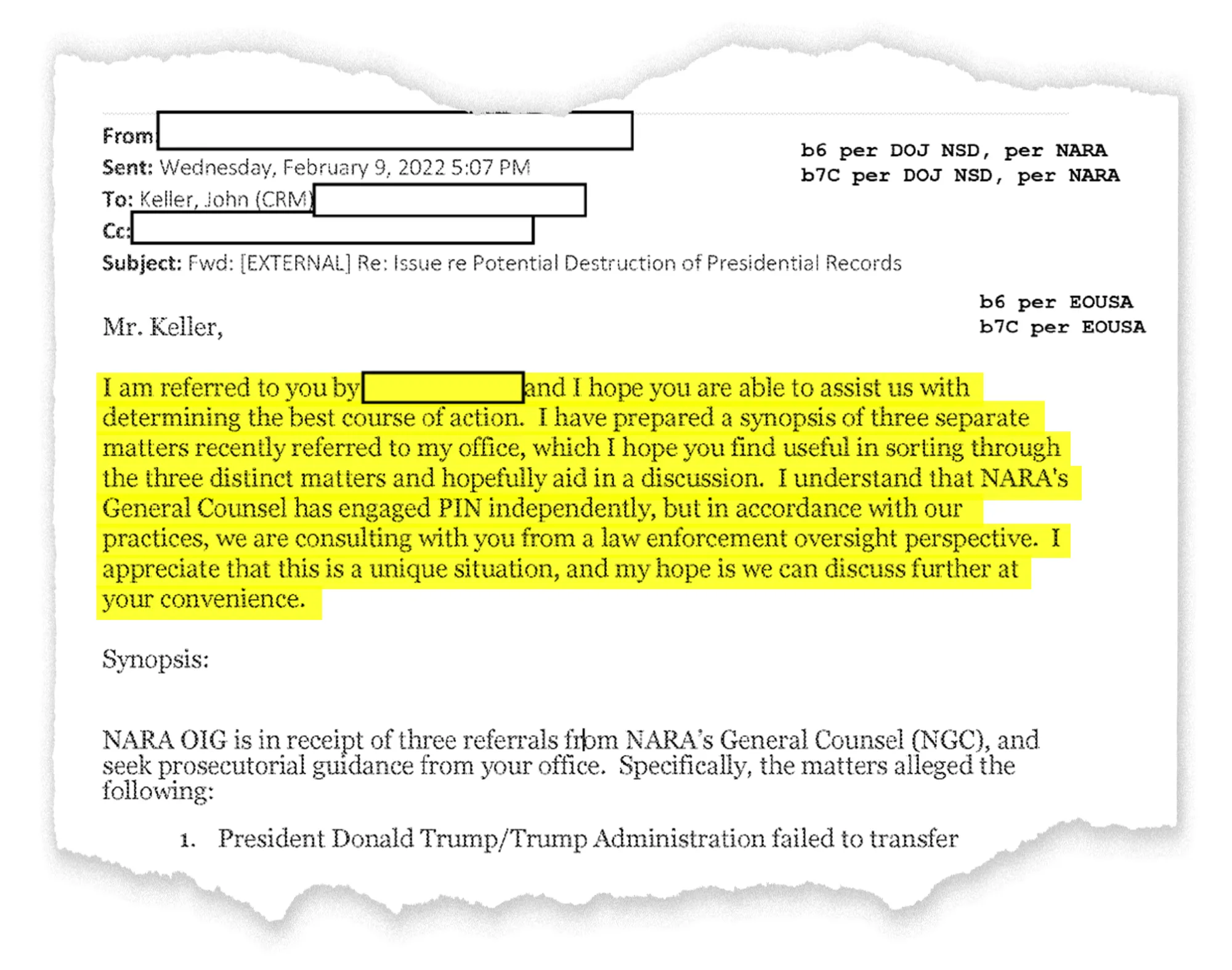
The agent explained that the OIG received three separate referrals from NARA’s Office of General Counsel related to Trump’s handling and retention of presidential records and his former lawyer’s use of a private email account to conduct official business. The one referral related to Trump’s alleged destruction of documents quoted portions of a memo or email from NARA’s then-general counsel, Gary Stern.
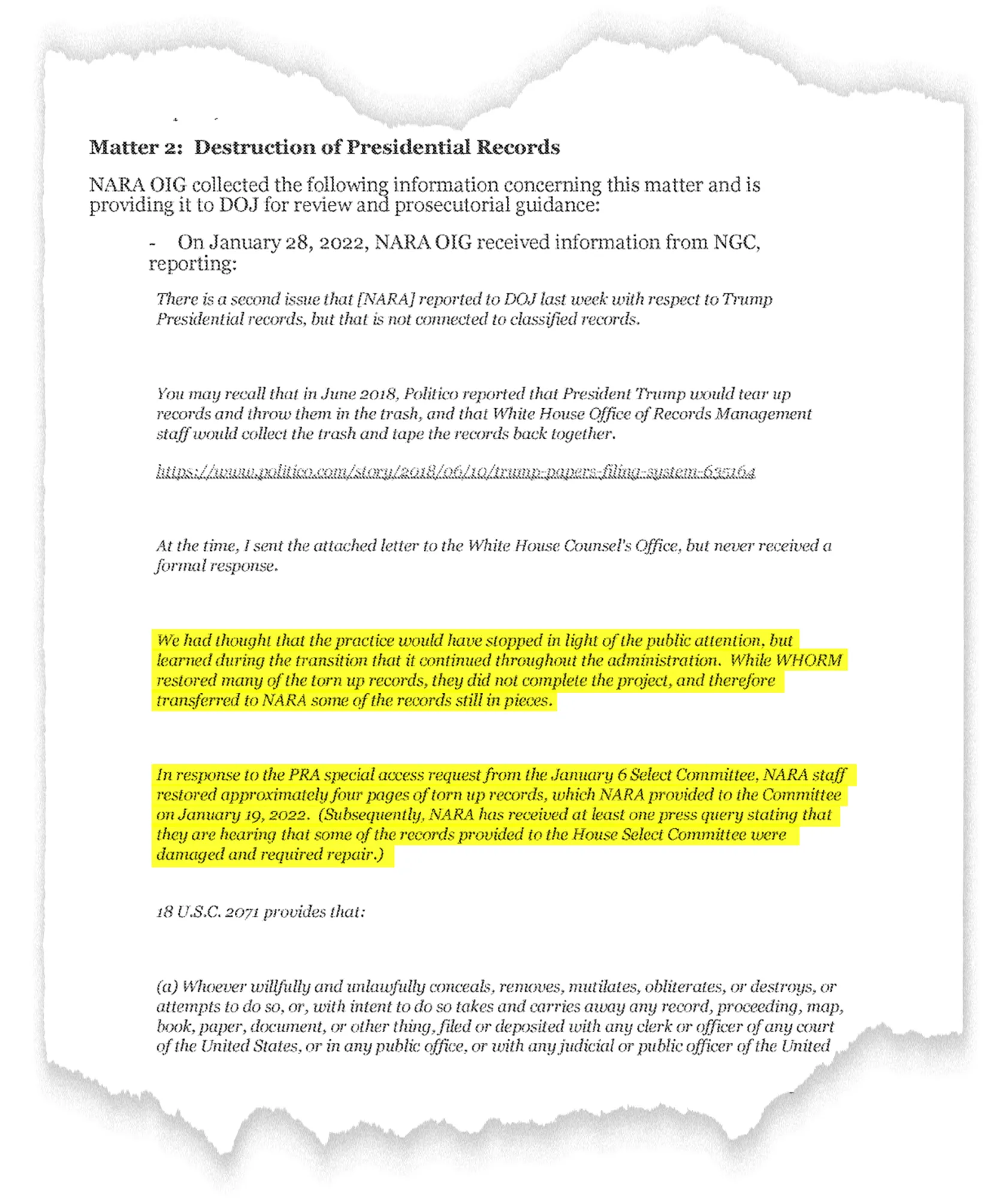
Stern wrote that after Politico reported in 2018 that Trump allegedly tore up documents, he sent a letter to the White House “but never received a formal response.”
“We had thought that the practice would have stopped in light of the public attention, but learned during the transition that it continued throughout the administration,” Stern wrote. While the White House Office of Records Management “restored many of the torn up records, they did not complete the project, and therefore transferred to NARA some of the records still in pieces.”
Stern added that in response to a special-access request under the Presidential Records Act from the Jan. 6 Select Committee, NARA staff restored approximately four pages of torn-up records and provided them to the committee.
In closing his email to Keller, the agent wrote that they were seeking the public integrity division’s “review of these matters, prosecutorial guidance and a determination if [the division] is interested in pursuing these matters.”
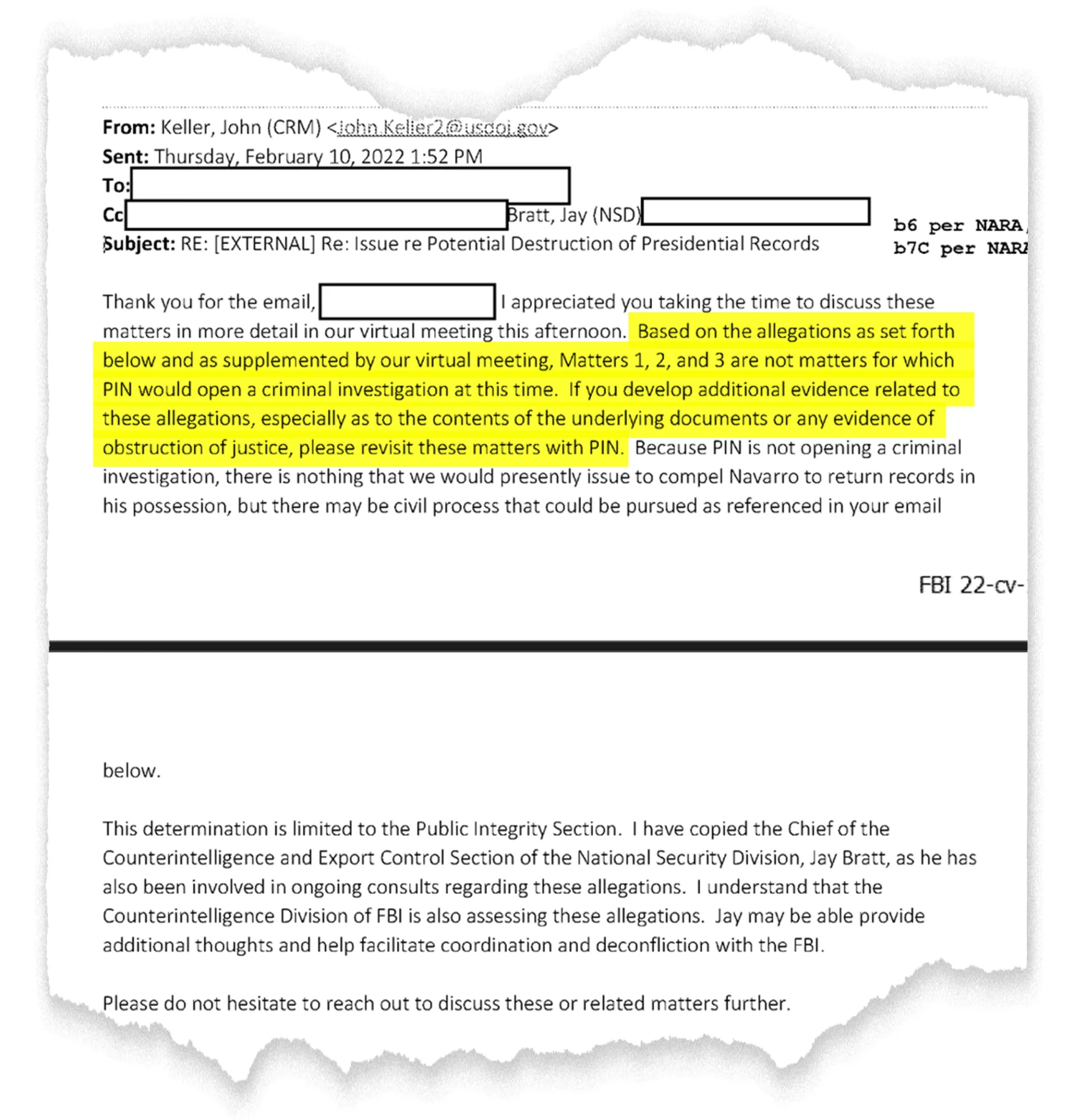
Keller responded the next day to the agent and other officials that he would not be opening a criminal investigation “at this time.”
Putting the ‘pieces’ back together
For the next month, the NARA OIG agent investigated the torn presidential records while officials at the DOJ and FBI exchanged a flurry of emails on how to turn NARA’s referrals into a criminal investigation.
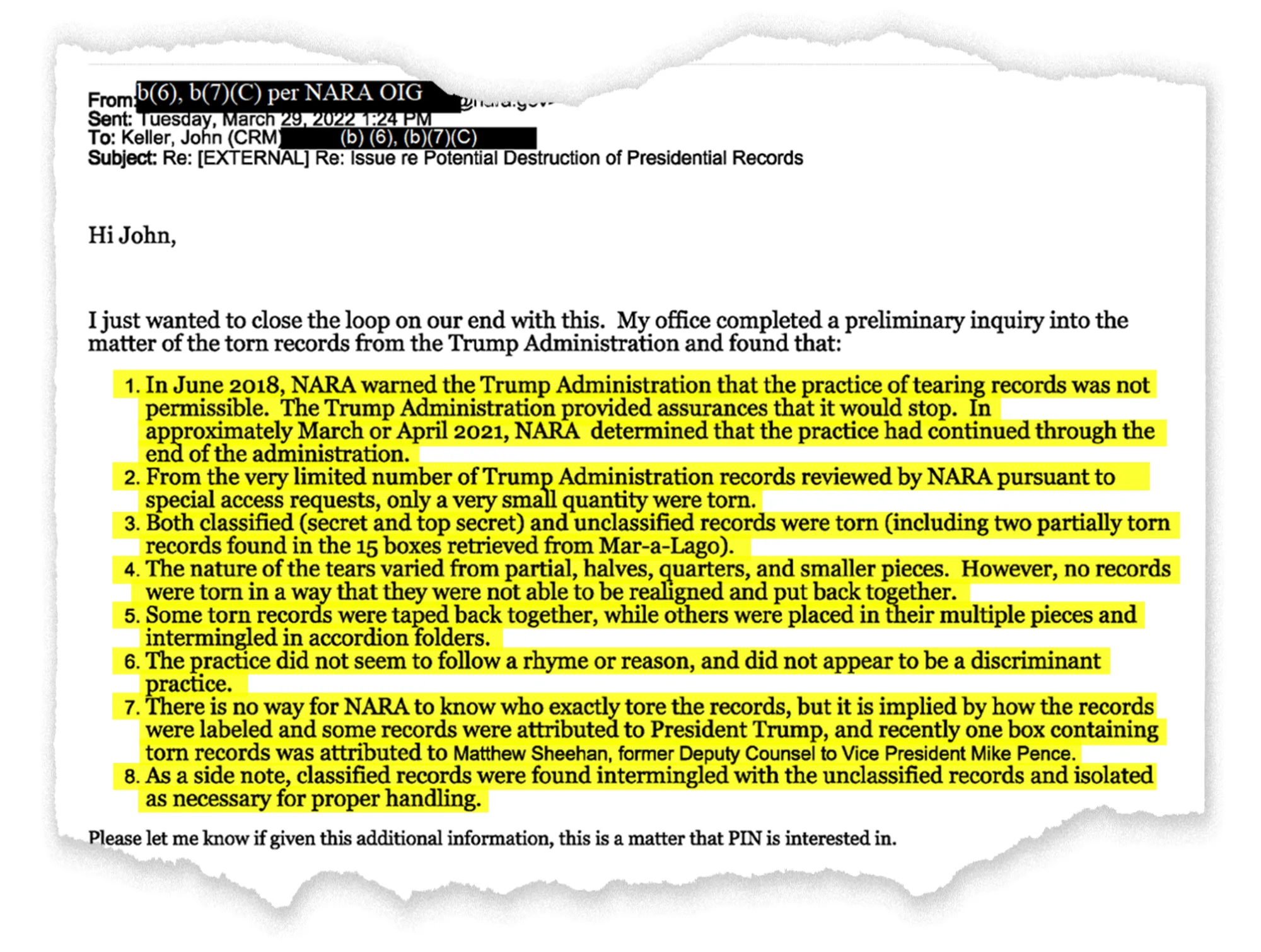
On March 29, 2022, the agent sent another email to Keller with his preliminary findings and checked one last time if the public integrity division would open a criminal investigation.
The agent said they determined that NARA’s review of a “limited number of Trump Administration records” based on special access requests by congressional committees concluded “only a very small quantity were torn.” Two partially torn records were found in the 15 boxes returned to the archives in January 2022.
“The nature of the tears varied from partial, halves, quarters, and smaller pieces,” the agent wrote. “However, no records were torn in a way that they were not able to be realigned and put back together.”
The agent said some of the torn records were taped back together, “while others were placed in their multiple pieces and intermingled in accordion folders.”
“The practice did not seem to follow a rhyme or reason, and did not appear to be a discriminant practice,” the agent added. “There is no way for NARA to know who exactly tore the records, but it is implied by how the records were labeled and some records were attributed to President Trump, and recently one box containing torn records was attributed to Matthew Sheehan, former Deputy Counsel to Vice President Mike Pence.”
That agent’s last line about Pence’s lawyer is new. I reached out to Sheehan to ask him about the agent’s claims. He said there’s no truth to it.
“I was not involved in collecting records outside the Office of the Vice President, nor did I ever damage or tear records,” Sheehan told me. “The boxes of documents that I collected from Office of the Vice President staff and the documents that I transferred to boxes were sent by me to White House records personnel in the condition I received or found them.”
Ultimately Keller confirmed in an email to the agent that he would not open a criminal investigation into the torn records.
“The results of your preliminary inquiry solidify our initial view, at least with respect to” the public integrity division, Keller wrote. “As such, we do not seek to pursue the matter further based on the information currently known to us and with the understanding that” DOJ’s national security division “is examining the classified records issue.”
I reached out to the White House about the torn presidential records.
“The President and his team are focused on winning for the American people, not whether Bloomberg discovered a ripped piece of paper from 2022,” said White House spokeswoman Lauren Bis. “The President is committed to preserving records from his historic time in office.”
As a reminder, earlier this year the DOJ’s Office of Legal Counsel issued an opinion that said the Presidential Records Act is unconstitutional and Trump “need not further comply with its dictates.”
Do you have details to disclose about the current state of the FOIA? Or documents you think I should request? Send me an email: jleopold15@bloomberg.net or jasonleopold@protonmail.com. Or send me a secure message on Signal: @JasonLeopold.666.
More From FOIA Files
US Effort to Combat Iran-Backed Groups Was Disorganized, Audit FindsDOJ Memo: Trump Need Not Comply With Presidential Records ActThe National Archives Needs Trump’s Support But the Agency Has a Target on Its BackPam Bondi’s Secret DOJ Email Address Revealed
More from Bloomberg
Like FOIA Files? Check out these newsletters:
Washington Edition for following Trump’s second term through the lens of business, markets and the economyCalifornia Edition for a weekly newsletter on one of the world’s biggest economies and its global influenceSoundbite for reporting on podcasting, the music industry and audio trendsCyber Bulletin for coverage of the shadow world of hackers and cyber-espionageGreen Daily for the latest in climate news, zero-emission tech and green finance
Explore all newsletters at Bloomberg.com.

 点赞
点赞 收藏
收藏 点踩
点踩 分享
分享