How is music possible
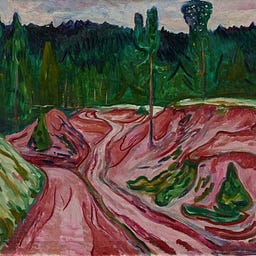
Woods near Oele, Piet Mondrian, 1908
If there is a rapid change in the weather, we can sometimes receive faint radio signals from Poland or Lithuania on the island, once even Finland. Out of nowhere these unfamiliar soundscapes will enter the car, evoking worlds I know little about—then we’ll make a turn down the hill, and they’ll be gone.
Today, we listened to Swedish P2, where they were playing a mixtape that Sara Parkman had put together of folk music from around the world. I looked in the rearview mirror and saw that Maud, our nine-year-old, had closed her eyes. She does that when something is particularly good. It makes her see things, she says. Little films. Though she won’t say what they are. Parkman played a Sámi joik that had been recorded in Moscow a few months after the collapse of the Soviet Union,
and I turned off the main road, down one of the gravel paths through the beech forest, so I could slow the car to a walking pace and really listen. Rolling my window down and leaning out, I looked up at the slowly passing trees—they looked otherworldly wrapped in this music. I had never seen them like that before.
How is it possible for music to alter the world like this? It’s like when you take a scene from a horror movie and add funny music and the killer suddenly looks hilarious. Isn’t it strange that that happens? Why can we put certain sounds together that make the trees feel unfamiliar? Music is tones and rhythms in various mathematical relationships to each other—it is almost pure abstraction. Why should that move us? It is a realm of patterns largely independent of outside reality, and yet, when Maud closes her eyes, the music leads her somewhere, to some inner landscape.
How can these landscapes arise?
Very brief notes on music psychology
Looking into it a little bit, I get the impression that people who study musical psychology are fairly confused about this, too. There are, as I interpret it, two broad families of perspectives. One, the more traditional, suggests that music works roughly the same way as painting. We have a very sensitive auditory processing system in our heads that helps us keep our bearings in the world, especially the world of social relationships. We can tell from the sound if something is far away, approaching or leaving, and infer the size and shape of a space from its echo. We can tell what someone is feeling from the slightest pause or change in tone. And music, according to this theory, plays around with these perceptual systems and expectations. For example, if we are sad we might speak with melodies that contain a lot of minor thirds—and so if we play that interval on a piano, our brains will pattern match that as sad. Music is complex patterns of sounds that trigger various things like that, weaving together a series of emotional and spatial cues into something we interpret as a mood or a story or a landscape. It is a way of hacking our biology to produce novel experiences, allowing us to travel far outside the realm of landscapes that exist in outside reality.
This story is somewhat complicated by studies that show that the way we experience and interpret sound depends a lot on what culture and music we grew up surrounded by. The sorts of results I’m referencing in the last paragraph tend to come from studies done on people who live in the West, often specifically students at the US universities where many of these studies are done—not a very representative sample. And when music psychologists bother to go out in the field and ask, say, The Kalash of northwestern Pakistan, how they experience music, the results can contradict the theories quite a bit. The Kalash, for instance, rate minor chords as positive. Major chords (which is what people who grew up hearing Western music tend to rate as positive), the Kalash instead describe as “strange,” rating them as less pleasant to listen to than “the most dissonant [of] all the possible tetrachords possible within the octave”. So it’s not a simple story of music pushing certain buttons in us. It is, from this second perspective, some messier kind of thing where our innate capacities to read sound are shaped by associations and norms until we can sense certain landscapes in the music.
I notice I’m not very satisfied by these sorts of explanations, though. I mean, when Maud performs with her choir, they have these sections where the audience joins in the singing, and when I mumble my way through these Danish hymns I don’t know and look around at the other villagers, all singing about the beauty of leaves in spring or some such thing—I can never keep myself from crying. To explain that by saying that the music is manipulating the audio processing circuits in my brain feels too thin compared to the vastness of that experience. I will look around at the faces of the people congregated in the community center, strangers whom I normally only see at the store or passing by in cars, and suddenly I feel so close to them—they, too, are afraid of death and feel a deep joy when spring arrives and a sadness late at night when they have nobody to talk to. In other contexts, we would never express these things among strangers. If one of them comes to my house to fix the plumbing, we’re polite with each other and money changes hands, but we would never ever drop our guards and share our humanity with each other, it is unthinkable—except when we’re singing. Somehow music lets us feel a wide-open connection both to ourselves and others, a connection that would be too scary and intimate in other situations. And that doesn’t feel at all like “the overtones of the chords creating dissonances that we experience as tension” and “the reward center getting activated.” It feels divine.
Metaphysical theories of music
Experiencing music can give us the feeling that we are confronted with “the deepest recesses of our nature,” as Schopenhauer put it. His explanation for that feeling, by the way, was very different from the accounts I’ve given so far. He didn’t merely think music evoked emotions; he thought music and emotions were both evoking something, and evoking the same thing, something more fundamental than both. Let me give his theory as an example of how people have gone about attributing music to sources outside normal reality.
For Schopenhauer, the world that we perceive—all the objects and events—is the outward manifestation of an underlying reality he called Will. And music, he thought, is unique among the arts because unlike painting and narrative, which depict the trees and people and situations that the Will manifests itself as, music depicts the Will directly; the other arts “speak only of shadows, but [music] speaks of the thing itself.” Since humans are also manifestations of the Will—we experience its force as desire and frustration and effort and so on—we recognize our deepest nature in the emotions evoked by music because… music is a representation of the same thing as us.
There is something obviously kind of bonkers and tautological about this sort of explanation. But I have to admit that it does match how music feels to me. When I hear a piece that I get overwhelmed by, there is precisely this sense of stripping away the veils and coming in contact with a deeper, more true reality. Sometimes when a particularly strong piece comes on the radio, like the prelude to act 1 of Lohengrin,
I just have to pull the car to the side of the road and stare out across the waves, because they’ve suddenly become so real to me. They’re not just waves, they are each individuals, and I notice how, at the very moment they break, the sun shines through the waves for a brief moment, making them green—and then they crash into whiteness. I’m dropped into some deep, existential place inside myself; I remember what it’s all about. It is a feeling similar to the one I have when someone I love passes away, if in a less intense way: there is this sense that this is what matters, this love, this existence, and all of the games I’m normally caught up in are illusions. I really do feel connected down to something more fundamental, something that lies beneath the reality I normally operate in. It is not surprising to me that some composers experience writing music as a way to channel God.
Still, I’m even more dissatisfied by metaphysical theories of why music affects us than I am by theories that reduce the experience to audio processing. If we assume a God (or a Will), and assume He gifted us this ethereal realm of musical beauty—that is an explanation without content. You can explain anything that way. It just waves the mystery away. There is nothing miraculous about it. If we assume, on the other hand, that something as rich and meaningful as music can arise out of something as pedestrian as neural circuits evolved to infer emotion from speech tone, that is at least miraculous (in the etymological sense of that word: “something to smile at in astonishment”). It’s like when you define a set of axioms in mathematics, “every natural number has a successor,” “different numbers have different successors,” just a boring little list of rules. But then, somehow, as if hidden inside of those axioms, there is so much complexity and structure that mathematicians can spend centuries exploring it, finding one marvelous idea after another. How can something so vast come from something so small?
The desert
Now that I think about it, I suspect the reason I’m dissatisfied with all of the explanations of why music moves us comes down to this enormous distance between how simple the building blocks are and how far reaching their consequences.
I wonder if music is perhaps best thought of as an emergent phenomenon. It is built from small, mundane actions (plucking a string, manipulating our emotional processing, synchronizing our body movements with others to create a sense of bonding, and so on). But the thing that emerges (these swooping existential experiences) can’t be understood by just looking at the building blocks—much as the behavior of a sand dune can’t be understood by considering a single grain of sand. Sand dunes move around, larger ones more slowly than smaller ones, and when they collide, they exchange sand in various ways—none of which are properties that sand grains have.
New levels of emergence like this require their own concepts and explanations. And perhaps the vague, poetic language we reach for when talking about what music does to us—saying it feels like it “lifts us up” or “confronts us with a deeper reality,” and so on—is the best we can do when talking about the ever-evolving desert landscapes that arise, inexplicably, out of the simple-looking sand grains called notes. Perhaps I just have to accept that.
However that may be, it is astounding that we get to live in a universe where music is possible. Absolutely astounding.
Listening to mixtapes of folk music in the car reminds me of this. We’ve found a continent inside of sound, a whole continent. And it is an unbelievably vast continent, this space of all possible music—nearly every week I discover new genres that I’m unfamiliar with and which put me in moods I’ve never imagined before. The space of possible emotional and bodily experiences we can have in relationship to sound is so large it gives me vertigo in all directions at the same time. There is so much to feel, so many ways for the trees to look new.
Acknowledgements
This essay benefitted from conversations with Andy Matuschak and Kristian Matsson. It was edited by Esha Rana.
Apparently, this phenomena is called tropospheric ducting. (I’m just learning this right now, as Claude is fact checking the claims in the essay.) What happens is that when the weather has been warm during the day and then rapidly cools in the evening, the hot air can get caught above the cold air, creating two distinct pockets of differently tempered air. When radio signals are sent out, some will reflect back down when they hit the colder air, creating a sort of tunnel where the radio signals can travel further than normally. It is most common along coasts.
Of course, a lot of music has lyrics, which can bring the music back toward the concrete. But music does not require lyrics to move us.
This point about music being shaped by the expectations and experience of the audience reminds me indirectly of something Fran Leibowitz said in one of her conversations with Martin Scorsese:
When people talked about the effect that AIDS had on the culture, they talked about what artists were lost. But they never talked about this audience that was lost. Why was New York City ballet so great? Well, it was because of Balanchine and Jerome Robbins and so on, but also, that audience was so… I can’t even think of the word. There would be a billion people who knew exactly every single thing. There was such a high level of connoisseurship of everything that people like this were interested. That made the culture better. A very discerning audience, an audience with a high level of connoisseurship is as important to the culture as artists.
When we talk about how to improve the arts, we tend to focus on how artists/musicians/writers can get the proper experience and training, and how we can make sure they can afford to do serious work—all of which is important. But I wonder if we should think more about how we can become better audiences, too. Both for the reason that Leibowitz gives, that a discerning audience pushes the artists to a higher level. But also, if art is what happens when a certain prompt (a song, an essay, a painting) interacts with a certain mind, the experiences that artists can create is strictly limited by the quality of their audiences. “I would sure like to create this sort of experience, but I can’t—because I don’t have access to minds that are capable of having those experiences.” If had more well-trained and diverse ears, we could experience a wider range of beauty, and provide the necessary audiences to fund the work of those artists who dedicate their lives to venturing out beyond the horizon to locate novel pleasures.
It is striking how many of the most powerful musical experiences are group experiences. We’re in a crowd singing along, or watching a performance. Perhaps part of the power of music is that it enables a sort of merging with the collective in a defenseless way? Our breathing is synchronized; our attention is shared; and it is directed at deep, emotional truths. It might even be that some of the effect that music has on us when listening alone on our headphones is similar: we are imaginatively transported into a vulnerable communal state with the musicians we hear on the recording. We are face to face with a stranger. And that is moving.
Perhaps part of the reason why music affects us is that it has the right combination of surprise and structure to make us very alert and present, which makes reality come at us with high resolution, including the reality of our inner lives. But if so, this only explains a small part of the effect that good music has on us.
Like math, music has not one but several such simple-looking collections of “axiomatic” building blocks. There is Western harmony, which starts from one set of assumptions and rules. There are various strains of Indian music that allow a bunch of other notes that would sit in between the keys of a piano, and so on. There is serial music. There is Eve dance drumming. There is spectral music. And each of these systems open up their own infinite (or near-infinite) worlds, some of which people have spent millenia exploring. Also, there has to be many, many such sets of musical building blocks that we haven’t discovered yet and which will open up meaningful landscapes that we won’t be able to imagine until we hear them.
Most of the landscapes we would find if we enumerated all possible musical grammars would be barren. There are an infinite number of possible musics, and only a very small subset of them will resonate with the human soul. Its like when Jonathan Gorard set up an automated theorem proving framework to enumerate possible mathematical axiom systems and explored if these systems had any structure in them. Most didn’t. And of those that did, many were systems we were familiar with—topology, Boolean logic, group theory. But there were also “mathematical systems just as rich as topology or set theory, with just as many non-trivial theorems, but which did not correspond to any known mathematical objects or theories that humans had ever investigated.” Studying the theories in these axiom systems, however, Gorard writes, “they didn’t ‘make sense’ to me on any deep instinctive level. I couldn’t figure out why we *cared* about these structures, or what the *stories* behind the theorems were. There was no motivation, no intuition, no big questions to which these were answers.”
William James: “Music gives us ontological messages which non-musical criticism is unable to contradict, though it may laugh at our foolishness in minding them.”
Strikingly—obviously—sadly, though, when I flip over to one of the commercial radio stations, every song they play comes from the same very, very tiny region of this immense musical continent. Why do we do that to ourselves? There are a bunch of stations that play pop, two that play rock, and one dedicated to hip-hop—and we make a big thing out of the differences between these genres, but when you put them next to the endless diversity of art and world music, it’s clear that commercial pop, hip-hop, and rock are really three villages in the same small valley. It is like we’ve collectively spent tens of thousands of years discovering an endless palette of colors, and then we’ve decided to only use three or four of them.

 点赞
点赞 收藏
收藏 点踩
点踩 分享
分享