Some remarks on being stuck, with digressions on David Hockney, developing style, and gardens

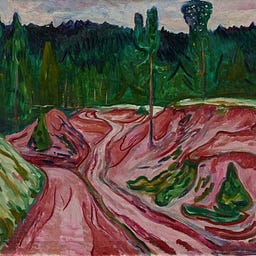
The Picnic, George Bellows, 1924


Esha emailed me to see how I was doing, and I replied:

I am both filled with creative energy and blocked at the same time. Excited and frustrated, I feel like a storm flood trying to flow through a straw! I am overflowing with interesting ideas, my diary is filled with reflections and scenes, and I read much that stimulates me and have a lot of interesting conversations... but I just can’t shape any of it into essays.

There’s this sense of being in a room with a hundred doors. I walk up to one and try to open it… but no, it’s locked. So I will try the next one… it doesn’t have a handle. Upon closer inspection, they all lack handles. I’ve tried a hundred different things: a hundred different ways of structuring my projects, a hundred different ideas, and a hundred different ways to approach them. And none of them have worked. It gets frustrating.

But it is also, at the same time, fun to be in a room with so many doors. I’ve spent the last few years in a room with five or six doors—and that had its perks, because I knew how to open them. But I was getting a bit tired of those doors. And now suddenly there are doors in all directions! There is just one catch! They can’t be opened.

I’m confused about what exactly is going wrong here. Why has almost nothing I’ve worked on for the last three months amounted to anything? I should try to think it through.

I guess the obvious thing you could say is that I’m trying to do something new (I’m a little tired of my old ways of writing) and new things are, by their nature, much less likely to work. When you’re in a phase of experimentation, it’s not particularly surprising that you will feel very generative and, at the same time, that nothing will be of production-grade quality, so to speak.

The essays I’ve done in the past five years have been the best work I’ve done. After a half-decade of experimentation (2014-2019), I was finally able to solve some conceptual and technical challenges in 2019-2021, which made it possible for me to write what I wanted to. In particular, I was able to integrate a certain breed of analytical writing with techniques I had learned from writing poetry and fiction. Now I’ve spent five years honing and exploring that mode of writing, getting a better and better grasp of it. It is a mature form. Naturally, when I try to explore beyond that form, I can’t do anything as accomplished right away. I have to accept that things will deteriorate and become more tentative for a while. But how long?

One of my favorite reading projects this summer was going through pretty much everything that has been written by or about the painter David Hockney, the patron saint for people who can’t resist a quirky project. The paintings he is most famous for, such as his pool images, were done in the early 1970s, as a culmination of the work that Hockney had done up until that point. He was in his mid-thirties.

And then, in 1974-5, when he was 37 (wait, I’m 37!), he grew frustrated with that mode of painting and began searching for a way beyond it. And the stuff he did at this point was, I think, a lot more confused and unappealing than what he’d done a year before. Here, for instance, is Kirby (After Hoghart) Useful Knowledge from 1975:

And then… the year after, it was still not as good. And the year after that…

Talking to Johanna, I say (riffing on one of her ideas) that I suspect a central reason Hockney was a bit hit-and-miss artistically from 1975 to 1980 was that while he knew he was frustrated about his earlier work, he was unable to grasp what frustrated him about it. When he talks about it in retrospect, he is able to articulate that he had grown tired of painting in one-point-perspective, tired of looking at the world in that static, one-eyed way a camera sees, and wanted to find ways of painting more true to human perception. But this clarity is years later. At the time of Kirby (After Hogarth) Useful Knowledge, all I sense is an anarchic lashing out at the strictures of conventional perspective. (In fact, the painting is based on an illustration that warns how wrong things can go if an artist fails to understand the “laws of perspective.”) It is more a gleeful refusal of the rules than a positive path forward.

Here is the original, from Kirby’s Satire on False Perspective, 1754.

It wasn’t until the early 1980s, when Hockney did his Polaroid collages, that he figured out the proper way to articulate the problems with his old images and, with that, how to proceed with his new projects. The problem with his old images, and with photography, was that that is not at all what the world looks like to us. And with this articulation, he was able to delineate what was to become the main project of the second half of the career, namely, as I said: finding ways of making pictures that are more true to how we see the world than photography is.

The collages (which mimic the way we see the world, not from one perspective like a camera, but by stitching together multiple images that the eyes take in as they dart around in saccadic bursts) were the first deep solution to this problem. (Later, Hockney found other deep ways of representing vision, drawing on innovations in Cubism and Chinese scroll paintings.)

Johanna and I are talking about this late at night, sitting downstairs in the kitchen in the thick darkness. On the wall opposite me, there is a convex, round mirror with a wooden frame, and I can see Johanna as a long, bent shape tracing the left side of the mirror: she’s eating noodles, broth, and eggs.

“I often think about when I couldn’t figure out what to do with the lavender bed by the terrace,” she says (meaning when she was designing that part of our garden). “I just tried one thing after another all summer, and nothing worked. Then one day, I sat down and thought hard about why none of the ideas I tried worked. And once I did… the solution was fairly obvious.

“What I realized was that I hadn’t extracted the information I got from all of my failed attempts. The failures were telling me so much. But I wasted that information by trying new things all of the time, more or less at random. I didn’t examine what I had tried and articulate why it wasn’t working. As a result, I failed to make use of the information that was right there in front of me.”

I sit silent for a long time, thinking about the endless experiments I’ve done over the last three months. I stare at myself in the convex mirror. What is it that frustrates me about my writing, really?

“I do like that prompt…” I say. “But at the same time… I’m not sure. It is not that simple. I mean, in Hockney’s case—it is not at all easy to look at the paintings he was doing and figure out that what was wrong with them was that they used one-point perspective. Nearly all paintings use one-point-perspective. It is like trying to notice the water.

“Or if I think back to when I left the literary world in 2014… I had to learn so much before I could even conceive the shape of the writing that would solve my problems.”

“No, I’m not saying that articulating your frustrations immediately solves the problem,” Johanna says. “If you are dealing with a complex problem, you will have to figure out a small part of it, and then deal with the next steps. It will take time to really get into it. (And it will require many other tactics and techniques beyond articulating what is wrong.) But the point is that if you’re just jumping from one thing to the next, you are wasting information—”

“As I do.”

“As is easy to do.”

I get up to make a cup of silver tea. And I picture myself at the start of my last long bout of confusion regarding my writing—the one that stretched for seven years. At the start of it, in 2014, when I left the literary world, sick of the kind of writing we were doing, would it have been possible for me to articulate that frustration clearly enough to invent the solution I eventually found seven years later?

The way I phrased the frustration at the time was that I “wanted my poetry to be more like mathematics.” This was a somewhat fuzzy image. But I do think it would have been possible, with the right support, to unpack that notion into something like: I’m tired of how everything we’re doing is just creating moods that please the in-group; there is no rigor in our words, no “reach”: what we write doesn’t expand and deepen our understanding of reality (the way, say, physics does).

What could I have made with this notion? I guess I could have made a closer study of forms of writing that attempted to be more rigorous—like scientific papers—and asked myself, “Like this? No? So what is wrong with their approach?”

Had I paused to articulate my reaction and extract the information I needed to direct my search, it seems conceivable that, within a few months of such targeted study, I could have articulated the rough shape of what interested me: how to develop a way of writing aimed at orchestrating an inner experience (like poetry) but which also forces me to sharpen my thoughts and give them more reach (like mathematics). I probably could have sped up articulating this goal a lot if I hadn’t just bumbled around. And perhaps the work of figuring out how to shape a style that lets me write like that (to my satisfaction) could have been done faster, too? Maybe I could have done it in three years instead of seven? But it is hard to imagine doing it faster than that!

It took David Hockney five years to untangle his confusions, five years of stumbling around, doing work that was weaker than what came before—and this was at the height of his powers, when he had near-endless resources and assistants and access to every collaborator and expert he needed (not to mention that he was much more talented than I am and didn’t have kids climbing all over him).

I feel better remembering this. I needn’t be frustrated at myself for having been confused for three months. These things have to take time. There is no way around it.

Hopefully, I won’t need seven years this time. Hopefully, I can articulate with more clarity what is wrong and figure out a shorter path onward.

But so what if it is seven years?

Something I valued about working at the art gallery (2021-24) was that I made a lot of friends who were in their seventies and eighties, and when they talked about their lives, I would be reminded that what to me seemed like my whole life to them was just one episode among many. It felt viscerally that I would live multiple lives beyond the one that now filled me to the brim. In a similar way, I find it comforting right now to look at the five years Hockney spent confused in the context of his full career—what followed the years he spent grasping for the right question was 46 very productive years exploring the answers that came from it.

So, yes. I might be confused and frustrated right now; my essays might be falling apart, unable to contain what is rushing through me. But life, if we’re lucky, is very long. We have plenty of time to try different things, to live different lives, to be confused, and figure things out, and then be confused again.

添加评论
点赞收藏
点踩分享查看原文
评论
?
参与讨论