The Attractive Economics Behind Anthropic Data Center Sprint


Why is Anthropic driving its partners to speed up the $530 billion of data center leasing deals it has signed?
It’s simple: Every server Anthropic plugs in sooner to run its products could be wildly profitable, according to fresh analysis of upcoming AI data center sites, including one Anthropic will rent outside Baton Rouge, La.
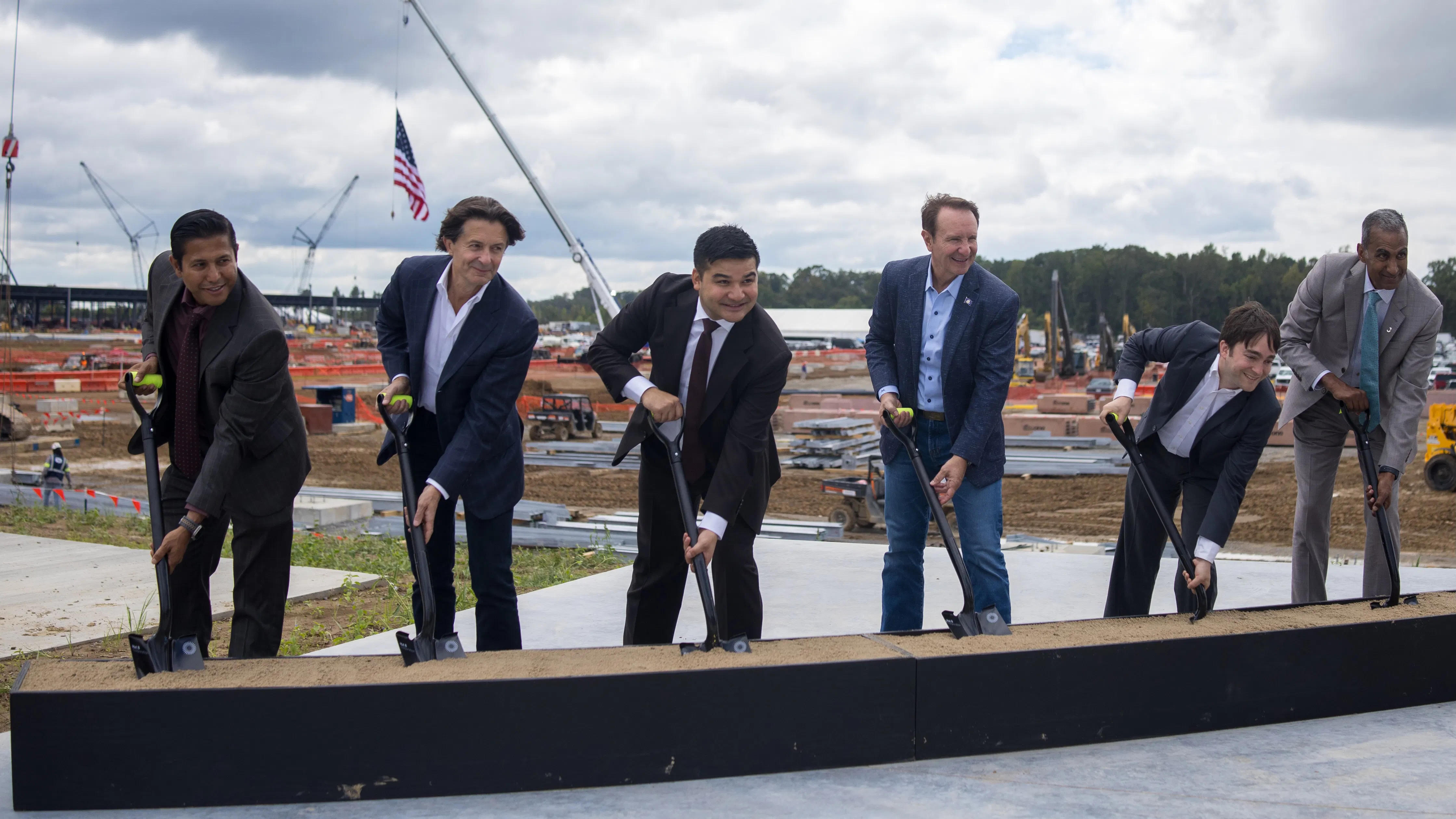
Anthropic’s frantic race for data center capacity brought me to a kickoff event last week in rural St. Francisville, where the Claude maker will put Google’s AI server chips to work at a 330-megawatt site, starting the second quarter of 2027. The site’s developer, Hut 8, is seeking to grow the site to 1 GW of capacity, which would cost many tens of billions of dollars to set up and fill with chips. Fluidstack will lease and operate the site while Anthropic will supply the Google chips.
Like many of Anthropic’s latest partners, Miami-based Hut 8 is relatively new to AI infrastructure and runs a legacy bitcoin mining business with Donald Trump, Jr. and Eric Trump. Don Jr. was on hand for the glitzy celebration under a tent in a muddy 627-acre field with partially erected buildings. Joining him were Louisiana’s governor and 300 bankers, investors, and utility officials as well as Anthropic’s head of compute, James Bradbury.
Think of Hut 8 as one of the many fresh horses Anthropic has brought to the race to switch on data centers and grow its revenue before and after an initial public offering, expected next month. In the coming years, Anthropic has committed to renting or leasing an astonishing 15 GW of capacity from the likes of Amazon Web Services, Google, SpaceXAI and more than a dozen other cloud providers and data center firms. Anthropic has also entered a multiyear cloud deal with publicly traded IREN, another crypto miner-turned-AI server provider, that has not yet been announced, people familiar with the relationship say
Measured AI, an AI construction newsletter, projects Anthropic’s capacity will rise from 1.4 GW in 2025, to 5 GW this year, 9.5 GW in 2027, and 15+ GW in 2028. To put that in perspective, Microsoft’s entire Azure cloud business operated at about 5 GW at the end of 2023—and that was to serve all of its customers, before the AI buildout accelerated.
Anthropic’s ability to win a compute-expansion race against OpenAI is increasingly going to depend on Hut 8, TeraWulf, IREN, Nscale and other current and former bitcoin companies, some of which are now struggling to raise money from public market investors at the valuations they want.
Valuable Energy Rights
Nevertheless, these firms and other Anthropic partners are key because they previously picked up grid-connected power rights at former aluminum smelter campuses, failed green hydrogen sites, renewables-rich land and other non-obvious data center backwaters that bigger cloud providers either missed or turned down. Such rights are hard to come by and extremely valuable, given the long waits to connect new projects to the grid.
For instance, Apollo-backed Stream Data Centers just acquired two failed hydrogen project sites from former high-flyer Plug Power, whose grid connections may be attractive. Anthropic is in talks to lease up to 1 GW in future capacity from Stream.
Anthropic is calling on its partners to gallop hard. For example, cooling and electrical equipment leader Vertiv is redesigning its products for rapid installation at data centers including the Hut 8 Louisiana campus. Vertiv CEO Giordano Albertazzi said at the Hut 8 event that it packages power modules, for example, with batteries, switchboards, cooling and fire protection in pre-fabricated bundles assembled at its factories offsite to cut the typical installation time in half.
“The whole way of building data centers is changing” so they can be “deployed at speed,” he said.
In a time of server scarcity, speed matters. The Louisiana campus plans to consume 330 MW of power to produce 245 MW in usable compute capacity. If that capacity can get online even one month faster than its current schedule calls for, Anthropic could generate an extra $1.3 billion or more in revenue, based on investors’ and analysts’ estimates. That assumes it uses all the capacity to serve up answers rather than develop new models.
High Margin
Even if the facility doesn’t come online early, the potential economics of roughly $1.3 billion in revenue a month for a quarter-gigawatt of capacity are highly attractive. At publicly disclosed rates for recent long-term AI contracts, Anthropic might pay roughly $200 million a month to lease chips from a cloud provider, says Christian Okoye of Occam Edge, which consults infrastructure investors, lenders and developers. That implies it can generate a 85% gross profit margin in the Louisiana example, assuming the facility is used entirely for inference. Anthropic is working to cut out such cloud middlemen in some data center projects, so its gross profit margin could get even better. (Gross margins don’t include model-training costs as well as payroll and other business expenses.)
Okoye’s analysis includes deals at facilities supplying both Nvidia GPUs and alternative chips such as Google tensor processing units. While GPUs are more expensive to rent than Google tensor processing units, Nvidia claims GPUs produce a lot more tokens per watt than any other chip.
In any case, Anthropic’s strong inference economics help explain how it went from spending about $2.30 on operations for every $1 of revenue in spring of 2025 to turning a slight profit on that basis in the June 2026 quarter.
A few caveats: Anthropic at the start of the year projected that its model-training costs would be more than twice as high as its spending on inference, and its spending spree on server rentals this year from SpaceX and others is sure to depress its margins. Plus, large Claude customers such as Microsoft and Meta have cut their spending with Anthropic and it faces more competition from OpenAI and open source models.
At the moment, however, Anthropic is still operating as if it has pricing power over most of its customers, my colleague Kevin recently reported.
One issue for the broader industry and capital markets is that Anthropic may be the only company with such pricing power; nobody else running generative AI apps, including OpenAI, seems to be generating anywhere near Anthropic’s gross margin from inference.
Affordable Grid .
Developers working with Anthropic say the Claude maker is focused on ways to get data center power quickly, even if it means temporarily cutting electricity use when the grid is strained, going on backup power, or locating its facilities farther away from customers, meaning AI results would take more time to travel through fiber networks. Hut 8 CEO Asher Genoot said at the Louisiana event that he’s in constant dialogue with utilities and other partners, asking “what can we do to speed up some of those builds.”
The attractive data center economics explain why AI developers like Anthropic wouldn’t balk at paying higher power prices themselves, even as rising utility bills have become a sensitive topic for consumers. Energy analyst Hans Royal from Royal Powers Energy tracks what he calls the “Compute Heat Rate,” the electricity price that a data center powering AI inference workloads could afford to pay while still earning a return. In the third quarter of 2026, facilities powering commercial AI applications could make money even if their power cost $5,631 per megawatt-hour, which is more than 100 times higher than the typical wholesale grid price of $50 per MWh.
And Royal said the most advanced AI makers, such as Anthropic, could technically still generate a profit at a power price of $12,791 per MWh if they had to!
Royal’s analysis is a signal that power companies could be charging AI data centers far more than they currently are.
Lowering Everybody’s Prices
But there may be a better trade than simply charging more. Anthropic and its data center partners could potentially use these strong AI inference economics to convince utilities to let AI data centers get partial power sooner if they agree to remove their facilities from the grid for a few peak hours a year. The money Anthropic could earn would compensate for occasionally switching off the facilities, according to a new paper from Royal Powers and Occam Edge. Plus, innovative companies are developing ways for Anthropic and other users to automatically switch to backup power or move computing elsewhere when the grid is strained.
This is another reason adding more AI data centers could lower power costs for everybody. The utility earns more revenue on the same base of assets, and those costs get spread over a wider base of ratepayers.
In Louisiana, the local community near the Hut 8 site sees a chance to reorder its finances as the money rolls in. For instance, West Feliciana Parish President Kenny Havard got a bill through the state legislature that allows local officials to lower residents’ property taxes 25%, to match the tax discount the parish is giving Hut 8. However, Hut 8’s tax payments on the facility are eventually expected to triple the parish’s annual revenues to $130 million from $40 million.
It all sounds pretty rosy, assuming energy, silicon, construction capacity and debt capital remain plentiful in the coming years. That’s still a big ‘if.’
In other news:
· Google’s move to unlock nearly a nuclear reactor’s worth of energy, or 890 MW, by funding upgrades at 11 reactors, plus contract for another 2.7 gigawatts in a major supply deal with Constellation Energy, is a strong move to relieve a power shortage in the Mid-Atlantic grid where AI energy demand is exploding.
· VEIR, a Microsoft-backed creator of superconducting power delivery systems that has pivoted into AI data centers, announced the closing of an oversubscribed $110 million Series C financing, bringing total funding to $225 million and paving the way for a commercial deployment, likely by a neocloud, to show how VEIR can streamline the step-up of electricity in rapidly emerging 800-volt DC data center power architectures.
Ann Davis Vaughan is the author of the AI Infrastructure newsletter for The Information. She is a former senior Wall Street Journal investigative reporter turned investment strategist who has tracked the energy, industrial and financial sectors for three decades.

 点赞
点赞 收藏
收藏 点踩
点踩 分享
分享