Premium: How Has AI Changed The Economy?

This week, the Wall Street Journal ran an alarming illustration of AI’s potential share of GDP that I’d argue did more to muddy the waters than actually telling anyone anything, mostly because its measurement, for whatever reason, covered 2025 to 2032, meaning that six out of the eight years of the analysis were estimates of spending.
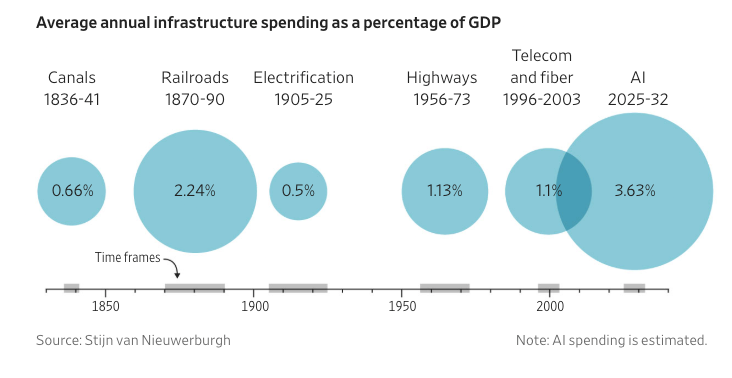
To be fair, this analysis came from the Brookings Institution’s Stijn van Nieuwerburgh rather than the Journal itself, but I cannot express how profoundly unhelpful it is to discuss things years in the future.
The Journal itself acknowledged this, giving us a far-more-useful number, emphasis mine:
Projecting investment is tricky, and total spending might well end up substantially lower. Still, the money poured into data centers this year already represents an investment unprecedented in recent history. AI investment in the U.S. is projected to hit 1.9% of GDP in 2026, according to new estimates from Goldman Sachs. The railroad boom of the late 19th century marked the last time the build-out of one new industry accounted for a larger share of the economy.
Yet it’s important to be specific that this is almost entirely a result of AI data center construction and GPU sales rather than anything to do with the companies actually renting AI compute. In other words, AI itself isn’t helping boost America’s economic growth, but rather the infrastructure for it to theoretically run on.
This is extremely problematic, because it means that at some point data center construction will slow or stop (as discussed in this week’s free newsletter) through some combination of moratoriums and ever-pricier debt, removing any contribution to GDP and leaving AI — either through the revenue generated from selling services or productivity improvements — to cover the shortfall.
The problem with calculating the exact contribution of the tech industry is that so many different pieces of these companies flow into different “industries” (of which there are seventeen in total) in the BEA’s data based on the specific economic contribution.
For example, Apple’s services vertical (like iCloud) would flow into the “US Information/ICT” indices of GDP calculation, but its sales of iPhones, Macs and iPads would flow into manufacturing, the same place where NVIDIA’s GPU sales would go. ICT also doesn’t include consultancy revenue or IT services from companies like Accenture, but that isn’t really relevant to the analysis.
In any case, the ICT industry’s contribution to GDP is actually very, very useful for this calculation, because it specifically includes sales of AI software and rentals of AI GPUs. There’re two numbers to look at here. As a share of nominal GDP — strictly how many dollars it’s contributed to GDP — tech’s contribution has been flat for the last two years. In other words, all those supposed GPU rentals and AI software sales in 2024 and 2025 didn’t really do much on an economic basis.
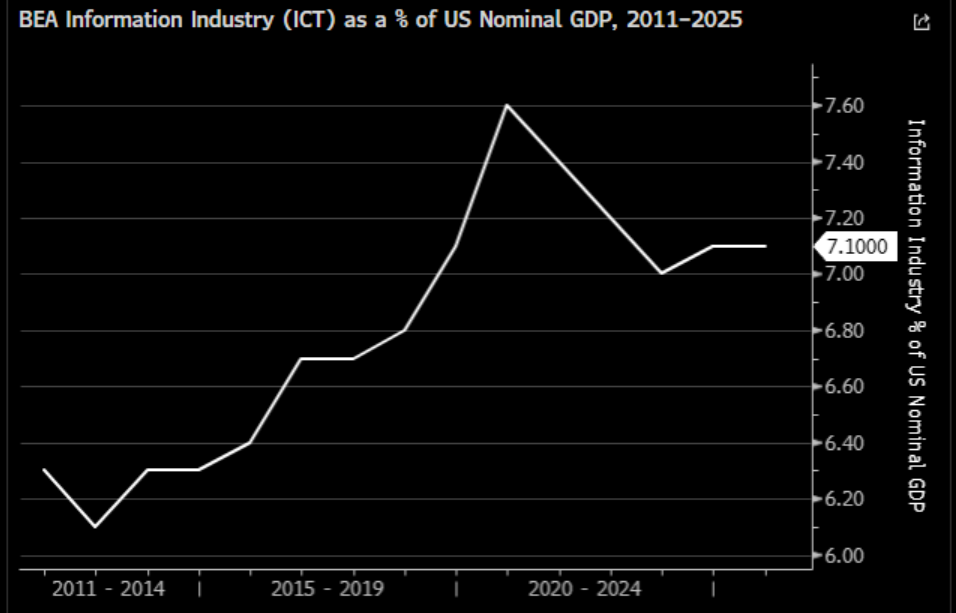
I can already hear someone screaming that we need to measure “real GDP” — which factors in improvements to software and hardware that would theoretically boost the real GDP contribution of the ICT industry.
The problem I have with that analysis is that the BLS’s Producer Price Index for Software Publishers — a measure of how prices for packaged software have changed over time that the BEA uses to calculate real GDP — is currently sitting lower than it was in 1997, suggesting that software prices have dropped over time in a period where general prices have roughly doubled.
This isn’t remotely accurate based on the actual experience of people buying software. As I covered in the Hater’s Guide To The SaaSpocalypse, more than half of SaaS companies have increased their prices every single year since 2022, customers are paying more every year for the same features, and overall SaaS inflation ran over nine percentage points higher than consumer inflation every single month of 2025. This problem began in or around 2022, when Microsoft bumped up prices, inspiring industry-wide inflation.
In other words, the BLS’ “quality” adjustments appear to be treating many of these price increases as customers getting better software for their money, rather than paying more money for the same software, with the BEA in turn counting that as businesses buying more software.
The BLS believes that software is effectively the same price as it was in 1997, largely because giving customers “more value” and allowing them to “do more,” which does not make sense if you’ve used a Microsoft product recently.
The BLS’ preferred method for these adjustments is based on the cost of the change (IE: how much more it costs to provide), meaning that any price increase connected to AI services, which require expensive tokens to provide, could be potentially considered the same or even lower-priced in the eyes of the BLS.
The BLS’ data is understating how much the cost of software has actually increased in the last few years, and as a result, the BEA may be — accidentally — overstating its contribution to GDP. And AI services are only making things worse.
With that in mind, I calculated the gross value (a business’ sales minus its costs bought from other businesses, so no wages included) added by the ICT industry against real GDP, and found that while tech’s share has grown steadily, said growth hasn’t changed dramatically in the era of AI, even using the BEA’s own flattering figures.
Sidenote: I want to be crystal clear about the data I’m discussing here. The ICT industry portion of what you’re about to read is inclusive of GPU rentals, but the BLS data around software does not include them.
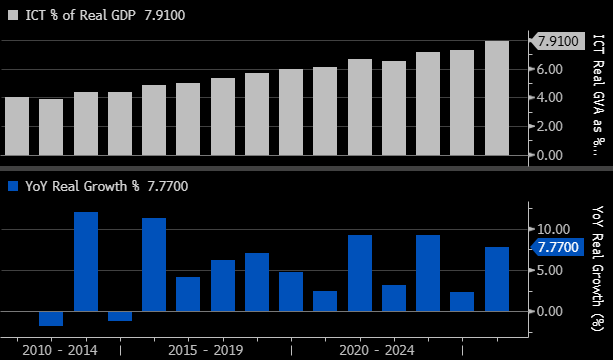
All of this is to say that even with various statistics agencies having a fairly distorted view of the tech industry — at least when it comes to selling software and renting infrastructure — the AI era’s contribution feels a little mediocre.
In preparing this newsletter, I’ve realized something a little worrying: that basically every economic analysis of “AI’s contribution to the economy” is based on either flawed data or flimsy assumptions about AI and the tech industry itself. Economists have tied themselves in knots trying to rationalize the astonishing amounts of money invested in AI, and in doing so haven’t made sure that even their simplest assumptions — like how much the tech industry itself contributes — are meaningfully capturing what’s going on.
Today’s newsletter is a frank evaluation of AI’s true effect on the economy, specifically focused on actually measuring what’s happening today rather than the endless analyses of hypotheticals that you’ll find everywhere else.
You see, everybody is obsessed with metrics that don’t matter — cost-per-token, teraflops, and vague analyses of jobs data — all to avoid a much grimmer point: that when you remove the capex, AI has had a negligible effect on GDP.
And beneath the surface, I’ve found evidence that software sales’ contribution to GDP may have been meaningfully misstated since 2022.

 点赞
点赞 收藏
收藏 点踩
点踩 分享
分享