Waves find order in the chaos of an oddly shaped cavity

When light or sound bounces around inside an oddly shaped room, its reflections can quickly become difficult to predict. But new research led by scientists at the Advanced Science Research Center at the CUNY Graduate Center (CUNY ASRC) shows that waves can behave very differently when they travel through a special class of materials.
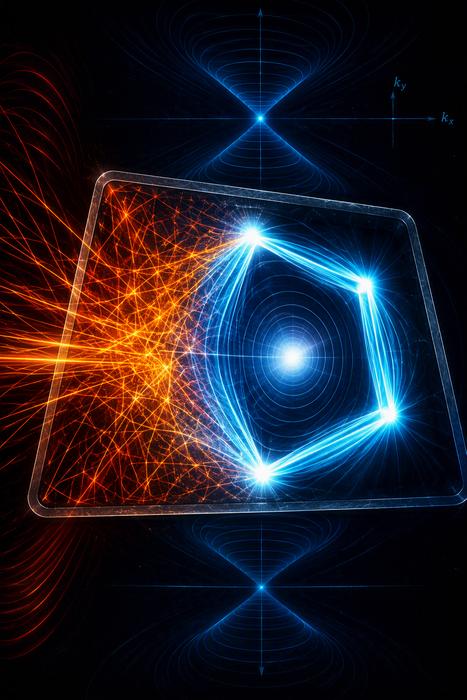
The study demonstrates that waves inside an irregularly shaped cavity made from hyperbolic materials (which are named after the hyperbola mathematical curve because of the unique shape these materials force light waves to take) can organize into stable, repeating paths rather than scattering chaotically. The researchers call these structures “hyperbolic wave attractors,” and their findings could eventually help scientists and engineers design new ways to control light, radio waves, and sound in complex environments.
“This work shows how geometry and the properties of a material can work together to produce wave behavior that is both surprising and useful,” said Andrea Alù, the study’s principal investigator, director of the Photonics Initiative at the CUNY ASRC, and Distinguished Professor of Physics at the CUNY Graduate Center. “By understanding how waves organize themselves in these hyperbolic media, we can begin to explore new approaches to controlling energy, information, and communication signals in complex environments.”
When waves take an unusual turn
In everyday materials, waves generally reflect from a surface in a familiar way: The angle at which a wave arrives matches the angle at which it leaves. In an irregularly shaped room, repeated reflections can send waves in many directions, creating complex chaotic patterns. This is the basis of a classic physics problem known as a dynamical billiard, in which the motion of a ball — or, in the wave version, light — inside a curved or irregular container quickly becomes unpredictable.
Hyperbolic materials can drastically change this picture. These materials have unusual properties that force waves to travel along narrow, highly defined directions instead of spreading freely in all directions. As a result, when a wave encounters a tilted wall, its outgoing direction can differ from what would be expected in an ordinary material.
Alù’s team wanted to understand what would happen when these unusual reflection rules were combined with an irregularly shaped cavity.
“Normally, we expect a complicated cavity to produce complicated, chaotic wave patterns,” said Simon Yves, a postdoctoral researcher in Alù’s lab and a first author of the study. “Here, the opposite happens. The unusual propagation and reflection of waves create a strong geometric organization, producing well-defined paths that can persist across a broad range of wavelengths.”
From chaos to wave attractors
The researchers found that the waves inside their cavity can progressively organize into closed trajectories. These paths are stable and scale-invariant, meaning their underlying geometric structure persists across different scales.
The effect arises from a breaking of mirror symmetry in the wave-reflection process. As waves bounce around the cavity, their wavelengths progressively shrink, helping create the conditions for the formation of the attractors.
The resulting wave patterns also have a property called handedness. This describes whether the defined wave’s trajectory inside the cavity rotates clockwise or counterclockwise. The attractors’ handedness and stability are connected to the unusual geometry of wave propagation in the hyperbolic material.
The team demonstrated these effects by engineering vibrations in a mechanical metamaterial, a human-made structure designed to control how waves move through it.
“The most exciting aspect of these results is that they connect a simple geometric idea with a rich set of wave phenomena,” said Enrico Renzi, a doctoral student in Alù’s lab and a first author of the study. “We can observe how the waves become organized, and we can connect that organization to properties such as stability and handedness. This gives us a framework for designing wave behavior rather than simply observing it.”
A bridge from ocean waves to nanophotonics
The researchers’ findings have intriguing parallels with internal wave attractors studied in oceanography and fluid dynamics. In oceans and other stratified fluids, waves traveling through water with density gradients can reflect unusually from underwater slopes. These reflections can focus energy into closed paths and contribute to wave turbulence.
The new study translates a related phenomenon into a tabletop, solid-state metamaterial platform, showing how concepts from geophysical fluid dynamics can be explored in engineered materials and in simple linear settings.
The framework that the scientists introduced can also extend to hyperbolic phonon polaritons — hybrid light-matter excitations that can arise in natural two-dimensional anisotropic crystals such as hexagonal boron nitride and molybdenum trioxide, which support similarly odd propagation and reflection properties. These materials can support light confined to tiny regions, offering opportunities for low-loss nanophotonic circuits, enhanced interactions between light and matter, and control of infrared light.
In the future, hyperbolic wave attractors could inform the design of compact optical chips, devices that separate optical signals, particle-trapping systems, analog wave-computing platforms, and highly sensitive biological sensors.
“This research opens a path toward engineering stable and robust wave patterns in systems where waves would normally be expected to rapidly become chaotic,” Alù said. “Our goal is to understand how these effects can be harnessed to create new functionalities for photonics, phononics, and wave-based technologies.”
References
- Yves, S., Renzi, E.M., Mann, S.A. & Alù, A. (2026) Hyperbolic wave attractors Nat. Phys. doi: 10.1038/s41567-026-03453-7
The post Waves find order in the chaos of an oddly shaped cavity appeared first on Mapping Ignorance.

 点赞
点赞 收藏
收藏 点踩
点踩 分享
分享