Nanocellulose: from the most abundant biopolymer to next-generation sustainable materials

Author: Víctor Calvo Peña is a Postdoctoral Researcher at INRAE BIA (Nantes, France)
26 April 2026 will always be remembered as the day an apparently impossible barrier was finally broken. At the London Marathon, Kenya’s Sabastian Sawe and Ethiopia’s Yomif Kejelcha became the first men to officially run the 42.195 km distance in under two hours, finishing in 1:59:30 and 1:59:41 respectively. Reaching this landmark was not the result of a single innovation but of decades of progress in training, nutrition and sports science. One piece of technology, however, has increasingly come into focus: the shoes beneath the athletes’ feet. Modern racing shoes combine lightweight foams with rigid carbon-fibre plates and carefully engineered geometries to improve running efficiency and energy return. Similar advances can be seen in many other sports. In cycling, for example, bicycles and sportswear are becoming lighter and more aerodynamic, with components engineered to combine low weight, stiffness and reliability. In mountaineering, waterproof and breathable membranes allow climbers to cope with extreme weather conditions by controlling the transport of moisture through their clothing. In all these cases, performance increasingly depends not only on what a material is made of but also on how it is structured. With environmental challenges growing, this raises another question: could the next generation of high-performance materials also be more sustainable?
Cellulose is found in everything from wood and cotton to agricultural residues and other forms of biomass, and it gives plants the mechanical strength they need to grow. But cellulose is not interesting simply because it is abundant. As noted above, the way a material is structured can be just as important as its chemical composition. At the nanoscale, this becomes particularly striking: the same cellulose molecules can be organised into structures with very different dimensions, morphologies and properties. This ability to modify a material’s properties by controlling its structure at the nanoscale is the basis of nanotechnology, and cellulose is not the only material in which it can be exploited. Quantum dots, for example, are semiconductor nanostructures whose optical properties change with their size. They are now used in technologies such as QLED displays. In a similar way, controlling cellulose at the nanoscale can transform this common biopolymer into a material with entirely new capabilities. This is the idea behind nanocellulose. The term does not describe a single material but a family of nanoscale forms of cellulose (Figure 1), mainly cellulose nanocrystals (CNCs), cellulose nanofibres (CNFs) and bacterial nanocellulose (BNC). Although they share the same basic chemical building blocks, their different structures and origins give them distinct properties and potential applications.
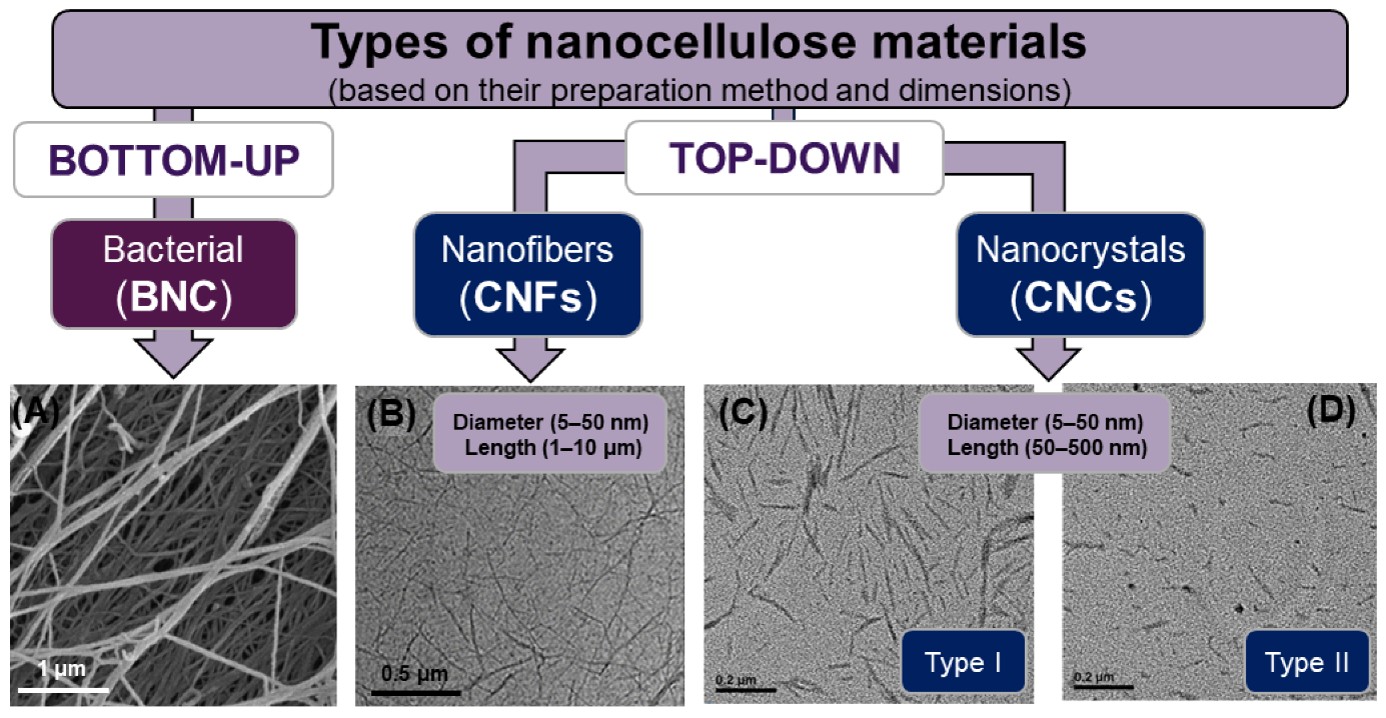
But how can cellulose be brought down to the nanoscale? For CNCs and CNFs, the starting point is cellulose in a much larger form, such as wood pulp, cotton or other plant fibres. Through physical, chemical and/or biological treatments, these structures can be progressively disintegrated into their nanoscale building blocks. The production of CNCs selectively removes the less ordered regions of cellulose, leaving behind short, rigid and highly crystalline nanocrystals. CNFs, in contrast, are obtained by breaking the fibres down into long, flexible nanofibrils that can form interconnected networks. These structural differences give each type its own strengths: CNCs can stabilise emulsions, reinforce polymers or help disperse other nanomaterials, while CNFs can form films, hydrogels and lightweight aerogels. The surface of cellulose can also be chemically modified in many different ways, allowing its properties and its interactions with other materials to be tailored for specific applications. BNC takes a different route. Rather than breaking down plant cellulose, bacteria build cellulose directly from sugars such as glucose or sucrose, as a network of nanoscale fibrils. Komagataeibacter xylinus, for example, is one of the species found in the bacterial community used to make kombucha. Growing at the interface between the culture medium and the air, these bacteria produce a highly pure, crystalline and porous cellulose network that can be used in membranes, biomedical scaffolds and other three-dimensional materials.
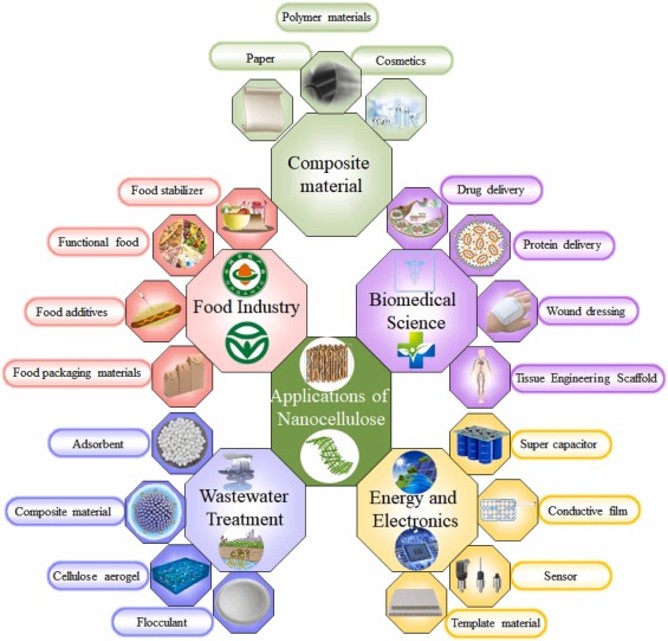
The potential of nanocellulose stems from the unusual combination of properties that can emerge from these different nanoscale structures, and researchers are exploring an increasingly broad range of uses. CNCs, for example, can stabilise interfaces between otherwise incompatible materials, making them useful in emulsions, while their reinforcing ability is being investigated for making lighter and stronger polymer composites. Their surface chemistry also makes them attractive as dispersing agents for other nanomaterials, opening up possibilities for water-based functional inks and coatings. CNFs, with their long and interconnected fibrils, can instead form continuous networks that can retain large amounts of water or be dried into lightweight, porous structures. This has led to research into films, hydrogels and aerogels, as well as three-dimensional materials for insulation, separation and other applications. BNC offers another distinctive architecture: its nanofibrillar networks can be produced directly as membranes and are being investigated for biomedical materials and other applications where controlled porosity and water management are important. Beyond these more established research directions, nanocellulose is also being explored as a platform for sensors, conductive materials, energy devices and electronic textiles, often by combining it with other functional materials. The important point is that nanocellulose is not simply cellulose in a smaller form: nanoscale organisation gives this abundant biopolymer new functions that are difficult to achieve with conventional materials.
Yet the potential of a material cannot be measured by functionality alone. Its environmental performance must also be considered: how much energy and raw material are needed to produce it, what happens during use and whether it can be reused, recycled or safely disposed of afterwards. Major sports brands are already exploring new materials and manufacturing approaches aimed at combining high performance with a lower environmental impact, driven by rising consumer awareness and tighter environmental regulation. Replacing a fossil-based material with one derived from biomass does not automatically make a product sustainable if its production is energy-intensive, its lifetime is short or its end of life is problematic. The real challenge is to design materials whose functional advantages are accompanied by a lower environmental burden across their entire life cycle. This is where nanocellulose becomes particularly interesting: it is a renewable alternative to conventional materials and a platform for new functionalities, with the potential to enable more biodegradable and environmentally benign materials.
Nanocellulose will not replace every material, nor should it. Its value lies in offering another set of possibilities for designing materials in which performance and environmental considerations can be addressed together. The journey from a familiar polymer found in wood and cotton to nanoscale crystals, fibres, networks and three-dimensional structures illustrates how much can change when we learn to control matter at ever smaller length scales. The question for the future is therefore not simply whether we can make materials from renewable resources but whether such materials can be genuinely better – and better for the world around us.
References
- Víctor Calvo, Carlos Martínez-Barón, Laura Fuentes, Wolfgang K. Maser, Ana Benito and José Miguel González-Domínguez (2024). Nanocellulose: the ultimate green aqueous dispersant for nanomaterials. Polymers. doi: 10.3390/polym16121664.
- Qinghua Ji, Cunshan Zhou, Zhenqi Li, Isaac Duah Boateng and Xianming Liu (2023). Is nanocellulose a good substitute for non-renewable raw materials? A comprehensive review of the state of the art, preparations, and industrial applications. Industrial Crops and Products. doi: 10.1016/j.indcrop.2023.117093.
The post Nanocellulose: from the most abundant biopolymer to next-generation sustainable materials appeared first on Mapping Ignorance.

 点赞
点赞 收藏
收藏 点踩
点踩 分享
分享