Data Centers Create $3 Billion Opportunity for Catering Giants

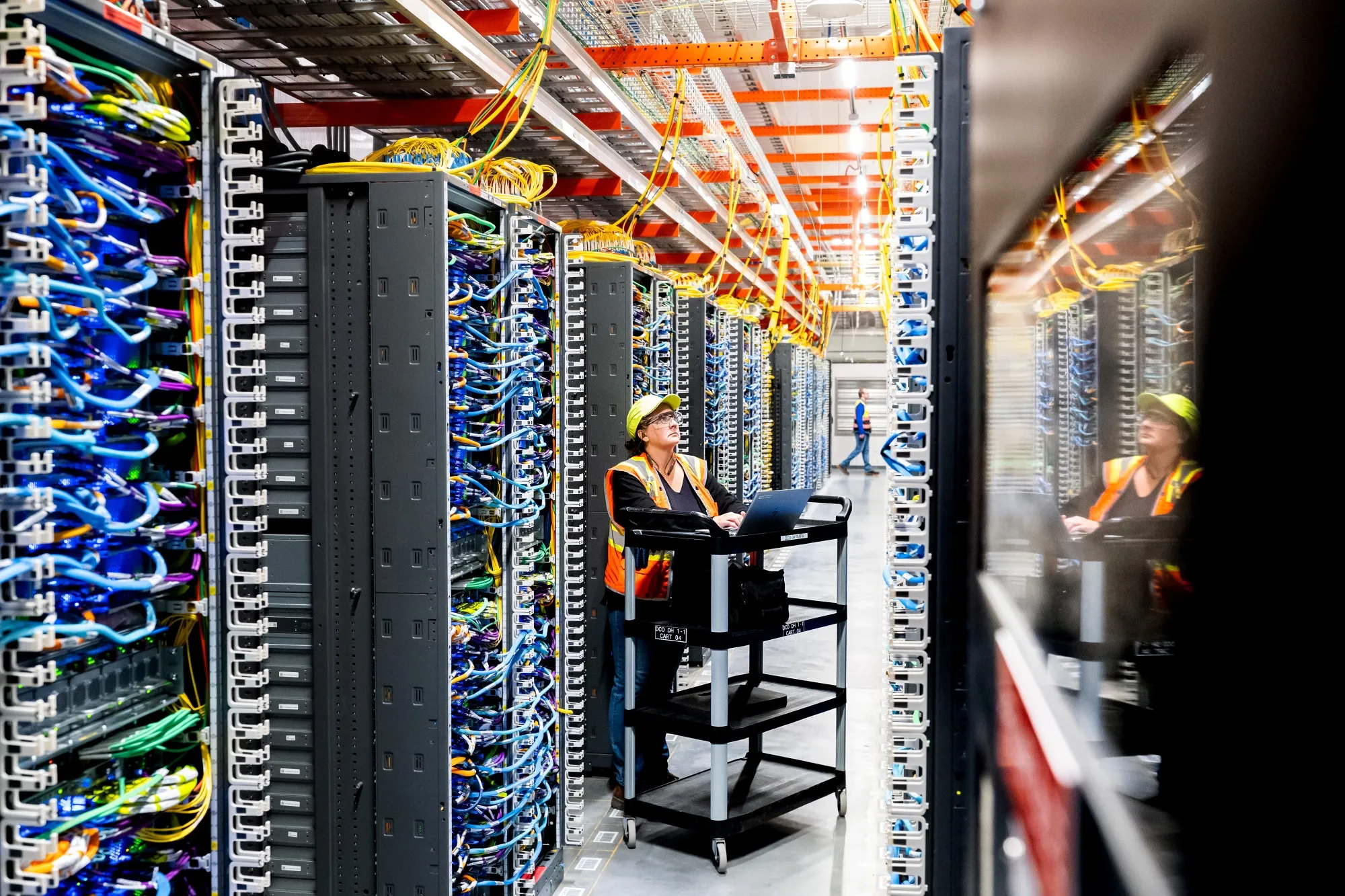
Catering companies have a $3 billion opportunity: providing food, gyms and entertainment to a growing cohort of data center workers.
As hyperscalers pour billions into building sprawling server farms, global caterers like US-based Aramark, the UK’s Compass Group Plc and France’s Sodexo SA are being tapped for services ranging from laundry to round-the-clock refreshments for both projects under construction and fully operational campuses.
With data centers scaling up across the US, this “implies several years of elevated demand for catering, housekeeping and facilities management,” Bloomberg Intelligence analysts Stuart Gordon and Evgeniy Batchvarov said. They project the outsourcing opportunity to reach annual revenue of $3.2 billion in 2032.
Aramark told analysts in August that it expects $400 million to $500 million in additional revenue from data center contracts in fiscal 2027 and 2028. It said this month it will provide catering, fitness centers and “resort-style entertainment” at a Texas data center with more than 4,000 workers, a deal Citi analysts estimate will add roughly $100 million in additional run rate revenue as it ramps up.
“We’ve kind of shifted that mindset from what was, ‘Hey, we just want a hot food option and a place for somebody to sleep,’ to really creating an environment for a person to live on a day-to-day basis,” Aramark Chief Executive Officer John Zillmer said at an investor conference this month.
Aramark raised guidance twice this year, citing the data center opportunity. It’s luring developers and operators to its amenities and services — an offering called Nexus — to help them woo workers amid fierce competition for talent.
“Statistics are saying that the country will be short about 500,000 skilled laborers by 2028,” Zillmer said. “The competition for those skilled laborers, whether electricians, plumbers, or whatnot, is going to be key.”
Philadelphia-based Aramark will likely control around 35% of the market, BI estimated. Compass is expected to capture about 30%, while Sodexo could take roughly 20%.
“If you start with Aramark, it looks like the opportunity is real — signed contracts, and the way the economics seem to be working means that it’s material,” Citi analyst Leo Carrington said in an interview. “Almost whichever way you would cut — the opportunity in the US or the global opportunity, you don’t need much imagination to get to some quite big numbers.”
Aramark’s Nexus offering, which combines services like housekeeping, dining, employee transportation and fitness and wellness programming, has helped it quickly build up market share and jump out to an early lead, BI wrote.
Though a smaller player, Sodexo signed a contract with Meta Platforms Inc. in July to provide catering across the tech giant’s offices, data centers and conference hubs globally. The opportunity for growth in this sector is “significant,” CEO Thierry Delaporte said on a recent earnings call, noting demand is coming both from data centers under construction and ones already in operation.
The benefits may also spread beyond hyperscaler campuses. “The supply chain isn’t just about the data center,” Compass CEO Dominic Blakemore said at an investor event earlier this month. “It’s about all of the manufacturers and construction companies within that supply chain that are also our clients, and where their employees are our consumers, and they’re going to be enriched by what’s going on.”
The segment that encompasses hyperscalers is the strongest performing sector with double-digit organic growth, Compass said in its latest trading update.
Temporary Growth Spurt
Annualized revenue will peak at $3.2 billion in 2032, then halve over the longer term as the frantic expansion slows down, Gordon and Batchvarov said, making quick geographic expansion and new project wins crucial to keep up momentum.
It’s all about the construction phase, according to Citi’s Carrington. “If you’re a food and facilities management provider, your revenue is going to effectively be linear to the number of people that you’re serving.”
Competition will be fierce. Carrington isn’t confident that Sodexo will meet all of its 2030 ambitions “in the context of a market with two major competitors performing extremely well,” he wrote after the company unveiled new targets.
Another challenge may be growing backlash against data centers over electricity bills, environmental concerns and broader unease around artificial intelligence. A September poll conducted by the New York Times and Siena University found 61% of US voters oppose the construction of data centers. That’s up 12 percentage points from a February and March poll by the Annenberg Public Policy Center of the University of Pennsylvania.
Political blowback and recent calls from leaders at AI labs to slow down development of frontier models over safety concerns have led most investors to consider the opportunities for catering firms on a contract-by-contract basis, Carrington said.
“The contracts need to be signed when the projects have got the green light,” Carrington said of the catering firms. “That matters most.”

 点赞
点赞 收藏
收藏 点踩
点踩 分享
分享