Who’s Borrowing and Lending in Repo Markets?

Gara Afonso, Jun-Davinci Choi, Gonzalo Cisternas, and Will Riordan

Repo markets play a vital role in the U.S. financial system. In this three-part series, we examine who participates in these markets, what trade-offs influence how different repo segments are structured, and why repos matter for monetary policy. Today’s post introduces repo transactions, focusing on the major private-sector participants and why they engage in these markets.
What’s a Repo?
A repurchase agreement or repo is a financial transaction in which one party sells a security in exchange for cash, with the commitment to repurchase the same (or a closely related) security for a prespecified price on a future date. (From the perspective of the party buying the security and later reselling it, this transaction is called a reverse repo.) Repos are an essential component of the U.S. financial system, acting both as a source of funding and short-term investment for many financial institutions, as well as a marketplace for obtaining specific securities. Recent estimates assess the daily amount of outstanding agreements in the U.S. at around $13.5 trillion or 40 percent of U.S. GDP (see OFR 2026).
The time between the initial sale and the repurchase, along with the price difference, determines the interest rate, known as the repo rate. Repo rates vary depending on a variety of factors, most notably the type of collateral accepted (the securities sold), maturity (the length of time between the initial sale and repurchase), counterparty, the size of the haircut (the difference between the value of the securities sold and cash delivered), and clearing (the process between the execution and final settlement of a transaction). Around 70 percent of repos are collateralized by U.S. Treasury securities and most have an overnight maturity. In terms of clearing, around 60 percent of repos are cleared through a central counterparty (35 percent) or through a third party (25 percent), while 40 percent are directly cleared between the buyer and seller (OFR 2025).
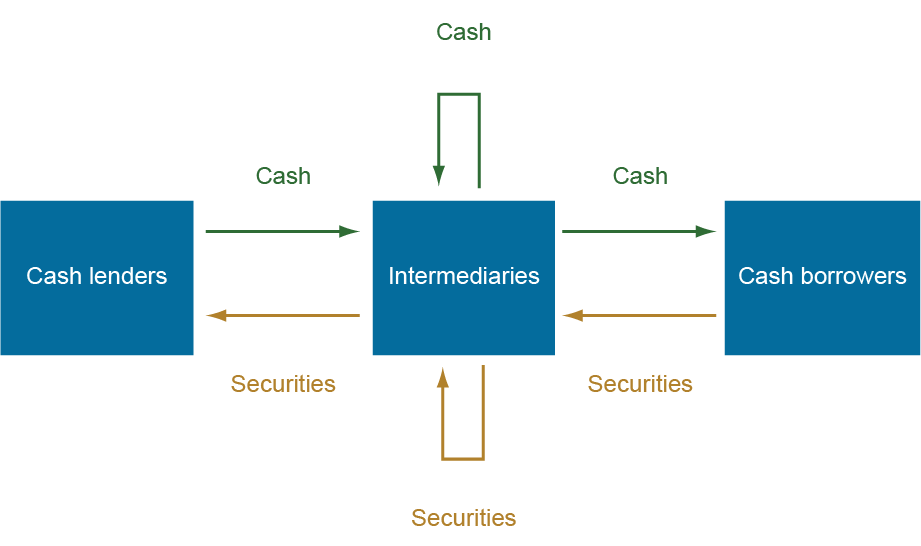
As an illustration, the diagram below shows a stylized representation of a repo market. Many different types of transactions take place in repo markets. For example, a dealer—acting as an intermediary—can purchase securities from levered investors like hedge funds (a reverse repo from the dealer’s perspective), and also enter into a repo with other dealers or with cash lenders such as money market funds (MMFs) to sell the securities, thus ultimately channeling funds from cash lenders to cash borrowers. In tomorrow’s post, we delve deeper into the microstructure of various segments of repo markets.
A Stylized Representation of a Repo Market
Repos can be traced back to the early 20th century. Repo market size and contracting conventions changed markedly in the 1980s following the failure of several dealers, amid a rising level and volatility of interest rates and growing supply of Treasury debt (see Garbade 2006). An important convention that has contributed to the liquidity and growth of repo markets is that repos involving Treasury and federal agency securities are exempt from the automatic stay under the U.S. Bankruptcy Code that, as the name suggests, comes into effect when a company files for bankruptcy and stays creditors from taking certain actions on account of their claims against the company. This means that if the cash borrower defaults during the life of the repo, the cash lender can generally terminate its repo contracts with the defaulting counterparty, sell the securities promptly, and avoid the delay and uncertainty of the bankruptcy process.
What Are Repos Used for?
In a repo, the party selling the security is interested in borrowing cash. The counterparty, however, may enter the repo transaction for one of two reasons: to invest cash and earn a return, or to obtain a specific security. The first motive makes a repo economically similar to other short-term money market instruments such as federal funds, Eurodollars, or commercial paper. Unlike in these markets, the transaction is collateralized: from the perspective of the cash lender, the securities reduce the risk of the trade.
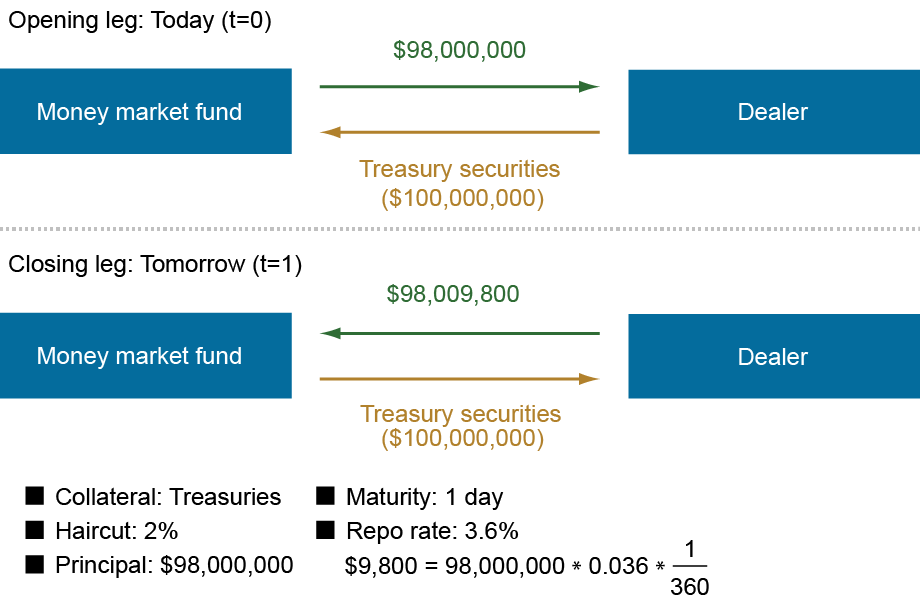
A “general collateral repo” (or GC repo) is a good example of a repo transaction in which the cash lender is not interested in the specific securities it receives. In GC repo, the cash lender agrees to receive any security that meets a specified criteria (for example, Treasury securities with less than ten years to maturity) rather than a specific security. This makes GC repo a funding market both for cash borrowers seeking to finance a basket of securities and for cash lenders looking to invest cash at a competitive rate. The diagram below shows an illustration of a repo used as a funding instrument. In this example, a MMF is looking to invest $98 million in cash overnight and lends to a repo dealer against a basket of Treasury securities including a haircut of 2 percent. The following day, the MMF receives $98,009,800 (at a return of 3.6 percent in annual terms) and returns the securities.
An Example of a Repo Transaction
Participants may also engage in repo to acquire a specific security. In the specific issue market, the securities used to settle the transaction are identified at the outset of the trade. When a particular security is in high demand relative to available supply, it has scarcity value and is known as a “special,” and typically trades at a lower rate relative to the prevailing GC rate: the cash lender, seeking to obtain a specific, scarce asset is willing to forgo some return (Duffie 1996). From this perspective, repos are like a security lending transaction against cash collateral rather than a collateralized loan. There are two important differences: first, repo mainly uses fixed-income instruments as collateral and, second, repo typically does not grant the lender the right of early recall of the securities.
Repos also play a key role in monetary policy implementation. In today’s post we focus on private repos, returning to their use in central banks’ toolkits in the third post of this series.
Who Participates in Repo Markets?
Relative to the federal funds and Eurodollar and selected deposits markets, the landscape of private repo participants is more complex for two main reasons. First, there is a broader and more diverse set of ultimate borrowers and lenders. Second, dealers are instrumental intermediaries in repo markets. In the remainder of this post, we shed light on the first category, describing the key role of dealers in tomorrow’s post.
The Borrowers
The top cash borrowers in private repo markets are hedge funds. Hedge funds rely on repo markets for leverage to boost their returns. An example of a hedge fund strategy that uses repo is the so-called “Treasury cash-futures basis trade.” In this strategy, a hedge fund purchases a Treasury security and sells a Treasury futures contract, which enables it to profit from the price differential. To amplify the return on the basis trade, hedge funds finance the purchase of the Treasury securities with cash borrowed in a repo that uses those securities as collateral. As the chart below shows, hedge fund borrowing in repo markets tripled over 2013-23, from $400 billion to $1.5 trillion; and then it doubled again in the following two years, reaching $3 trillion in late 2025.
Hedge Funds Are the Main Cash Borrowers in Private Repo Markets
The next three largest borrowers in repo markets today are U.S. branches and agencies of foreign banks (FBOs), U.S. depository institutions (USDIs), and real estate investment trusts (REITs). Jointly, their outstanding borrowing in repo has ranged between $800 billion and $1.3 trillion since 2013.
The Lenders
The main cash lenders in repo are MMFs. As the next chart shows, between January 2013 and January 2021, MMF lending increased by 90 percent, from under $600 billion to $1 trillion. In the following five years, MMF lending almost tripled, reaching $3 trillion in January 2026. Repo markets offer MMFs a short-term investment that meets their regulatory requirements on maturity and asset composition while providing flexibility to help manage investor redemptions.
The second largest lenders in repo are hedge funds. Although hedge funds are net cash borrowers in repo, they also lend to manage cash and liquidity and for collateral transformation. In late 2025, hedge funds lent around $1.3 trillion, a steady increase from $350 billion in early 2013. The next three largest lenders—government-sponsored enterprises (GSEs), U.S. branches and agencies of foreign banks, and U.S. depository institutions—are key players in the federal funds, Eurodollar, and selected deposits markets, and jointly lent $0.6-$1.5 trillion in repo over the 2013-25 period.
MMFs Are the Main Cash Lenders in Repo Markets
In Sum
Repo markets are the venue where financial institutions lend and borrow money in a collateralized manner, usually short term. While borrowers in this market obtain cash, lenders may seek short-term investments or a specific security of interest. As a marketplace in the trillions of dollars, repo markets host a wide variety of participants. In the next posts in this series, we will examine the microstructure of various segments of this market, and the market’s importance for monetary policy implementation.

Gara Afonso is a financial research advisor in the Federal Reserve Bank of New York’s Research and Statistics Group.

Jun-Davinci Choi is a research analyst in the Federal Reserve Bank of New York’s Research and Statistics Group.
Gonzalo Cisternas is a financial research advisor in the Federal Reserve Bank of New York’s Research and Statistics Group.
Will Riordan is a capital markets trading advisor in the Federal Reserve Bank of New York’s Markets Group.
How to cite this post:
Gara Afonso, Jun-Davinci Choi, Gonzalo Cisternas, and Will Riordan, “Who’s Borrowing and Lending in Repo Markets?,” Federal Reserve Bank of New York Liberty Street Economics, September 28, 2026, https://doi.org/10.59576/lse.20260928 BibTeX: |
@article{GaraAfonso,Jun-DavinciChoi,GonzaloCisternas,andWillRiordan2026,
    author={Gara Afonso, Jun-Davinci Choi, Gonzalo Cisternas, and Will Riordan},
    title={Who’s Borrowing and Lending in Repo Markets?},
    journal={Liberty Street Economics},
    note={Liberty Street Economics Blog},
    number={September 28},
    year={2026},
    url={https://doi.org/10.59576/lse.20260928}
}
You may also be interested in:

The Evolution of Repo Contracting Conventions in the 1980s
Disclaimer
The views expressed in this post are those of the author(s) and do not necessarily reflect the position of the Federal Reserve Bank of New York or the Federal Reserve System. Any errors or omissions are the responsibility of the author(s).

 点赞
点赞 收藏
收藏 点踩
点踩 分享
分享