Regarding the Topology of Traversable Singularities in Kerr-Newman Spacetime vs. Schwarzschild Geometry
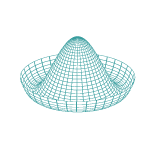
I am currently exploring the geometric differences between Schwarzschild and Kerr-Newman black holes, specifically regarding the singularity structure and potential traversability.
In the Schwarzschild metric, the singularity is spacelike and point-like ($r=0$), which acts as an unavoidable "end-point" for any infalling observer. However, in the Kerr-Newman metric, the singularity is ring-shaped. It is known that an infalling observer, under specific conditions, might bypass the ring singularity without experiencing the infinite tidal forces characteristic of the Schwarzschild point singularity.
My question is regarding the "other side" of this geometry: In popular physics literature, the Schwarzschild black hole is sometimes visualized as a funnel (reminiscent of Gabriel's Horn) leading toward an inevitable singularity. If we consider the Kerr-Newman solution, specifically the possibility of it connecting to a white hole through an Einstein-Rosen bridge (or a similar structure), how would the topology of this connection differ from the Schwarzschild case?
Is it theoretically sound to visualize the Kerr-Newman interior as a "tunnel-like" structure leading to an exit (white hole), or does the presence of angular momentum and charge fundamentally alter the global topology in a way that makes the "white hole exit" concept less intuitive compared to the Schwarzschild wormhole?
Any insights into the Penrose diagram or the embedding diagram interpretation of this specific geometry would be greatly appreciated.

 点赞
点赞 收藏
收藏 点踩
点踩 分享
分享