Learnings from a week in the wet lab

I work on biosafety evals for LLMs, but have never set foot in a wet lab. This seems kind of silly, so this week I decided to change that.
On the 8th floor of Frontier Tower is a community wet lab. You pay $190/month to access the tower and $160/month to be a member of the nonprofit that runs the floor.
People often speak about tacit knowledge that biologists have in their heads but don’t write down anywhere. A lot of it just boils down to feel, motor skills, and common sense reasoning about the 3D world and physical items.
My friends Nate and Bob (fake names) are cracked biologists with tons of tacit knowledge, who are also into peptides. We decided to take GLP-1, fuse it with various fluorescent and bioluminescent proteins, and make glowing rainbow peptides. Follow along as we make sketchy drugs in a community lab, and decide for yourself if LLMs can do the same.
Disclaimer: This is from the perspective of someone with very little biology experience and written for a general audience. Don't make random peptides and eat them, nothing here is recommended or medical advice.
Day -30
Before doing anything in the lab, you have to make a protocol and order plasmids.
A protocol is like a recipe with all the reagents, equipment, and steps you need to take to conduct an experiment. Here are some example protocols.
A plasmid is a small circular strand of DNA that is inserted into a host cell to make your protein (fun fact: plasmids can spread among a population of bacteria, conferring traits like antibiotic resistance). Sounds simple, but on top of putting in the gene that codes for your protein, you also have to include
- Upstream promoter sequences that turn your gene on (like AOX1, which is turned on by the presence of methanol)
- Downstream tags like His tags and antibody tags to fish out your protein later from E. coli soup
- An antibiotic resistance gene so you can grow it on dishes where nothing else grows
- An origin of replication with a unique sequence nowhere in your gene or elsewhere, that is compatible with restriction enzymes you have on hand (so it only cuts the plasmid there and not in random places)
- Some mysterious thing called a Kozak sequence
- All the above but for multiple expression systems/organisms. For instance, yeast plasmids are typically first amplified in E. coli before being placed in the yeast for final protein expression
- You may need to have multiple antibiotic resistance genes for both expression systems
- Or use something like Zeocin that kills both prokaryotic and eukaryotic cells (but can't be shipped to a residential address because it's essentially poison)
It's sort of like designing a mini computer program, except you only get one shot to run it.
You can order DNA online as easily as shopping on Amazon. Popular vendors here include IDT, VectorBuilder, and Twist Bioscience. The vendor will ship a vial of plasmid (very shelf stable) or the host cells containing the plasmid (less shelf stable). Lead times range from 6 days to weeks, and pricing is usually a couple hundred bucks per design but varies widely based on the size, complexity of the protein, and expression system. We ordered live BL21 E. coli with our fusion proteins and a kanamycin resistance gene, and it took about a month to arrive, either from Addgene or this shop.
Day 1
Our bacteria shipped in little tubes of agar, a jello-like food bacteria like to eat. We first take a small chunk and move them to LB with kanamycin to incubate in a shaker and grow out into a culture (this took a few hours).
The high-level goal is to isolate a single bacterium that seems to be relatively glowy and healthy, and grow that into a whole monoculture we can use for controlled experiments later. We do this by making agar plates and growing a bunch of colonies.
Then, we pipette out a drop of E. coli culture onto the agar.
Now for one of the coolest parts: diluting the solution logarithmically with a special streaking pattern. The idea is by the time we get to the center there will be individual bacteria far far away from each other to have the space to grow into separate colonies, which we can pick out later.
We then put the plates into a 37 C incubator and wait for them to grow overnight.
Day 2
Did any of the colonies grow? Some did!
Some of the blues and purples are still not very colorful, we just have to trust they are late bloomers.
Using an inoculation loop, we picked out the brightest, juiciest colony to drop into new LB + kanamycin.
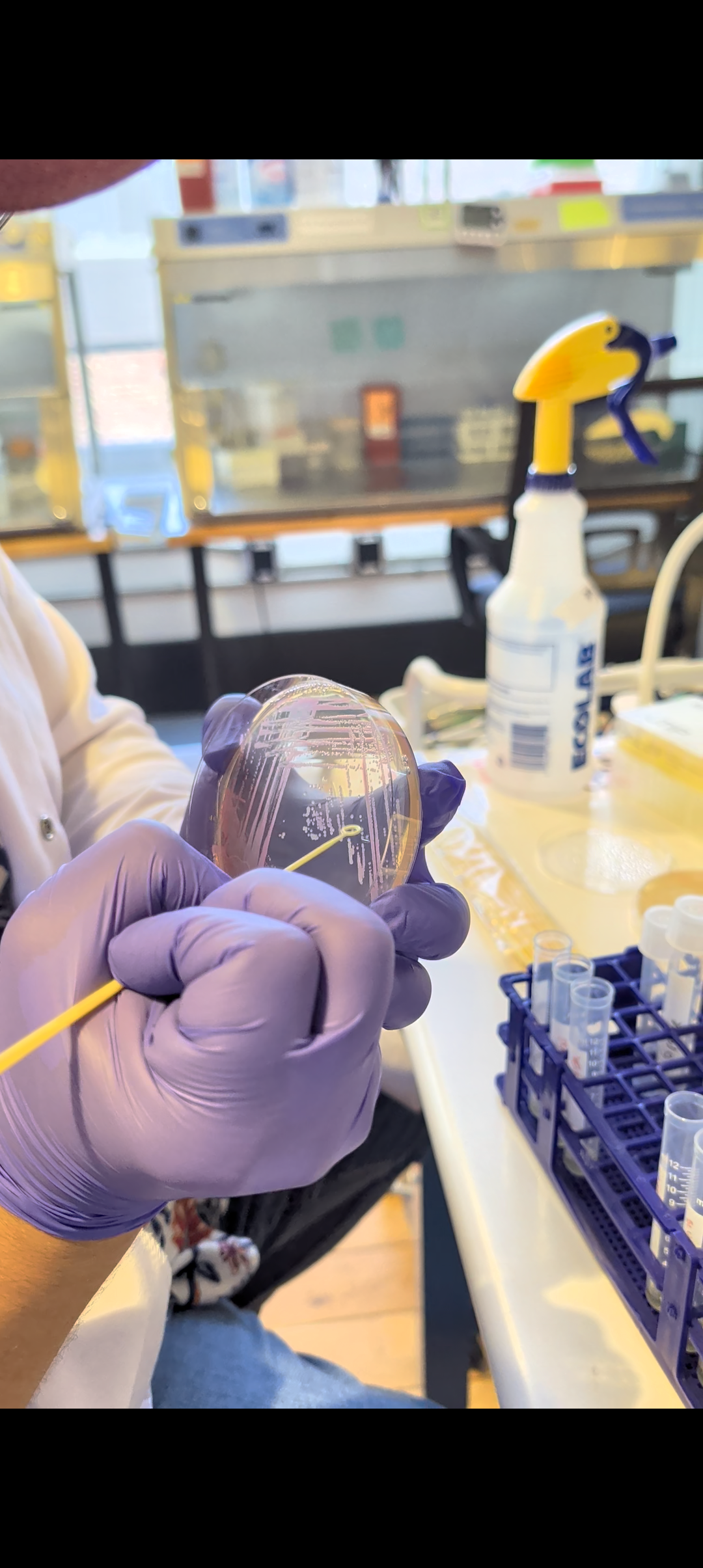
We placed them into a shaker (at an angle, to maximize surface area and oxygenation) and incubate them overnight again.
Day 3
We have monocultures! Now let's freeze them in glycerol stock so we can use them for future experiments. These are sort of like those vegetable broth cubes you can keep in your freezer.
We can now thaw them, regrow them overnight in LB, and use them for whatever other experiments we'd like (like 3D printing bioart).
But at what cost?
By now you're probably thinking, "can I afford to make rainbow peptides in a sketchy lab too?" and the answer is "almost certainly yes, if you have $500 and some patience."
The full biopunk lab costs $350 for 1 month of membership, and the bacteria and plasmids can be purchased for $120.
The tricky part is finding an expert to help with all the steps and tacit knowledge, as well as general physical dexterity to operate pipettes etc.
Conclusion
There is a lot of talk about the AIs synthesizing a bioweapon, making mirror life, or curing all diseases and aging. I was curious how this would actually happen in practice. Some main takeaways are:
- Wet lab is really hard, even for the most basic experiments
- Things take a long time, from waiting for things to ship to waiting for cells to grow and divide
- Human experts uplift humans far better than the LLMs currently can
Some ways I can see the AIs being more effective here include using robotics and lab automation like the ones from Opentrons, Revvity, Hamilton, or Thermo Fisher, or using cloud CROs (Contract Research Organizations) like Emerald Cloud Labs. There are also companies like Transfyr AI and Tacit Labs helping to distill tacit knowledge into the AIs, we'll see how that goes.
Appendix
Here’s some more tacit knowledge and things that can go wrong
- We had our bacteria shipped in a nondescript blue envelope so it got lost in the mailroom for days (the bacteria weren't happy)
- Don’t touch the sides of test tubes with your pipettes or plastic scrapers (to prevent contamination)
- Don’t lean or work over open test tubes and plates (to prevent contamination)
- Agar plates should be placed upside down to prevent condensation (and contamination)
- If you’re really good, you circle the place on the agar dish where you took the colony from (Nate doesn’t lol)
- Pipette tips and loops are all single-use and thrown away. You go through so much plastic for just a single experiment
- It’s easier and cheaper to just throw something away than try to clean it, fail, and contaminate your experiment, or run further experiments to confirm you cleaned it correctly
- Pipettes
- Have a button that can be depressed to multiple stages
- Press down halfway before sticking it in the media, stick it in, then slowly unpress it (to avoid the liquid splashing up and contaminating the pipette shaft)
- Press it down 2 stages to release (the first stage releases the liquid, the second stage pushes air out to make sure everything is expelled)
- Sometimes there is also a third stage that ejects the pipette tip (or a separate button, depending on your pipettes)
- When pouring agar, pop the bubbles with a toothpick or move them to the sides, to not interrupt your streaking motion later
- The electric pipette wasn’t charged. Let’s switch to another manual pipette
- Kanamycin from the freezer is cold and it’s fine to use as is, because it’s a powder
- Agar must be heated in a microwave to be melted and cooled down before mixing in the kanamycin. How cool? Cool enough to not be uncomfortable to hold
- The fancy accurate scale is broken, let’s use this sketchier scale instead
- The parafilm is old and tears easily, let’s use way more parafilm
- Once you put the E. coli on the plates, you don’t use parafilm anymore because they need oxygen
- Place the test tubes with E. coli culture at an angle in the shaker racks, to increase surface area and aeration of the media
- Oop we made a math mistake and accidentally poured out 3 OOMs more kanamycin than needed (throw it out, don't put anything back into the container)
- Oop we labelled the test tubes wrong. Is this one red or orange?
- If this were a legit experiment, Nate would recommend throwing everything out, because the cost of analysis and continuing the experiment would be more than starting over
- Write labels along the circumference of plates, as small as possible (to make viewing your colonies easier later)
- E. coli is happy to grow at room temperature, but grows much faster at 37 C
- E. coli will sometimes kick out the plasmids you put in them, because their top goal is to survive, not make whatever random protein you want them to express. You can select/keep them hostage by fusing an antibiotic resistance gene with your gene of interest and growing them on antibiotic-infused agar, so they better uptake your plasmid or die. (I love bacteria capitalism)
- Things that LLMs aren't great at (yet)
- Causation instead of correlation for sure.
- Addgene is a nonprofit DNA sharing repository, you get a discount if you are also a nonprofit.
- Fun fact: No one agrees on what LB is. It could be Lysogeny Broth (what its creator intended), Luria Broth, Life Broth, or Luria-Bertani medium depending on who you ask.

 点赞
点赞 收藏
收藏 点踩
点踩 分享
分享