If math is more than proof, we need to better celebrate the rest of it

[This is a guest post by Grant Sanderson. This blog post was initially written in a different file format and converted using AI. — T.]
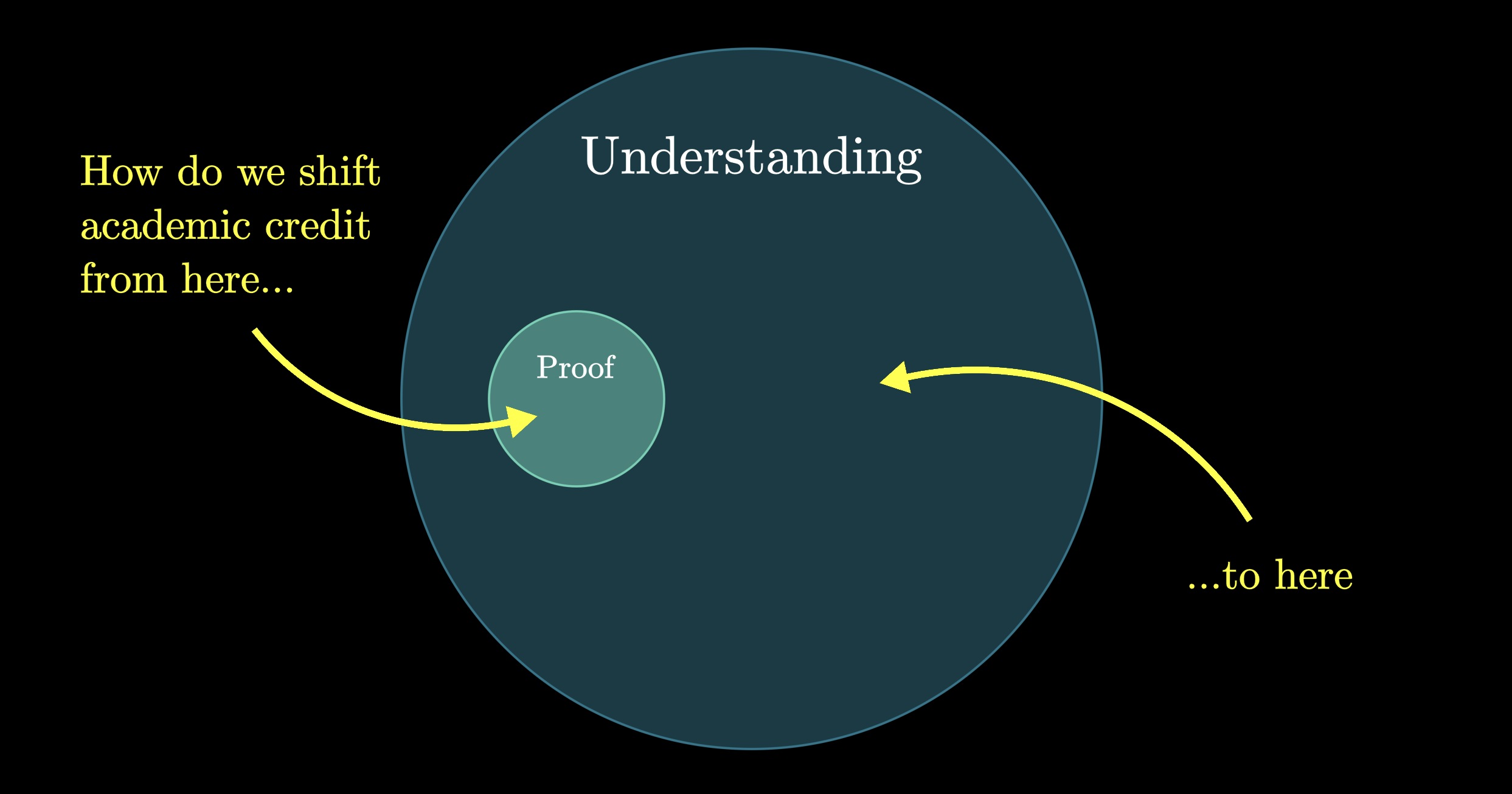
A sentiment echoing throughout the mathematics community right now is that solving problems and generating proofs have always served as proxies for the true goal of mathematicians, which is to further human understanding. When proofs can be generated without that understanding, it undermines their value as a proxy.
This immediately raises a question: What other proxies should we use instead?
I want to propose that we more firmly define a notion of a “motivated explanation” and that we give novel and compelling motivated explanations academic credit similar to what generating new proofs of open problems has had historically.
Further, I believe this is an important step to help those outside of math better understand what it is that mathematicians contribute. If outsiders believe that proof-generating machines render mathematicians obsolete, while insiders see that as a misconception of what researchers add, it’s incumbent on this community to better project its true values through the kind of work that it rewards. Outsiders can be forgiven for this misunderstanding if the work most celebrated skews heavily toward generating proofs, while clarification and exposition are treated as second-class.
I should acknowledge up front an obvious personal bias. I have a non-traditional career in math, focused on producing videos about the topic. This shares the goal of “furthering human understanding”, but my focus has been on explanations and intuitions that resonate with the public, not on solving outstanding problems. A cynic could easily read this proposal as shamelessly self-elevating.
As a practical matter, though, my own career and funding exist outside academia, and I have no skin in the game for what this community assigns credit to. Moreover, in proposing that we elevate the status of motivated explanations, I don’t mean popularization. I mean any work which primarily aims to answer the question “how would you think of that?”, even if the subject matter requires deep expertise to appreciate.
The examples I highlight below show this is nothing new. Practicing mathematicians already devote a meaningful amount of mindshare to work like this. The proposal here is mainly to 1) more clearly define this work, and 2) elevate its status.
What defines a motivated explanation?
Although it might be clear what this phrase “motivated explanation” is intended to mean, it’s worth briefly contrasting it with proof.
In a proof, definitions sit at the start. It is common and expected to begin with a new construction and proceed by analyzing its properties.
In a motivated explanation, definitions sit in the middle. New constructions are only allowed to enter the vocabulary if the problem they are addressing has been clearly established.
In a proof, all statements must be correct, each claim following as a necessary implication from what comes before.
In a motivated explanation, it is okay and often desirable to start with an idea that is not quite right and requires correction, but whose origins are relatable.
A genre of motivated explanation I’m fond of is “discovery fiction”, a term coined by Michael Nielsen. You develop an idea with a narrative that starts with a simple-but-wrong solution to a problem, see where it breaks down, fix that problem, discover a new problem, and so on.
The scope of a proof is to explain why a particular theorem is true.
The scope of a motivated explanation is not only to clarify why a theorem is true, but why the theorem is the right one to pose in the first place, and how it is used in the surrounding context.
One clear shortcoming of a motivated explanation is that its validity is not binary the way a proof’s is. This is a big reason proof is so useful a way to measure progress: You can clearly define what does and does not have a proof yet. There will never be Lean for motivated explanations.
If we’re serious about the goal of advancing human understanding, there’s no way around the fact that this aim is intrinsically squishier than that of finding proofs, because defining human understanding itself is squishier. To shy away from metrics which are more subjective is to shy away from the more human aspects of the field.
The reason I’m leaning on the word “motivated”, as opposed to other potential choices like “lucid” or “demystifying”, is that this is a more verifiable property. It’s not quite as rigidly verifiable as a proof; almost nothing is. But it’s enough to be a practical measure. In my own work, I often repeat the phrase “I want this to feel like you could have discovered it yourself”. I say this not just to placate a viewer, but because it’s an actionable guideline for myself to assess whether an explanation feels complete or not. For each new idea introduced, you can ask whether it’s clear where that idea comes from. The answer is not quite a binary yes or no, but it’s close enough for practical purposes.
Exemplars of motivated explanations
One of the best repositories I can think of for motivated explanations is Part IV of the Princeton Companion to Mathematics. It covers over two dozen active fields of research, each one introduced by an expert with a talent for clear communication.
Whether it’s Andrew Granville explaining analytic number theory, or David Ben-Zvi introducing moduli spaces, these articles offer a level of intuition and motivation more typically found in one-on-one conversation at a blackboard.
The background on this book is noteworthy for the present discussion. It was edited by Timothy Gowers, who discusses it in his interview on the Numberphile Podcast with Brady Haran. Having been asked what impact the Fields Medal had on his life, here’s what he had to say:
People who’ve got Fields Medal feel freer to do slightly different things…for example I took on editing a book called the Princeton Companion to Mathematics, which was an absolutely massive task. It took I would estimate half my working time for about five years or something like that…It was a project I believed in and possibly wouldn’t I probably wouldn’t have actually been offered the chance to do it if I hadn’t been a Fields Medalist.
He was right to believe in it; this work adds tremendous value to the field of math, but it seems a shame to me that one requires a Fields Medal to feel justified in spending time on it.
Another example of someone exceptionally talented at writing proofs, but whose contributions extended far beyond proof, is Bill Thurston. His deservedly famous essay On Proof and Progress in Mathematics, though written three decades before LLMs, opens by suggesting that the right framing of the question “What is it that mathematicians accomplish?” is to ask “How do mathematicians advance human understanding of mathematics?”
Here’s one section with uncanny resonance with today:
The rapid advance of computers has helped dramatize this point, because computers and people are very different. For instance, when Appel and Haken completed a proof of the 4-color map theorem using a massive automatic computation, it evoked much controversy. I interpret the controversy as having little to do with doubt people had as to the veracity of the theorem or the correctness of the proof. Rather, it reflected a continuing desire for human understanding of a proof, in addition to knowledge that the theorem is true.
On a more everyday level, it is common for people first starting to grapple with computers to make large-scale computations of things they might have done on a smaller scale by hand. They might print out a table of the first 10,000 primes, only to find that their printout isn’t something they really wanted after all. They discover by this kind of experience that what they really want is usually not some collection of “answers”—what they want is understanding.
The essay itself offers a beautiful articulation of what the practice of doing math is beyond generating proofs. I want to draw your attention to what he writes at the end.
I have put a lot of effort into non-credit-producing activities that I value just as I value proving theorems: mathematical politics, revision of my notes into a book with a high standard of communication, exploration of computing in mathematics, mathematical education, development of new forms for communication of mathematics through the Geometry Center (such as our first experiment, the “Not Knot” video), directing MSRI, etc.
Again, why should these “non-credit-producing activities” follow a Fields Medal, and not contribute to it?
On a personal note, one product from the Geometry Center he referenced had an especially meaningful impact on me when I was younger. It was a short film called Outside In, perhaps the earliest example of a viral video about substantive math, visualizing the key idea of Thurston’s own construction for sphere eversion.
An original proof that showed an eversion must exist, say Smale’s, advances human understanding in the sense of going from 0 to 1. A video like this which gets millions of people to engage with the underlying idea, advances it in the sense of going from 1 to N. I’m grateful that Thurston spent so much time on this “non-credit-producing” activity.
Another relevant paper is Timothy Chow’s A beginner’s guide to forcing. Not only does the paper itself offer a prime example of a motivated explanation, but its introduction offers helpful vocabulary around it.
All mathematicians are familiar with the concept of an open research problem. I propose the less familiar concept of an open exposition problem. Solving an open exposition problem means explaining a mathematical subject in a way that renders it totally perspicuous. Every step should be motivated and clear; ideally, students should feel that they could have arrived at the results themselves.
What would it look like for these open exposition problems to be treated similarly to open research problems? As an extreme case, we might imagine what it could look like to have an analog of the Millennium Prize Problems for open exposition problems. An institution or group of researchers would formally define mathematical results they see as important, and which are not yet well understood despite technically having proofs. At the moment, every AI-generated proof is born an unsolved exposition problem. As such, it seems likely the next few years will see a flood of them, and it will be valuable for leaders to clarify which ones deserve focus.
A rubric would have to be agreed upon for what constitutes a resolution to an important unsolved exposition problem. Again, this is intrinsically more subjective than verifying a proof, but any serious engagement with the more human aspects of math necessarily wades into this kind of subjectivity. And again, I’ll emphasize that checking whether key ideas are motivated is not unlike checking whether the steps of a proof follow logically.
If the world outside of math sees its leading figures treat open exposition problems with the same seriousness as they treat open research problems, it could go a long way to correcting misconceptions about the role of mathematicians.
The last example I’ll highlight is one that may better foreshadow things to come.
In April of this year, Liam Price submitted a solution to Erdős Problem 1196, sometimes called the asymptotic primitive sets conjecture. The solution came from Price’s interaction with GPT-5.4 Pro. Unlike many earlier Erdős problems which had been resolved with help from AI, this is one that those in the field had found both important and elusive. Stories like this are increasingly familiar these days, but at this point in the story, despite a proof technically existing, human understanding had not yet been advanced all that much.
The proof made its way to Nat Sothanaphan and Jared Lichtman, who were able to interpret what the AI’s approach was and clean up the proof into a human-readable form. In May, Boris Alexeev, Kevin Barreto, Yanyang Li, Jared Duker Lichtman, Liam Price, Jibran Iqbal Shah, Quanyu Tang, and Terence Tao put out a paper which expanded on the key idea underlying the proof. The authors explained how that key idea clarified not only the original problem, but many around it, for instance offering a cleaner proof of the Erdős Primitive Set Conjecture.
The value here is not that one more Erdős problem could be ticked off as solved. The value lies in the fact that our understanding of primitive sets is notably cleaner and more satisfying now than it was at the start of 2026. The original problem solution played some role in this, but arguably the work that deserves more celebration is this paper expanding, clarifying, and contextualizing its key idea.
Practical calls to action
At a pragmatic level, what would it look like for us to elevate the status of a motivated explanation? Here are a small handful of suggestions.
- A PhD advisor can still assign a small problem from their field for a new student to cut their teeth on, but the deliverable would not be to write up a solution; it would be to present that solution to peers and faculty as a talk. It could be an already-solved problem which lacks clarity, or perhaps it’s a problem that lacks a solution, and the student uses AI to help find it. In either case, the student knows that on a certain date they have to understand it well enough to explain it, and that the desired output is for others to understand it as well. In short, even small problems could be treated like small PhD defenses.
- A leading figure (cough, Terry, cough) could enumerate a modern analog of Hilbert’s problems, instead focusing specifically on unsolved exposition problems. What areas are both important and lacking in the deeper understanding we desire?
- Written standards could clarify what constitutes a motivated explanation, aiming to make it nearly as verifiable as proof, so that the resolution of unsolved exposition problems can be recognized and celebrated in the same way proofs of open problems can be.
- Journals can be established which focus more explicitly on making results understood more widely throughout the mathematics community. Mathematical Discourse offers an interesting new example in this direction.
- Hiring and tenure decisions could place a higher value on writing great textbooks and similar work. Think of the AMS Steele Prize for Exposition, but at a more granular scale with an emphasis on early-career contributions in this vein.
The value of visible cultural shifts
I’d like to close with a broader pitch that visible culture shifts in math carry an intrinsic benefit right now with respect to the external image of mathematics as a career.
Many young students who are otherwise passionate about the field are afraid to pursue it now due to the uncertainty of what happens in an age of proof-generating machines. However, framed correctly, this is one of the most exciting times to go into the field, because there is nothing more exciting than entering a field when it is malleable and you have a chance to actively shape what it will look like in the future. Even if we completely set aside any potential benefits from AI to help with our understanding, young prospective mathematicians should feel energized knowing that they are entering at a unique point in history when they might play a real role in determining what the field as a whole looks like.
However, change like this is only exciting when it feels deliberate, whereas it feels terrifying if it seems driven by forces outside your control. As such, tangible action from the field’s leaders now to help define and clarify what the field is will reassure young entrants about who is in the driver’s seat, and that the status of the career does not depend on what entities produce the proofs.
Similarly, I also believe this is one of the best times to fund math. If the next chapter of math is ushered in by the drumbeat of two words “human understanding”, whatever changes are about to happen seem likely to amplify math’s value as a public good.

 点赞
点赞 收藏
收藏 点踩
点踩 分享
分享