Silo and the impossible "dream" of programming humanity
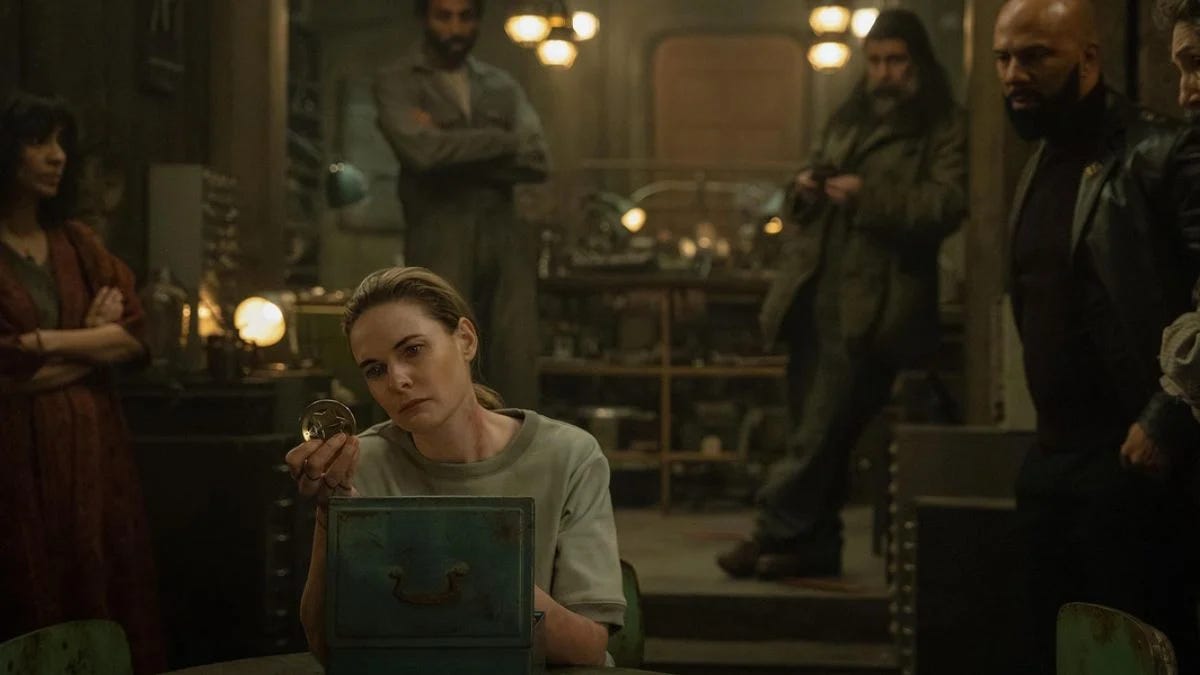
About Apple TV’s show “Silo” (2023 -); Created by Graham Yost. With Rebecca Ferguson, Shane McRae, Common, Tim Robbins
Last year I was in Las Vegas for work, and one of the guests at the event was Common (the rapper and actor). I spoke to him for a few minutes, asked him to do a little rap, and recorded it. What I never did, at any point in that conversation, was connect the man in front of me with Robert Sims, the character he plays in Silo. I knew Sims well. But I was looking at Common, the rapper who also acts, and the connection never happened in my head.
It is a small failure of recognition that became funnier to me after watching this season of Silo. This is, after all, a season deeply interested in memory, recognition and what is left of a person when those connections are removed on purpose. It is also a phenomenal show: exciting, beautifully made and increasingly willing to ask difficult questions about the strange society it has created.
WARNING: Spoilers from here on.
Designing humanity
This season takes more risks. We leave the silo we know, see more of what exists around it and discover much more about how this world was built. I had expected more elegance in the original design.
What we find instead are flawed parameters, questionable assumptions and enormous decisions based on the personal experiences of a very small group of people. That turns out to be more interesting than elegance.
Intentions are altered, corrupted or misunderstood by the people left to carry them out. Rules created for one reason acquire another purpose. People adapt them, exploit them or obey them without knowing why they exist. For a story set in such a technological future, there is also less artificial intelligence behind the whole thing than I expected. Mostly it is ordinary human mess, scaled up and sealed in concrete.
I have always found that problem fascinating. A system can appear coherent when applied to a small group of people. Scale it to thousands, let several generations live inside it, and human complexity starts breaking the model. People have different interests and fears. They seek power, fall in love, become jealous, misunderstand instructions and change their minds. Societies need rules, but we also need enough freedom to question them. Finding the balance between the two has always been the difficult part.
The silos try to engineer much of that difficulty away. There is a Pact. Information is restricted, certain questions are dangerous and the past is hidden. There are procedures for rebellion and even a mechanism for killing everyone in a silo when the system decides things have gone too far. Yet the human beings inside keep behaving like human beings.
Memory, obedience and resistance
Memory is the strongest idea in the season. In Silo 18, the authorities can add a drug to the water supply that makes people forget, while telling them it is vitamin D. The name itself is part of the control: something designed to erase memory is presented as something ordinary and beneficial. Juliette Nichols also suffers the effects of memory manipulation after returning from Silo 17. The show is better on the emptiness this creates than on the mechanism itself.
Someone who has lost pieces of a life can still work, obey and perform a function. But something is missing. Part of the person against which the present was measured has disappeared. The clearest case is the young congressman who finds himself becoming part of Silo 1.
His memory is wiped, and he now sleeps for long stretches and is woken when needed for a very specific task, so his existence stretches across decades in a way no normal life is built for — performing a not very human task he was almost engineered to perform. He only knows about himself what he has been told, and does not recognise his own sister.
His values have slowly been replaced by the Pact, its rules and the directives he has been handed. He was a decent man once, and he ends up ordering a massacre. When thousands of people from Silo 17 try to escape, the system first attempts to kill them through the Safeguard. When that is not enough, they are shot.
That may be the hardest thing Silo has to say. You do not have to turn someone into a monster to get monstrous things done. Take away enough of the person they were, give them a mission and put them inside a system in which obedience looks like the rational choice.
Against that there is Juliette, and everyone else who keeps asking questions — her story is fascinating (the underdog full of grit, questions and desire to do something about it). The need to understand is one of the most human qualities Silo explores. When people sense that something is being kept from them, they want to know why. They want to know where they are, who came before them and why the rules exist. Some keep looking even when looking can get them killed.
The system was designed to contain that instinct, but its designers underestimated how difficult it would be to extinguish. When the Safeguard (the decision that gets everyone in a given Silo killed) is triggered against Silo 18, people work out what it is and block the pipe through which the poison would be released. The system has a procedure for killing them; the people inside understand the procedure and find a way around it. They think, improvise and help each other.
That resistance seems to be what finally breaks the founder of the Silos and of the guidelines in place for centuries. His ideas about memory came, at least partly, from his own experience and grievances. Forgetting a particular pain had worked for him, so erasing memory could work for others. The distance between a private wound and a plan for humanity gets very short once someone has the power and money to build the plan. There is an obvious contemporary resonance there, but Silo is more interesting to me as a story about the failure of the plan itself.
You can design the rules. Designing the people is much harder (and on that note, designing AI brings unintended consequences as well).
Why the relics matter
This is why the ban on relics (objects from the past, before the Silos) matters more than it first appears. A book, a photograph or an ordinary object from the old world does more than preserve the past. It is evidence that another way of living once existed.
Someone who remembers freedom can recognise its absence. Someone born inside a system, whose parents and grandparents knew nothing else, has a much harder task. The walls are the world. But a relic creates a crack in that certainty, brings questions and wonder. A photograph of forests does not merely tell someone that forests once existed. It proves that the world was different, and suddenly the present is no longer the only imaginable reality.
To want a different world, you first have to be able to imagine one. And imagining takes material.
This kept reminding me of 1984, which I reread recently. Orwell understood that control over the past gives power over the present. Remove the evidence against which the official story can be compared, and the person telling you what is true becomes much more powerful. Human beings can get used to constraints faster than we would like to admit, especially when we have no memory of anything different.
There is something deeply human in the importance Silo gives to ordinary objects. We do this ourselves on a much smaller scale. We keep things that are worth almost nothing because they carry a story. The object becomes evidence: this happened, this person existed, I was there.
On a personal note, I still have this small McDonald’s ball (on the left) that I gave to my now-wife back in 2002, before we even started dating (I’m old!). It is worth nothing, but more than two decades later it is still here. Without the story, it is just a small plastic ball. With it, it is evidence of a moment in our lives.
I have experienced something similar with old photographs. A photograph can bring back a person, a place or some tiny detail that had almost disappeared from memory. Sometimes I am no longer even certain how much I genuinely remember and how much the photograph has reconstructed for me. Memory is not just something we preserve. We keep rebuilding it.
That makes the systematic destruction of memory in Silo more interesting. Remove enough objects, photographs and stories and eventually you are doing more than erasing the past. You are narrowing what people can use to understand themselves and the world around them.
Still, Silo keeps returning to the same stubborn problem. Someone finds an object or remembers something. Someone notices that a story does not quite make sense and starts asking why. The silos were built to preserve humanity by controlling many of the things that make human beings difficult to control.
You can build the silo, write the Pact, design the Safeguard and spend decades predicting what people will do inside it. The variable that stays out of reach is the human being.
emot | Random Stories is a reader-supported publication. To receive new posts and support my work, consider becoming a free or paid subscriber.

 点赞
点赞 收藏
收藏 点踩
点踩 分享
分享