Against Cicerofishing
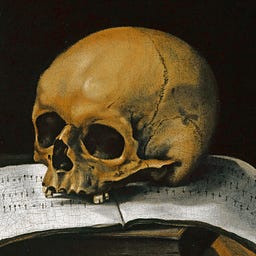
What if Substack had been around 500 years ago?
It was the 16th century. The Renaissance was sweeping through England, and it was a time when new technology (print), coupled with social and economic change, was rapidly changing the way people wrote.
Sound familiar?
This was a time when many English men of letters, who adored writers like Cicero — Tully to his fans — were importing thousands of new Latin words into English, attempting to remake the language along classical lines.
Not everyone was pleased with these new words, like condisciple (classmate), dominical (lordly), and revolute (revolve). Critics called these new words inkhorn terms — not as a compliment.
An inkhorn was the stereotypical scholar’s tool: a container for holding ink; an inkhorn term was therefore a word only an academic could love.
Many of the inkhorn terms didn’t survive, but many did: frivolous, celebrate, and clemency were once condemned as inkhorn terms, but are now core parts of the English language. The controversy over which words should be let into the language raged in English literature for a hundred years.
The following is — with apologies to Chris Best — my impression of a post that might have graced the feed of that 16th-century Substack. Read on and see how much you understand (and how much you agree with!). If you get lost, there’s a full explanation of all the strange words and spellings in the appendix.
You’re reading The Dead Language Society, where 85,000+ readers explore the hidden history of the English language. I’m Colin Gorrie: PhD linguist and your guide through 1,500 years of linguistic history.
I publish every Wednesday. Paid subscribers get every issue, the full archive, and my most in-depth work, including longer essays that trace the mysteries of English to their source, practical guides to reading historical texts yourself, and live book clubs where we read texts like Beowulf and Sir Gawain and the Green Knight.
September 16, 1553.
Of late it is become all the harder to telle what be written in Engliſh upon this Platfourme.
A reader of a Subſtacke publiſhed, ſtamped, & printed theſe few years paſt muſt ſurely wonder if it be in deed a Work of Cicero which he readeth, or of Ouidius, for the muchneſs of Latin wordes, the which he findeth on euery page.
Such is the lot of the man which would read Engliſh letters to daye. In place of beſeech, he readeth obteſtate; when he looketh for tire, he findeth fatigate; & his eyes muſt be fatigated in deede, when that they are caſt vpon ſuch monſtrous nouelties as adnichilate in ſteade of ſuch a rowe of homelye words as broughte to nothing.
I maruayle that ſuch Subſtackes as these, whoſe Authors I ſhall, for properneſse, not name, haue been found ſo plauſible to vulgar eares, while mine own writing, plentiful though it be, hath lain vnread, but ſuch ill hap, I fear, muſt be ſuppoſed in this fallen world.
Many wiſe men yet complayn theſe Inkorne Termes, as they haue lately been called, & not few haue priuatlye confeſsed they would forſweare Subſtackes for euermore, saying that they would ſooner read Latin books than theſe writyngs full wyth Latin words but half Engliſhed. I for my part could happilye liue out my dayes reading naught but Tullie & the verſes of Vergilius & die in my appoynted hour in perfect bliſs.
Ye may ſaye, what careſt thou? Let the vulgar ſort reade what they liſt! Yet is it Charitye to allow the vnlearned to be ſo deceiued by words in Roman rayment, that they read in them ſuch wiſdom as procedeth from the mouthe of Cicero? Fools are they, for they read not the wordes of Tullie but the vain ſcryblings of hys modern Imitators.
And yet, reſignation being no fit Virtue for an Engliſhman, I haue deuiſed a remedy by which the vnlettered reader may iudge whether the wordes, the which he readeth, be right Engliſh, or if they be doubtfull and forayne.
Firſt, let the reader pronounce the word; which thing, if he cannot do, ſhould be a ſign that before him lieth an Inkhorne Term.
Secondlye, let hym wonder if he euer heard the worde vttered by a fiſhmonger or another of the baſe vulgar people; which queſtion anſwered, Nay, he ſhould likewiſe be driuen to reiect the word as forayn &c.
And thyrdly, let each writer of Subſtackes include in the ſame, as poſtſcript, vnder the title How I dight this, an explanacion of his craft, & a thorough Apologetique of the inbringing of ſuch Latin wordes he hath vſed.
In fine, Cicero hath much to teache, but when that I would read Cicero, I ſhall reade Cicero & not a Ciceronian.
But here an ende.
The wicked will refuſe to heare,
but the good cannot
but liſten.
Sir Thomas Barleygrowe
How I dight this
My goal in writing this parody was not to compare the use of AI in writing today to the use of inkhorn terms in the 16th century.
My goal was to use a familiar genre — the “what is going on with writing today?” post — to introduce you to the language and literary culture of the English Renaissance.
As for how I dight — i.e. made — this, the answer is like the punchline to the old joke:
Q: How do porcupines make love?
A: Very carefully.
First, I glanced through some of the works criticizing inkhorn terms, especially Thomas Wilson’s The Arte of Rhetoricke (1553) to get a flavour of the style, and to steal some turns of phrase. Then, after determining what I wanted to write, I tried to write it in as Renaissancey a way as I could on my own.
Finally came the hard part: many trips to the Oxford English Dictionary website to ascertain whether the words and phrases I’d used were indeed present in the English language at the time.
I chose 1500 as the cutoff, even though the piece is dated 1553, since our writer is specifically complaining about novelty.
I imagine that his implicit motto — as for so many of his ilk — is something like: “Any language change that happened before I was born is the natural, inevitable evolution of language; anything afterwards is barbaric degradation.”
Spelling
The most obvious difference between 16th-century writing and our own lies not in vocabulary or grammar, but simply in spelling.
First, you’ll notice a letter that looks like an f being used sometimes in place of s, as in Engliſh or Subſtacke: this is long s. It is a variant form of lowercase s, which was used in English printing up to around the year 1800.
The rules governing where to use long s were complex, and varied from century to century. Put simply, however, you used long s everywhere but at the end of a word. So, instead of success, you would write ſucceſs.
Now that you’re in the 16th-century mood, let me introduce something subtler: the use of u and v. The letters u and v were not thought of as distinct until the 17th century.
Instead, they were considered two variants of the same letter, used, like long s, in different positions within the word. The v letter shape was used where we would use u or v today at the beginning of a word, as in vgly visions. The u letter shape was used in the middle of a word, again, for sounds we would write either u or v. For example, euil purposes.
The letter j was not used either: where you expect a j you will find an i. So prepare yourself for ioy and iudgement, not joy and judgement. This is for the same ultimate reason that u and v were not distinguished — the Romans didn’t distinguish them and this, after all, is their alphabet.
You will also see y used where i would be today, as in complayn or wyth, silent final -e aplenty, and little consistency in the spelling of individual words: read stands unashamedly alongside reade on the same page.
I hope you’ve found it fun to inhabit, however briefly, the head of the curmudgeonly fictional 16th century writer Sir Thomas Barleygrowe.
The Early Modern Period in English literature is justly famous as the home of Shakespeare. But I highly recommend reading other works from the era, beyond the Bard.
Outside of poetry, the difficulty of the language in most Early Modern texts is similar to what you’ve read above. If you want to learn more about the language of the era — Early Modern English — I’ve written a guide here.
Part of the fun of writing this has been realizing that the “state of writing today” article is the latest incarnation of a centuries-old genre of English prose, one that dates back to the early days of print. Though the issues and the language have changed, this peculiar institution has remained constant.
English has never had a Royal Academy to regulate language. Instead, it is the self-governing community of English readers, writers, and publishers who decide the fate of English writing, through books, pamphlets, letters to the editor, and, yes, Substack posts.
Long may that tradition continue.
Appendix: Hard words and other curiosities
in deed. in fact.
Ouidius. Ovid, author of the Metamorphoses,among other works.
the which. which.
muchneſs. quantity.
when that. when.
obteſtate, fatigate, adnichilate. Glossed accurately above as beseech, tire, brought to nothing. These terms in particular were mocked by Thomas Wilson in The Arte of Rhetoricke (1553).
rowe of… words. The concept of a phrase, a sequence of words in place of a single word, had only recently appeared in Scots, around 1550; our writer would surely not approve. I’ve used rowe here, as sequence doesn’t mean a series of things until later in the 16th century.
homely. Not ugly here but humble, simple, unsophisticated.
properneſse. propriety.
plauſible. popular. The word originally meant ‘deserving applause’. The phrase plauſible to vulgar eares appears in a later text, Hooker’s (1593) Of Lawes of Ecclesiasticall Politie. I couldn’t resist using it here, especially since all the words of the phrase were well established by 1500.
ill hap. lack of success.
ſuppoſed. expected.
complayn. The meaning is the same as it is today, but it could take a direct object in the 16th century: complayn theſe Inkorne Termes means complain about these Inkhorn Terms.
Inkorne Termes. The inkhorn was a vessel for holding ink, originally made of horn. In the 16th century, the inkhorn was a symbol of the stereotypical scholar, much as pocket protector stands in today (or at least it did in the 80s) for the stereotypical nerd.
but half Engliſhed. only half translated into English.
Tullie. This name for Cicero comes from his full name Marcus Tullius Cicero.
Vergilius. Virgil, author of the Aeneid, among other works.
what they liſt. what pleases them. A verb derived from the noun lust ‘pleasure’.
right English. genuine English.
doubtfull. dubious, worthy of doubt.
How I dight this. Dight means make, especially in the sense of literary composition. It descends from Latin dictāre ‘to dictate’.
Apologetique. A written defence.
inbringing. import, which does not appear in the meaning ‘bring in from another country’ until the late 16th century.
But here an ende. A direct quotation from the end of Book III of Wilson’s The Arte of Rhetoricke.
The wicked… the good. An adaptation of the end of Book II of Wilson’s The Arte of Rhetoricke. The visual motif of the lines decreasing in a triangle is used by Wilson at the end of Books II and III.
If you want to read that comparison, read it here.
A sequence of two s’s in the middle of a word would often be written ſs, such as properneſse.
If not earlier: Ælfric of Eynsham (c. 955–1010) complained about the malign influence of bad writers, whom he called unwrīteras, literally ‘unwriters’.
On Substack, these three categories — reader, writer, and publisher — coincide, perhaps more than they ever have.

 点赞
点赞 收藏
收藏 点踩
点踩 分享
分享