My new essay about Samuel Johnson
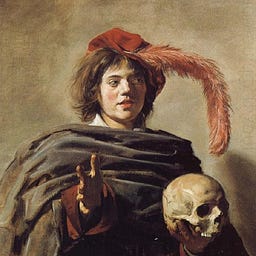
I am delighted to have written about my great love of Samuel Johnson for over at . Long term readers will know how I feel about Johnson. As I wrote in this new piece: “He is almost as important to me as Shakespeare, and I think of him almost as the second most important writer in English, absurd as that might sound.” Here is one extract, but I hope you will read the whole thing.
One need only open the newspaper, hear the latest family news, or walk down certain streets to think of the reveller hasting to his wine while the mourner is burying his friend. Johnson got these ideas directly from Shakespeare, of course, who has various of his characters tell us that “The web of our life is of a mingled yarn, good and ill together,” but it was the power of Johnson’s own invention that made this passage sing. What a splendid touch to say “sublunary,” to give not only the sense of Shakespeare as a secular writer, but to invoke in our minds images of young people scattering and frolicking under the moon, of fairies creeping out in mischief, of the mystical and magical side of ordinary life. However stern and reactionary he was, Johnson was no prisoner of the rational mind: he had one of the strongest imaginations in the history of English Literature.Critics are always trying to make sense of Johnson’s scheme, to bring some order to the conservatism and classicism of his works, to claim that his principles were bounded by prejudice, and to get out from under the weight of his influence by deflating his pomposity. It will not work. The man who was canonical in poetry, biography, and moral essays, who wrote a Dictionary, edited and critiqued Shakespeare, and produced the Lives of the Poets cannot be captured. He himself is too various, too much a man of parts, to be contained. He once said of the poet Gray that “he was dull in a new way and that made many people think him great.” The central truth of Johnson, as man and a thinker and a writer, is that he was never dull.
As I say in the opening, I brought one book “for pleasure” to America, and that was the marked-up, dog-eared copy of Boswell that I have been going back to for some twenty years. And I deal briefly with the idea of the “common reader”, after which this blog is named: “his greatest care was always for the ordinary reader. So important are we to Johnson that he named us as common readers.”

 点赞
点赞 收藏
收藏 点踩
点踩 分享
分享