The End of Salt?
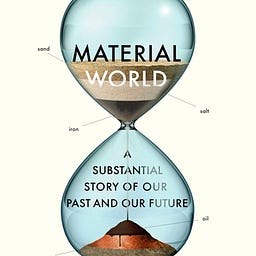
Of the six materials I wrote about in Material World, I’d say the one that most people were most surprised about was salt. If you were trying to tell the story of civilisation through a few key minerals then it’s blindingly obvious that you’d have iron and copper in there, and for that matter oil (or another hydrocarbon). But salt…?
However, if you’ve read the book you’ll know that salt is a massively underrated substance. Even today it’s the bedrock for a whole family of chemicals we still use for the manufacture of everything from paper and glass to the silicon wafers that become semiconductors and the lithium ion compounds that go into our smartphone and electric car batteries. Even today, salt is at the heart of everything.
All of which is why the film I’ve just made for Sky News strikes particularly hard. The long and short of it is I’ve spent the past few months travelling around the UK, revisiting factories and plants I first visited when I was researching Material World, to take the temperature of Britain’s chemicals sector. What I found was desperately depressing - because the scale of collapse in this industry went even beyond what I expected.
Many of the critical processes I describe in the book - from the manufacture of soda ash to the production of ammonia - are no longer happening in the UK. In the period between my book being written and the time you read this, the plants have shut down. In the case of those two chemicals, this is the first time we haven’t made them in this country in more than a century.
And soon, that might even be true of salt itself. Honestly, it feels crazy to posit this - after all, Britain has never had to rely on imported salt, never in modern civilisation - but we’re on the brink of losing our salt independence.
Anyway, rather than me blather on too much about this here, the main thing I wanted to say was: have a watch of this film. It’s not the most jolly but it is, I think, important. And let me know what you think
I suppose the only other thing I’d say is that this isn’t just about chemicals. It’s about a deeper question. What matters more: to be able to get hold of something cheaply or to be able to make it domestically? That’s not an easy question to answer. But it’s one I’ve been thinking about a lot recently. In fact, I’m in the thick of working on a new project that tries, one way or another, to get to the bottom of that question: why are some things made in one place and not another? Do we really understand the way the world’s networks of supply are really configured? And what does that teach us about the world we’re living in today (and the world we’ll live in in future)?
But that’s for another day. For the time being please do watch the film and spread the word. Britain is, for better or worse, providing the world with a pretty good case study of what deindustrialisation looks like. And far from slowing, the pace has accelerated since I wrote Material World.

 点赞
点赞 收藏
收藏 点踩
点踩 分享
分享