The Factory We Had to Build Again
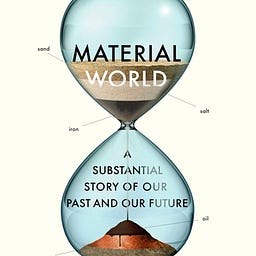
One of the nicest endorsements I ever got for Material World came from none other than Rachel Reeves. This was late 2023 and she wasn’t Chancellor of the Exchequer at the time (and as of yesterday she isn’t anymore, as we’ll get to in a moment) but she was preparing for her time in office and among the books she read back then was, well, my one.
Material World, she wrote when asked by the New Statesman about her books of the year for 2023, was “A vivid guide to the “material world” on which we all, often unconsciously, rely – and essential background reading to understand securonomics.”
It was, as I say, a generous (and totally unexpected) blurb and of course my publisher instantly put it on the cover of the book and, no, before you ask, I’m not sure what impact, if any, it actually had on sales. But anyway, the interesting thing for me at least was what happened next - something that is, of course, of far more consequence than anything to do with my book.
Securonomics was, in case you missed it, a neologism coined to describe a new attitude to economics. No longer was price all that mattered. From now on, if I’ve got it straight (despite having written the book that supposedly provided a decent primer to securonomics I have to confess I never quite understood what it actually meant), where something was made and by whom actually mattered. Understanding supply chains mattered.
And so when, the following year, Reeves became Chancellor, I was particularly interested to see what would actually happen to economic policy, especially since it might chime with the book I had just written. So I watched and waited and, well, roll on a few years and I’m still watching and waiting.
True: the government nationalised British Steel, but if anything this seemed like more of a knee-jerk reaction to its Chinese management than a grand strategy about the country’s industrial base. The Government invested more on transport and infrastructure than its predecessors but it’s a bit of a stretch to cast this as “securonomics” as opposed to a somewhat more Keynesian attitude towards the public finances.
Then again, I wasn’t in the slightest bit surprised that the sort of ideas in Material World (ideas that will be reprised in my new book, Trade World, when it comes out in September), struggled to gain traction in some corners of Whitehall. That comes back to the fact that we in Western economies are facing one of the biggest economic forks in the road in decades. In short, we are having to face up to the fact that the entire philosophy of how we ordered the world over the past half century or so might have had profound flaws associated with it.
I realise that probably sounds a little dramatic, but let me tell you a story - actually a couple of stories - that illustrate what I’m talking about. They are particularly ripe given the identity of the man who is taking over from Rachel Reeves, former Defence Secretary John Healey.
The first is one of my favourite stories from Material World - a story I’ve trotted out more than once in the subsequent years: the “glass famine” of World War One. Briefly (and with apologies to those of you who have read the book or heard me bang on about this already), the story goes as follows.
At the outset of the war in 1914, Britain suddenly discovered it had a desperate shortage of lenses, since 60 per cent of their optical glass - the most advanced lenses used in binoculars and telescopes and sniperscopes - came from Germany. This was patently disastrous. World War One was the first great war where weapons could be fired much further than the human eye could see. High quality lenses, then, were frequently the difference between life and death.
“The glass famine”, as it became known, was, at the time at least, a matter of deep national concern. Campaigns were launched by politicians and newspapers urging the public to donate any spare binoculars to the troops heading out to the front. So great did the shortage get that in 1915 an approach was even made, via secret agents, to the Germans themselves, and a deal done to buy Zeiss binoculars off the enemy in exchange for the natural rubber the British still had a near global monopoly on.
You can probably see why I liked that story; few moments illustrate the significance and importance of raw materials to the modern world. That two enemies would rather do a deal with each other to supply themselves with the materials needed to destroy each other also illustrates something else, something less palatable.
Anyway, in the course of researching this story, I found myself burrowing into all sorts of obscure reports and papers, many of them to be found in the National Archives. And one of the sources I spent rather a lot of time reading back then was an eleven-volume official history of the Ministry of Munitions.
This will, I appreciate, sound dreadfully dull, but it was an unexpectedly captivating read. Partly that was because it wasn’t just optical glass Britain was running short of (we’ll get to the other, even more jaw-dropping stuff in a moment). But partly because reading about this period is stunningly relevant to where we are now.
For decades, Britain had run its economy on the basis of what used to be called “laissez faire”. Broadly speaking, the authorities governed with as light a touch as possible, including imposing minimal restrictions on business, either in the form of interventions or trade barriers. Then came this war, a total warcompelling the country to convert much of its population into a military force, to convert much of its economic capacity into weapons, materials and tools of war.
The era of total war was, in part at least, a logical consequence of technology. The advent of high powered artillery meant in effect that victory wouldn’t inevitably fall to whoever had the fiercest soldiers or the best strategy, but to the army with the most equipment. Being able to manufacture cannons, shells, tanks and guns (as well as binoculars) was all-important.
That was a wrenching departure from many previous wars, and it was particularly hard for a laissez-faire nation like Britain, which had never previously had a culture of interfering much in business. In some countries, particularly Germany, the tendrils of government were already long integrated into business. Not so Britain, so a whole new government department was created to try to manage what would later be called the “military industrial complex”. This was the Ministry of Munitions, and its history is especially interesting right now because they were wrestling with precisely the same issues we are, again, wrestling with today, just over a century later.
How, for one thing, does one exert government control over businesses which have little or no experience of it? How does one ensure the supply of a particular component when no-one in the country is producing it? What to do when the vast majority of a critical mineral comes from overseas?
These are questions my upcoming book, Trade World, returns to, albeit with a slightly different focus than Material World. This time around I’m interested not just in raw materials and what we do with them, but why stuff is made where it’s made; how can it happen that a country like the UK, for instance, can become so dependent on everyone else for nearly every physical item we import - and does that matter? These are, I suspect, some of the biggest, most important questions of the coming decade or two.
All of which is why I found myself leafing back through the history of the Ministry of Munitions while researching Trade World. My main focus this time around was a product I look at in some depth in this new book: motor cars - the ultimate assembled manufactured product, both today and a century ago. I wanted to understand more about the wrenching process Britain underwent (America and much of Europe too) in turning some of those earliest car factories run by private sector companies into government factories, which could make not just cars but also tanks and armaments. It all makes for a fascinating story because, well, we had never really done this before.
And in re-reading the history I came across another detail, one I had overlooked in my excitement about binoculars a few years ago. Because it turns out in those early months of the war, the powers-that-be also noticed another item they desperately needed. That item was a chemical called toluol - though these days we mostly call it toluene.
Toluene is one of those foundational chemicals you get from hydrocarbons like oil and gas - though back in those days it was mostly derived from coal. Once upon a time Britain used to make plenty of toluol but in the decades running up to 1914, British companies had increasingly sought it from somewhere else far cheaper. That other place was, yes Germany.
All of which gets us to the punchline. What is it that toluene is used for? Well, among other things, it is essential for a chemical called trinitrotoluene. And trinitrotoluene is much better known by its abbreviated name: TNT. No toluene meant no explosives. Somehow, Britain had gone to war with a country which was also the main provider of the key chemical it needed to fight that country.
How on earth is it that one of the world’s military and economic superpowers can allow itself to become completely dependent on its arch-enemy for about the most important of all ingredients for its own survival? It seems like madness. Only, it turns out this sort of thing happens time after time. It’s not just optical glass and TNT; it’s a host of other materials as well.
The crucible of war happens to be one of the rare moments economics and defence collide and, just as interesting, people start to think deeply about where stuff comes from and how products are made. With our backs against the wall, we have no other choice.
But one of the subtexts of Material World (and a major theme of Trade World too) is that understanding this sort of thing is actually rather important in peacetime too. And in recent decades economists and politicians in the West have gotten out of the habit of thinking about it. More than that: they considered it a great success story that no-one had the faintest idea how something as simple as a pencil was actually made. And in one respect it is, and was: it’s the wonder of markets that hundreds of people who don’t know each other can converge and collaborate in the production of the stuff we all order and consume, from pencils to smartphones.
But every so often that ignorance is a problem - a big problem. And if you want to understand what this means in practice, a good place to begin is with one of the main products dependent on all that TNT: artillery. One of the main reasons the shortage of toluene back in 1914 was so perilous for Britain was that the majority of casualties in WWI (and for that matter WWII) were caused by artillery. Big guns firing big shells.
And up until very recently that’s been the case in modern wars too. For most of its first three years, the Ukraine War was a war of artillery, most of it fired by a category of cannon known as the howitzer. Much as these big guns might look like a thing of the past, having enough of them is still the difference between victory and defeat. Ukraine learnt this very quickly in 2022, when it burnt through much of its supply of artillery and had to fall back on donations from NATO.
And NATO is also learning this the hard way. Having donated many of their howitzers to Ukraine in the past few years, we are running short of them. And the great irony is, this shortage is reinforced by the fact that we have recently shut most of the factories making the guns.
Take the M777 howitzer gun. This is one of the most advanced pieces of artillery in the world, a super-light and super-deadly NATO-standard gun (meaning it fires the typical NATO 155mm shells) that is being used to great effect on the front line in Ukraine right now. The main customer for these guns is America, but they are actually manufactured by BAE, a British company, which had a plant dedicated to their production in Barrow-in-Furness. But a few years ago, as demand for the guns withered, BAE shut down the plant. No more howitzers being made in the UK.
Few noticed at the time - it was just another invisible part of Britain’s industry disappearing. But now, with a sudden rise in demand for these guns and no-one else to provide the particular titanium parts needed, BAE is doing something interesting.
It has built a plant in, of all things, a retail distribution hub just outside Sheffield. Here, near a fast fashion warehouse, the company is quietly constructing a production line to build the titanium parts for these howitzers for the first time in nearly a decade. The steel barrels of the guns are now being made nearby in Sheffield Forgemasters, again for the first time in many years.
I went to visit this BAE plant a few weeks ago while recording a new episode of my podcast Stuff Matters (do subscribe - you will like it) and I found it a fascinating, if somewhat unsettling experience. We saw the first batch of howitzer parts to be made in this country in years - parts that will soon be on their way to Ukraine. We saw the complex machinery being used to weld the titanium together (welding titanium is far harder, and more dangerous than most metals).
And it struck me: for all that much of my journalism over the past few years has covered the rapid deindustrialisation of the West (especially the UK, which has done it far faster than everyone else), here was a rare story of RE-industrialisation. A business was rebuilding a factory to make something it stopped making; it was having to reach back to old employees who had left to teach them how they used to do it.
And the funny thing is, this is precisely what happened back in WWI with both glass and toluene. Faced with a dangerous shortage of these materials, Britain rapidly restarted production of optical glass and toluene, with the result that by the second half of the war, it was more than self-sufficient in both. And here, today, in an obscure building outside Sheffield, something similar is happening right now.
Perhaps this is a template for how the UK rebuilds manufacturing. But in an era where, increasingly, warfare isn’t just about howitzers but about other technologies like drones - technologies the UK and US have never had a global lead in - that makes the task even harder.
All of which brings us back to Whitehall, and to Rachel Reeves and John Healey (who, as coincidence would have it, was the man who officially opened the new BAE plant in his previous role as Defence Secretary). One of the morals of these stories is that looking at the country solely through the prism of price is a fine way to run your economy most of the time, but that every so often, it leaves you in the same position Britain found itself in 1914. Then, all of a sudden, all the preconceptions you had about how best to run your economy are turned upside down. Now, price comes a distant second to security.
Now, this if of course a massive oversimplification but if you had to choose a government department which prioritised cheap stuff (value for money, they would call it) over everything else, it would be the Treasury. If you had to choose a government department that prioritised security over price, it would be the Ministry of Defence. Well, today, the Chancellor of the Exchequer comes into office (nearly) direct from the MoD.
So… will Healey succeed where Reeves failed? Or will he, like her, be won over by the Treasury brain? Whatever the result, the implications for this country will be significant.
Anyway, there’s much more about this in my latest episode of Stuff Matters. Do have a listen if you haven’t yet. As I say, if you’ve enjoyed Material World and my other stuff, the whole thing will be right up your street, and there are a bunch of pretty extraordinary stories in there.
And finally, do also consider pre-ordering Trade World. It’s coming out in September but if you pre-order from Waterstones and enter the code “SUMMER26” at the checkout, you will get 25 per cent off the RRP. This offer will end at close of play on Friday. So move fast!

 点赞
点赞 收藏
收藏 点踩
点踩 分享
分享