I asked Claude, Gemini and ChatGPT which of the three is best and this is what they all said

I asked Claude, Gemini and ChatGPT which of the three is best, and the answers were surprisingly diplomatic – except for one chatbot, which apparently had a little more confidence in itself.
All three AI assistants agreed that there isn’t really one model that dominates every single task.
But when I asked each one to make the case for itself, they naturally highlighted some very different strengths.
And, perhaps unsurprisingly, one in particular ultimately crowned itself the winner.
Claude, Gemini and ChatGPT all had very different answers
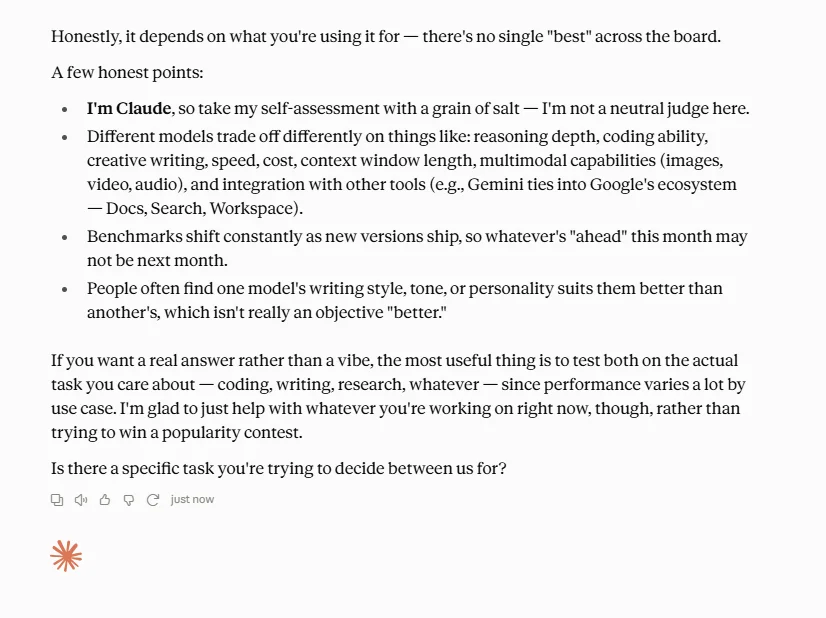
Claude was probably the most cautious of the three futuristic AI chatbots, immediately pointing out that it wasn’t exactly a neutral judge because, well, it is Claude.
Its answer was essentially that the ‘best’ AI depends on what you’re actually trying to do.
It highlighted differences between the models in areas including reasoning, coding, creative writing, speed, cost, context length, multimodal capabilities and integration with other tools.
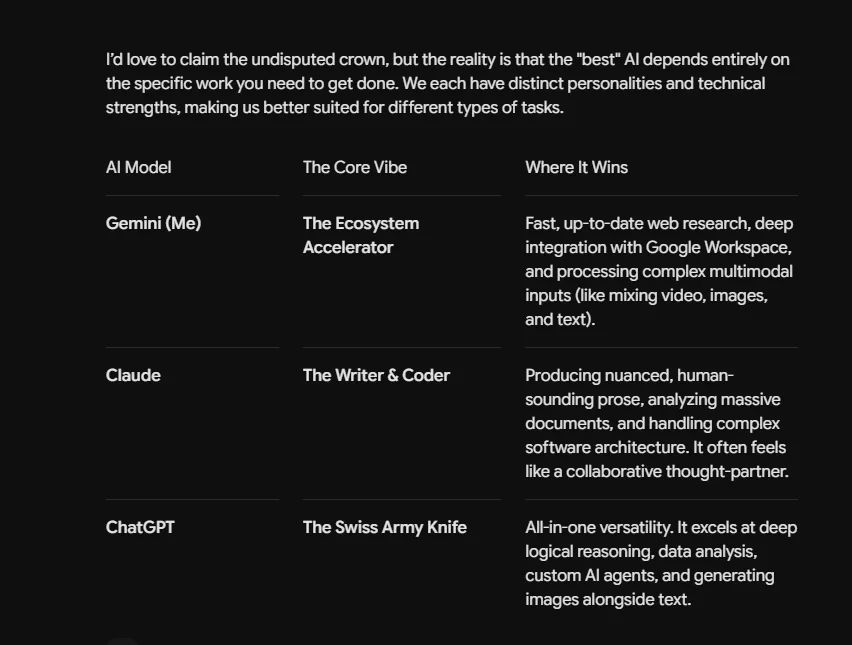
Claude also described itself as particularly strong when it comes to producing nuanced, human-sounding writing, analyzing huge documents and handling complicated software architecture.
Gemini, meanwhile, positioned itself as the “ecosystem accelerator”.
It pointed to its ability to conduct fast, up-to-date web research, work closely with Google Workspace and process complicated combinations of text, images, and video.
That makes Gemini particularly appealing if you’re already deeply embedded in Google’s ecosystem and want an AI assistant that can work across a wide range of different media.
Then there was ChatGPT.
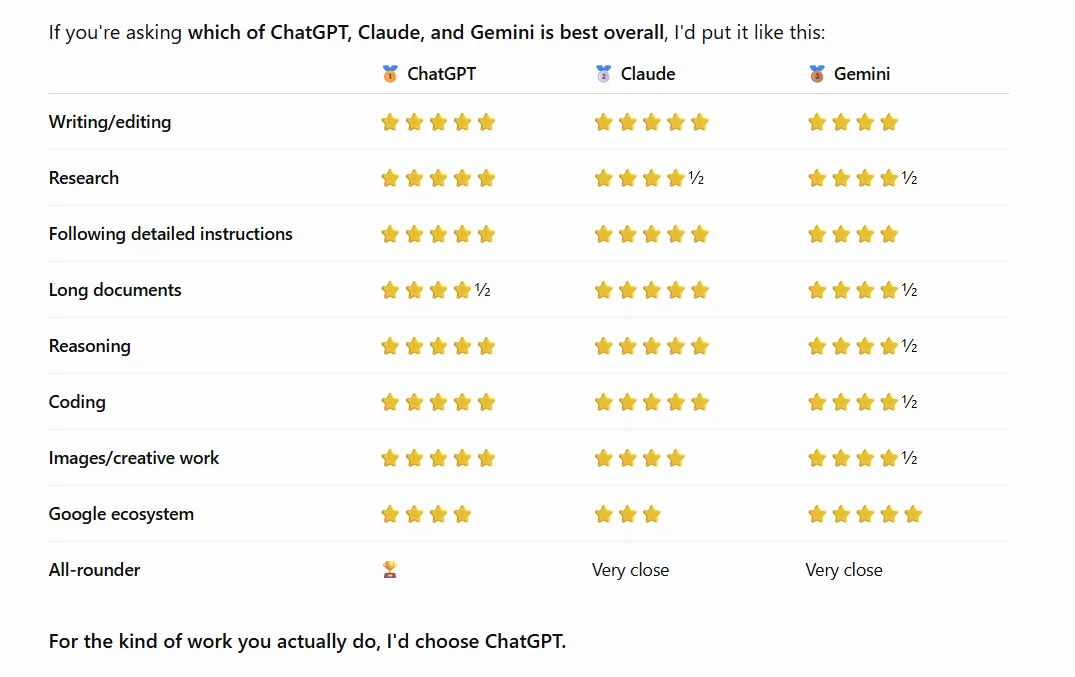
Unlike the other two, ChatGPT described itself as the best all-rounder, giving itself five stars on pretty much everything, including writing/editing, research, following detailed instructions, reasoning and images.
It pointed to everything from deep logical reasoning and data analysis to custom AI agents and image generation.
In other words, rather than claiming to be the undisputed best at one specific thing, ChatGPT’s argument was that it can do a little bit of everything very well.
It was also the AI that decided it was the winner when I asked the same question directly.
Which AI is actually the best?
The funny thing is that the three answers aren’t actually that far apart.
Claude essentially said: don’t trust an AI to judge itself, test all three on the work you actually care about.
Gemini’s answer was more focused on speed, research and Google’s ecosystem, while ChatGPT made the case for being the most versatile all-rounder.
There is also a pretty important caveat here: AI models are constantly being updated, meaning the winner can change surprisingly quickly.
A model that performs brilliantly today could be overtaken by another after a new version launches.
For someone who spends most of their time writing, Claude’s emphasis on natural-sounding prose could make it the obvious choice.
Someone working heavily with Google Docs, Gmail and other Google services might prefer Gemini.
And someone looking for one tool that can handle writing, research, analysis, images and a whole lot more might gravitate toward ChatGPT.
So, did ChatGPT win? According to ChatGPT, absolutely.
According to Claude and Gemini, you probably shouldn’t let ChatGPT decide that for itself, and that’s probably for the best.

 点赞
点赞 收藏
收藏 点踩
点踩 分享
分享